Get Full Government Meeting Transcripts, Videos, & Alerts Forever!
Get email alerts on the Records Archiving topic
No spam. Unsubscribe anytime.
Legislative Council adopts committee records archiving policy to preserve public testimony
Summary
The council adopted a policy requiring committee records — including public testimony submitted electronically or in writing — be archived in the legislative record; proponents said the policy improves transparency and will be effective immediately.
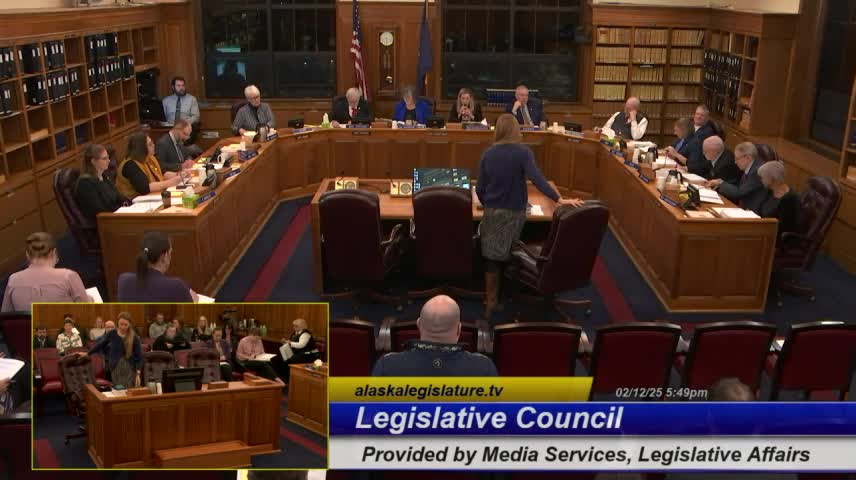
The Alaska Legislative Council adopted a committee records archiving policy on Feb. 12 that requires committees to archive public comment and testimony in both physical and electronic legislative records.
Senator Kathy Giesel, who introduced the policy, told the council the goal is to ensure that public testimony — particularly testimony submitted for committee consideration — is preserved accurately in the legislative record to protect transparency and accountability. She said the policy grew from concerns that practice had been inconsistent and should be standardized.
Legislative Legal Services staff supported the policy and answered members’ questions about how written and electronic testimony are handled. Emily Nauman (director, Legislative Legal Services) and Emily Nelman (identified in the transcript as a legal-services director) explained the policy covers testimony submitted through electronic portals and electronic mailing addresses and that committee recordings are archived through an agency process and sent to the Legislative Reference Library under existing practice.
Several members, including Representative Kerrick and Senator Klayman, spoke in favor of the policy and suggested that, if desired later, the legislature could work to amend the uniform rules (specifically Uniform Rule 23) to give the practice additional procedural force. Supporters said a policy was the faster way to ensure consistent archiving immediately rather than pursue a slower rule change.
The council adopted the archiving policy by unanimous consent during the meeting; the transcript records no objection.