Get Full Government Meeting Transcripts, Videos, & Alerts Forever!
Get email alerts on the Corrections Health Services topic
No spam. Unsubscribe anytime.
Corrections officials describe medical, mental-health and substance-use services; psychiatric-bed capacity and bed-to-bed transfers discussed
Summary
The Department of Corrections described intake screenings, psychiatric bed capacity, substance-use treatment slots and coordination with community providers and Medicaid during a committee briefing.
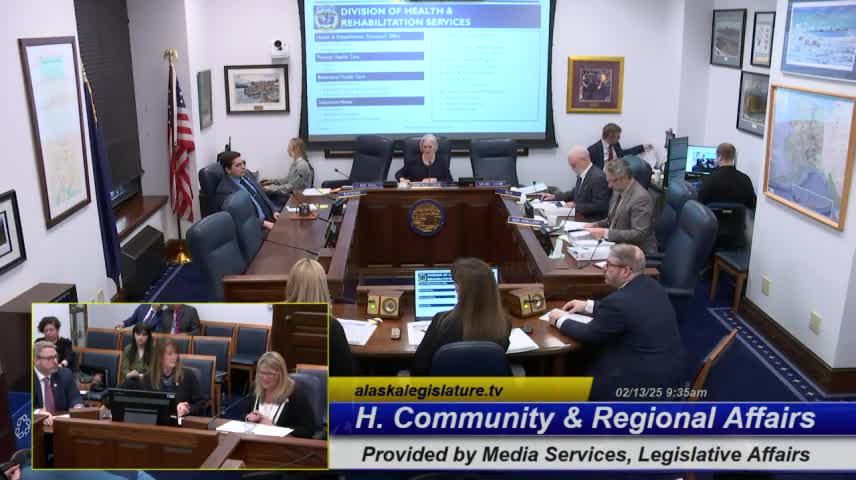
Juneau — The Department of Corrections told the House Community and Regional Affairs Committee on Feb. 13 that it provides constitutionally required essential health care to people in custody, operates psychiatric and subacute beds, and coordinates bed-to-bed transfers with community treatment providers.
Travis Welch, director of the Division of Health and Rehabilitation Services, said the department conducts intake medical and behavioral-health screenings and uses evidence-based tools to assess suicidality and withdrawal risk. “We are the largest provider of mental health services in the state of Alaska,” Welch told the committee.
Why it matters: Lawmakers pressed the department about psychiatric bed capacity, treatment availability in the community, how Medicaid applies to people leaving custody and how withdrawal protocols are applied during intake.
Details: Welch said the department operates two acute psychiatric facilities (Highland Mountain Correctional Center and Anchorage Correctional Complex) and five subacute psychiatric units, together giving up to 313 psychiatric beds at full capacity; however, single-cell housing needs can reduce operational capacity. The department reported approximately 1,200 annual screenings for substance-use disorder and about 280 treatment slots for in-facility substance-use work, including RSAT programs at Palmer, Highland Mountain and Wildwood.
On community transfers, Welch described coordination with providers such as Set Free Alaska and True North Recovery for bed-to-bed transfers. Medicaid generally cannot pay for care while an individual is incarcerated (the “inmate exclusion”), but if a person is transferred out of custody to a community inpatient program or community residential center, Medicaid can be the payer; the department’s social-work staff works with the Department of Public Assistance to activate Medicaid where eligible and providers may bill retroactively for some services.
On withdrawal protocols, the department uses clinical screening tools (COWS for opioid withdrawal, CIWA for alcohol) and nursing observation to decide whether to initiate medically supervised withdrawal protocols; staff training and observation are used when intake interviews are incomplete.
Ending: Committee members asked for more data on program completion rates, assessments versus treatment completions and community bed availability; the department agreed to provide further metrics in follow-up briefings and budget subcommittee sessions.