Get Full Government Meeting Transcripts, Videos, & Alerts Forever!
Get email alerts on the Legislative Procedures topic
No spam. Unsubscribe anytime.
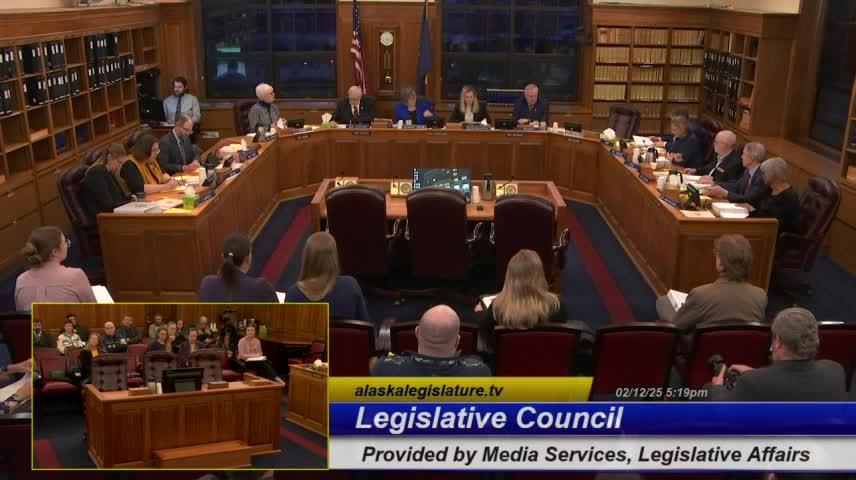
Legislative Council elects Sarah Hannan chair, keeps eight-vote practice and sets new roll-call rule
Summary
At its Feb. 12 meeting the Legislative Council elected Representative Sarah Hannan chair and President Gary Stevens vice chair, reaffirmed an eight-vote threshold to pass motions, and adopted a new practice limiting roll-call votes to teleconferenced members or when an objection remains.
Representative Sarah Hannan was elected chair of the Alaska Legislative Council on Feb. 12 and President Gary Stevens was elected vice chair as the council organized for the 2025 legislative session.
The council, a 14-member joint body of the Alaska Legislature, also reaffirmed a longstanding practice that requires eight votes both for a quorum and to pass motions, a rule intended to ensure bicameral participation. Members agreed, by unanimous consent, to retain that threshold.
Chair Hannan proposed and the council approved a related change to streamline voting: roll-call votes will be used only when one or more members participate by teleconference or when an objection to a voice/consent vote is maintained. The council also named alternate members for 2025–2026 — Senator Lukey Tobin as the Senate alternate and Representative Mayors as the House alternate — and clarified that alternates may participate only in the absence of an appointed member from their respective body.
The agenda was approved by unanimous consent following the leadership votes. Members discussed the rationale for maintaining the eight-vote rule as a protection against one chamber prevailing without the other and accepted the limited roll-call rule as a measure to speed meetings when there is no dispute.
No formal roll-call tallies were recorded in the transcript; the actions above were adopted by unanimous consent or by members indicating no objection during the meeting.