Get Full Government Meeting Transcripts, Videos, & Alerts Forever!
Get email alerts on the Communications Forensics It topic
No spam. Unsubscribe anytime.
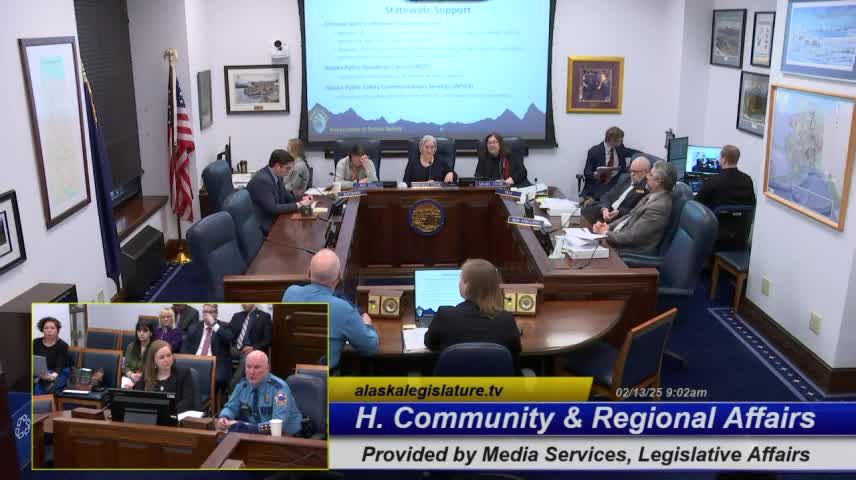
Committee hears on Alaska’s public-safety communications, CJIS functions and crime-lab capacity
Summary
Department officials briefed lawmakers on the state’s land mobile radio system, criminal-justice information services and crime-lab workload and recent capacity gains.
Juneau — On Feb. 13 the Alaska Department of Public Safety told the House Community and Regional Affairs Committee that the state’s radio backbone and criminal-justice IT services are critical but costly, and that the state crime lab has increased capacity after years of backlog.
Statewide Public-Safety Communications Services (the Alaska land mobile radio, ALMR) supports dispatch and responder radio traffic, the department said, with roughly 17 million to 18 million push-to-talk calls handled annually. Commissioner James Cockrell described the system as a “lifeline” for dispatchers, law enforcement and firefighters and said towers and maintenance are costly.
Why it matters: Committee members asked whether dead zones exist and how the department addresses them; witnesses acknowledged coverage gaps and described pilot work with satellite push-to-talk and use of Starlink for data uploads.
Details: Director David Canaris (state crime lab) told the committee the lab processed over 17,000 items in 2024 — about 6,000 work requests — covering DNA, seized drugs, firearms, fingerprints and more. The crime lab also administers the state breath-alcohol program and reported work to replace aging breath-alcohol instruments. Canaris said the lab deployed a new forensic tracking software to link DNA hits and reduce reliance on email transfers.
The Criminal Justice Information Services (CJIS) group manages the state criminal-history repository, concealed-handgun permitting and background-check functions for licensing. Director Lisa Purinton described efforts to provide fingerprinting training and virtual options for remote communities so non-criminal-background checks (teacher certification, child care staff) can be completed.
Ending: Committee members requested more technical and trend data on dead-zone coverage, radio-tower priorities and crime-lab turnaround times as part of upcoming budget and subcommittee work.