Get Full Government Meeting Transcripts, Videos, & Alerts Forever!
Get email alerts on the Wildlife Aviation Marine topic
No spam. Unsubscribe anytime.
Alaska wildlife troopers, aircraft and vessel fleet highlighted as critical to search and rescue and fisheries enforcement
Summary
Department of Public Safety officials described the Alaska Wildlife Troopers’ duties, aviation and marine fleet size and search-and-rescue roles and fielded questions about utilization and costs.
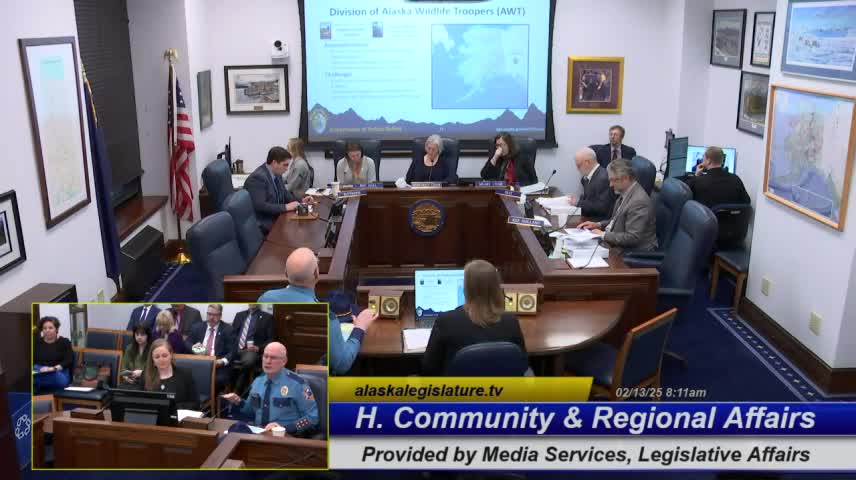
Juneau — The Alaska Department of Public Safety told the House Community and Regional Affairs Committee on Feb. 13 that Alaska Wildlife Troopers, aircraft and vessels are central to search-and-rescue operations, fisheries enforcement and remote access across the state.
The department said wildlife troopers are fully commissioned troopers trained at the same academy as Alaska State Troopers and carry out boating safety checks, fisheries enforcement and search-and-rescue missions. “They are fully commissioned, Alaska State Troopers,” Commissioner James Cockrell said.
Why it matters: Committee members probed the number and use of aircraft and vessels, maintenance costs, charter reliance and whether state resources duplicate or fill gaps in U.S. Coast Guard missions.
Details: Cockrell said the department operates 49 aircraft based in 19 communities and logged roughly 6,000–7,000 flight hours per year; he said aircraft are mission-driven and the department is working to right-size the fleet. On vessels, the department reported 41 craft, from 27-foot skiffs up to a 69-foot catamaran and a 56-foot Stimson vessel used for Bering Sea patrols. Cockrell described instances where the Stimson assisted in saving lives after a Kodiak fishing-boat capsize.
Colonel Brian Barlow, director of the Alaska Wildlife Troopers, told lawmakers the troopers average about a 5% citation rate per contact over a 10-year look-back; “if we have more contacts, we’re gonna have more enforcement action,” he said.
Committee members asked whether the state and Coast Guard duplicate work. Cockrell said the Coast Guard’s mission differs — navigation aids and broad search and rescue — and the state regularly partners with federal agencies and receives NOAA funding for offshore fishery patrols.
Ending: Lawmakers requested data on aircraft utilization, charter costs and vessel maintenance as the committee prepares for budget deliberations; Cockrell offered follow-up data and tours of aircraft facilities.