Get Full Government Meeting Transcripts, Videos, & Alerts Forever!
Get email alerts on the Water Fluoridation topic
No spam. Unsubscribe anytime.
Senate committee advances bill to stop adding fluoridation chemical to public water after hours of testimony; 5–1 vote
Summary
After several hours of public testimony both for and against, the Senate Natural Resources committee voted 5–1 to advance House Bill 81, which would remove the addition of fluorosilicic acid from public water systems and make fluoride available by prescription at pharmacies.
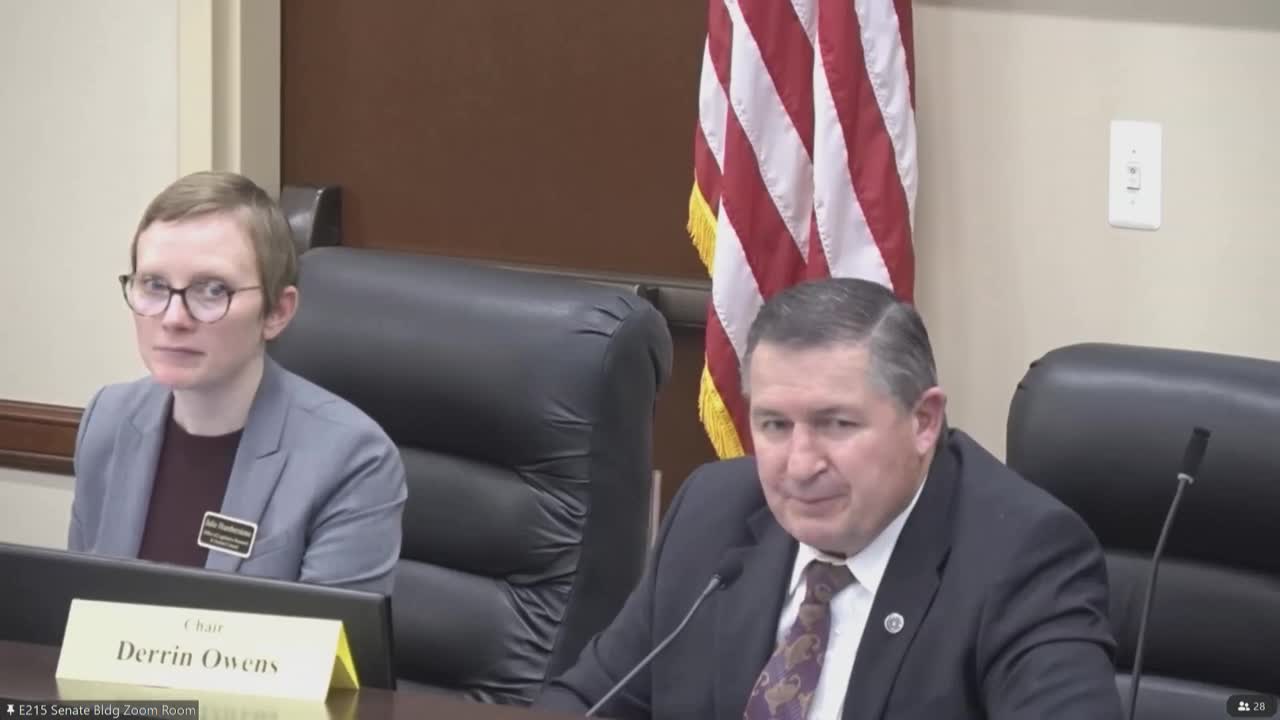
SALT LAKE CITY — After more than four hours of testimony from dentists, public‑health officials, water operators and affected families, the Senate Natural Resources, Agriculture and Environment Standing Committee voted 5–1 to advance House Bill 81 to the full Senate.
House sponsor Representative Gracious said the bill would remove the addition of hydrofluorosilicic acid (the fluoridation chemical commonly used in U.S. water systems) from public water systems and allow people who want fluoride to obtain it by prescription at pharmacies. Gracious cited a recent federal court ruling she described as finding “an unreasonable risk” from fluoride at 0.7 milligrams per liter and said the change would restore individual choice over a medication supplied through the public water system.
A large and sometimes emotional public comment period followed. Max Widmeier, a young man who said he suffered heavy-metal poisoning after a municipal water contamination event in Sandy, recounted long-term medical treatment and urged lawmakers to pass the bill: “I was 12 when I found out my body had been poisoned... I have the chance today to stop this from happening to another family like mine,” he told the committee.
Dentists and public-health organizations strongly opposed the bill. Brent Larson, a Salt Lake City dentist of 43 years, said fluoridation is “settled science” among public-health and dental associations and argued community water fluoridation substantially reduces childhood cavities. Pediatric dentists, the Utah Medical Association and the Utah Dental Association also urged the committee to leave decisions at the local level or to retain fluoridation, citing disease-prevention benefits and reduced costs for low-income families.
Water districts and some water operators spoke in support of the bill or of reconsidering current practice, citing operator safety and a small number of high‑profile chemical delivery or overfeed incidents. Scott Paxman, general manager of Weber Basin Water Conservancy District, said the chemical is “the most potent chemical that we deal with” and described respiratory effects among operators; Jordan Valley and several municipal representatives also expressed operational concerns.
Mayor D.J. Bhatt of Brigham City urged the committee to support the bill on fiscal grounds, saying his city spends $100,000–$150,000 annually to fluoridate water while “only 5% of that water is consumed by the humans within Brigham City.”
Committee members said the issue raises medical‑freedom and local‑control questions as well as operational safety and public‑health tradeoffs. Senator Hinkins moved to pass HB 81 for substitute to the full Senate; the committee recorded a roll‑call outcome of 5–1. Sponsors and opponents indicated the bill will continue to draw significant public attention on the Senate floor.