Get Full Government Meeting Transcripts, Videos, & Alerts Forever!
Get email alerts on the Education Funding topic
No spam. Unsubscribe anytime.
Committee amends bill reshaping how state treats basic school‑levy revenue; opponents warn of loss of local control
Summary
Senate Bill 37 would redirect the statewide basic property tax levy into state accounts and remit an equivalent amount to districts from state education funds; supporters say it simplifies budgeting, opponents say it shifts locally raised dollars into a volatile income‑tax base and reduces transparency.
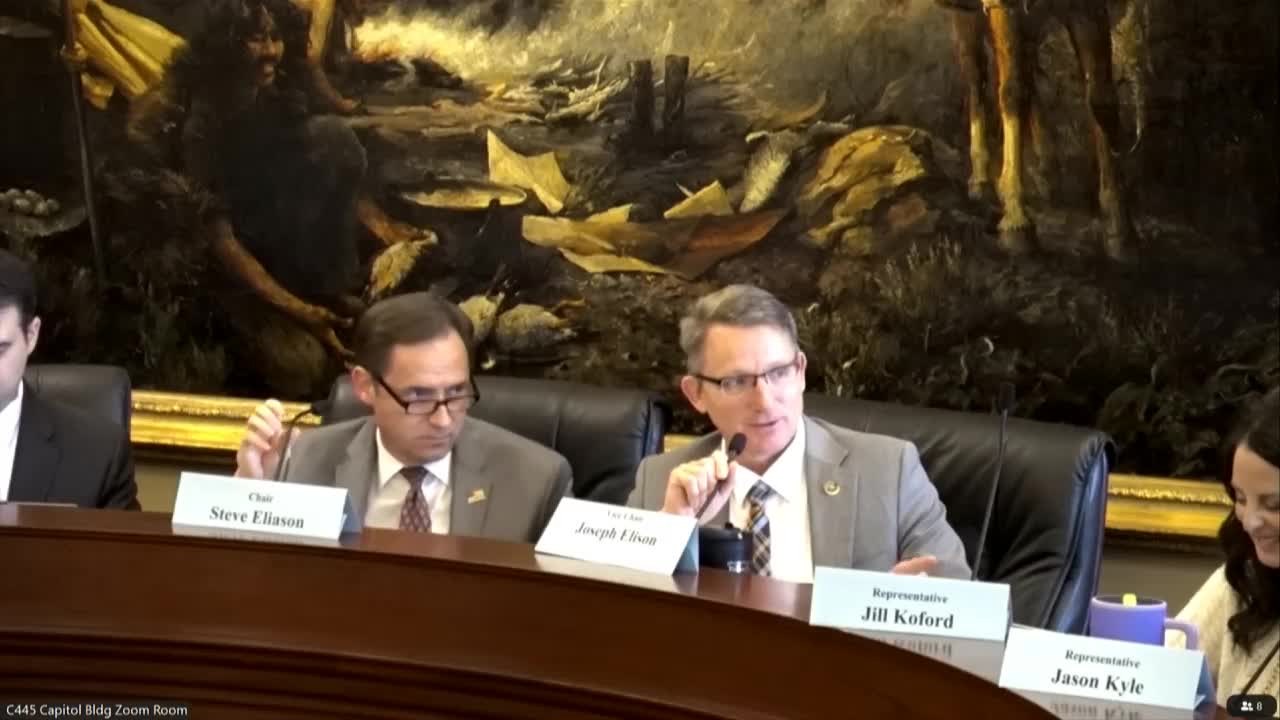
The House Revenue and Taxation Committee adopted an amendment and passed Senate Bill 37 on Feb. 21, approving language that would treat the state’s basic property tax levy as state revenue and have the state remit an equivalent amount to districts from the uniform school fund.
Sponsor Senator Fillmore told the committee that the change would not alter the dollar amount school districts receive; rather, it would centralize the calculation and distribution of the levy so the state can simplify the weighted pupil unit calculation and budget more predictably.
"This bill does not touch any property tax levy that is initiated by a local school district," Fillmore said. "It does not change the timing, the amount, or the permitted uses of any education dollars that school districts will receive." He said the change codifies a practice that already exists in some districts and would reduce the need for later recalculation of collections.
Opponents, including the Utah School Boards Association, Utah School Superintendents Association and the Utah PTA, testified that the bill would reduce transparency and shift reliance from a stable property tax base to a more volatile income‑tax base. "This moves locally raised property tax dollars into the state's general fund, where it can be spent on anything, not just education," said Lexi Cunningham of the School Boards and Superintendents associations. PTA representatives and local board members also warned that redirecting the levy could undermine local control and the link between local taxpayers and local school decisions.
The sponsor offered Amendment 3, which requires the State Board of Education to remit district funds equivalent to the property tax proceeds within 35 days of deposit, language intended to preserve timing and interest‑earning continuity for districts. Scott Jones, deputy superintendent for operations at the State Board of Education, said the board could process and distribute the funds on a monthly basis so districts would not lose expected receipts or the ability to earn interest on balances. "Assuming the monthly transfer ... the enactment of this legislation will not likely result in direct measurable cost for local governments," staff fiscal analysis said.
After debate and amendment, the committee voted to pass SB 37 as amended. Supporters said the change simplifies statewide budgeting and treats districts consistently; opponents said the shift reduces local transparency and could make education funding more vulnerable to future policy changes.