Get Full Government Meeting Transcripts, Videos, & Alerts Forever!
Get email alerts on the Healthcare 340b topic
No spam. Unsubscribe anytime.
Senate committee deadlocks over bill to limit drugmakers' single‑pharmacy restrictions on 340B program
Summary
A tie vote left Senate Bill 69 unresolved after more than three hours of testimony and debate at the Utah Senate Business and Labor Standing Committee on Thursday, Feb. 13.
A tie vote left Senate Bill 69 unresolved after more than three hours of testimony and debate at the Utah Senate Business and Labor Standing Committee on Thursday, Feb. 13.
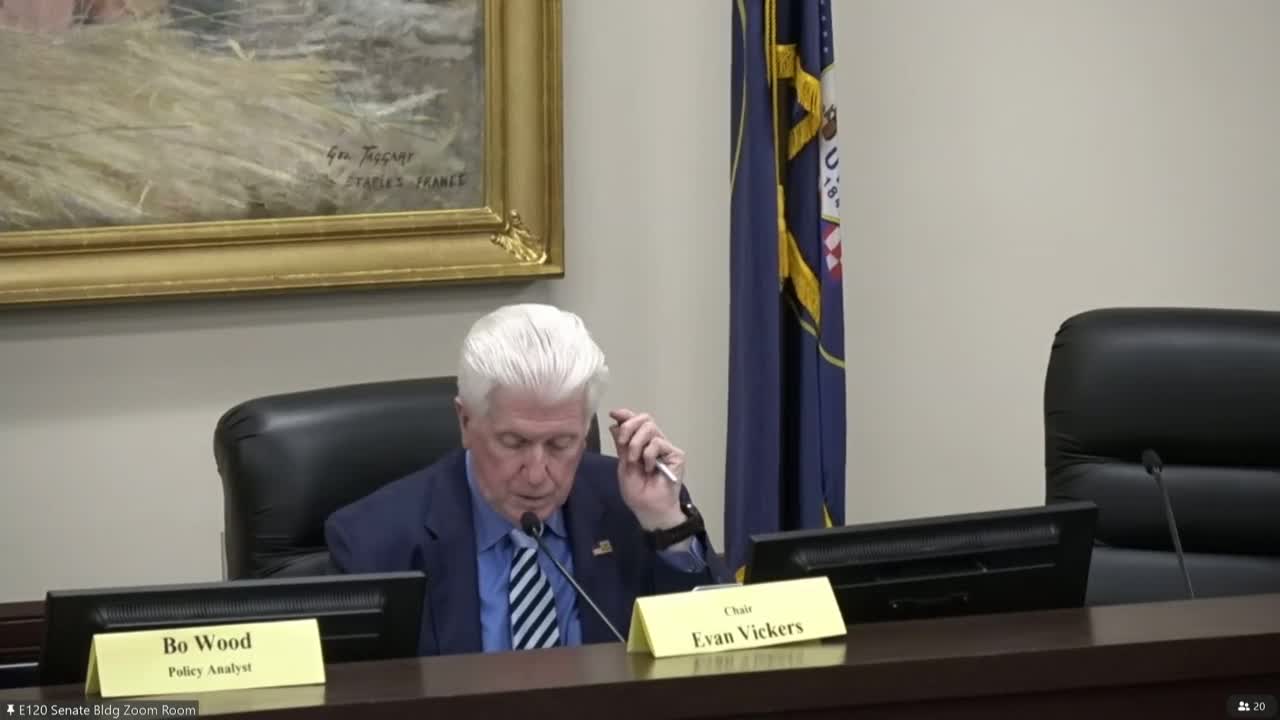
Sponsor Senator David Vickers introduced the measure as a response to drug manufacturers’ recent practice of restricting certain medications covered by the federal 340B program so they may be dispensed only through a single contract pharmacy selected by a covered entity. “The concern from the covered entities is that the list will just keep expanding until many patients will be denied access to more and more medications,” Vickers said during his presentation.
The bill would prohibit manufacturers from enforcing single‑pharmacy limits on covered 340B drugs in Utah. Proponents — including hospital and health‑center representatives, Intermountain Health officials and rural clinic leaders — said restrictions on contract pharmacies reduce patient access, particularly in rural areas. Dan Liljenquist, chief strategy officer for Intermountain Health and founder of CivicRx, told the committee the change is “circumvent[ing] what this program 340B was designed to do,” and said the practice already is costing Intermountain about $60 million annually for drugs on the current manufacturer list.
Rural providers and community health centers gave detailed examples. Rachel Craig, government affairs manager for the Association for Utah Community Health, said health centers serving rural and frontier communities have had patients directed to travel long distances — in some cases to Salt Lake City — to fill medications when contract pharmacies were restricted. Donovan Smith, a pharmacist and CEO of Wayne Community Health Center, testified that contract pharmacy limits are “one of the greatest barriers to care that health centers face.”
Opponents, including industry representatives from PhRMA and Johnson & Johnson, urged caution and said state law cannot override federal 340B statute. Kyle Piccola, director of state policy for PhRMA, said the program is governed exclusively by federal law and that some changes to contract pharmacy rules would be better handled at the federal level. Industry witnesses also argued the current program’s rapid growth and reported abuses — including expanded use of contract pharmacies since 2010 — create cost pressures for employers and state purchasers.
Committee members pressed witnesses on technical details: how manufacturers add drugs to the restricted list, what drugs are on the list (witnesses said manufacturers chose high‑cost, high‑volume drugs and that the list has grown from a few products to 35), and whether contract pharmacies may deliver to patients’ homes (testimony said delivery depends on drug type and pharmacy policy). Vickers said a substitute removes wholesalers from the bill’s original language and clarifies the program referenced.
After public testimony from hospital leaders, health‑center officials and pharmaceutical industry witnesses, Senator Weiler moved to favorably recommend the bill. The committee proceeded to a roll call. The vote recorded four yeas (Wyler, Ipsen, Pitcher, Vickers) and four nays (Colomar, Musselman, McKay, Bridal), and the motion failed on a 4‑4 tie.
The sponsor and several supporters indicated they expect further work, including continued discussions with manufacturers and possible federal engagement. No committee action was taken after the tie vote.