
Board hears evidence of rising hiring costs as district competes for experienced staff
Get AI-powered insights, summaries, and transcripts
Subscribe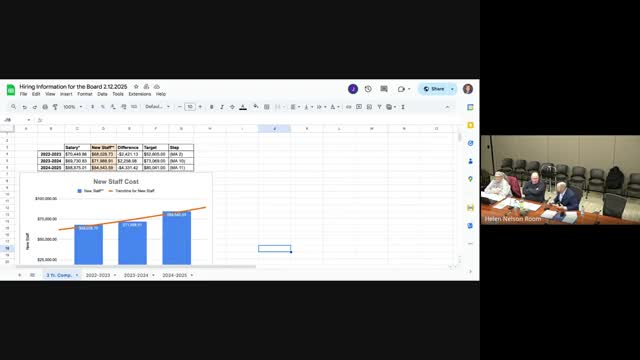
Summary
Administrators told the board that the district is paying more to recruit and hire teachers and other staff, with recent hires typically coming in at higher steps and with higher degrees than in prior years. The trend is increasing operating costs and complicating budgeting.
District administrators told the Newington Board of Education on Feb. 12 that hiring costs have risen because applicants now commonly hold higher credentials and begin at higher contract steps.
The overview: Finance and human-resources staff presented a chart comparing outgoing staff average salary and average salary of newly hired staff across recent years. Administrators said the earlier patternin which resignations were replaced by lower-step hireshas reversed in recent years: the district now frequently hires applicants at step 10 or 11 with master's degrees, rather than bachelor-step 1 or 2 applicants. That shift increases the per-hire cost.
Budget implications: Administrators said staff costs and benefits comprise the majority of the district's operating budget and are the single largest driver of growth. The district carries an allowance for degree changes and projected step changes during the year; those line items are adjusted when the board approves salary transfers in December after hires and resignations settle.
Recruitment and vacancies: The district faces shortages in some specializations and in paraprofessional roles; special-education paraprofessional vacancies in particular produced 'breakage' (unspent salary lines) that contributed to non-lapsing fund balances the district used in prior years. Staff said the district has also increased hiring targets to fill nonunion driver and support positions to create more bench capacity. Administrators said they would continue to update the board as salary transfers are finalized and more precise vacancy and hiring cost data become available.
Board follow-up: Members asked for additional detail on typical step changes for new hires and asked that staff continue to monitor recruitment markets and present options for retaining and recruiting staff in high-need areas.