Get Full Government Meeting Transcripts, Videos, & Alerts Forever!
Get email alerts on the Carbon Sequestration topic
No spam. Unsubscribe anytime.
Committee advances bill to allow Utah to seek state primacy for geologic carbon storage
Summary
The Public Utilities and Energy Committee voted to recommend House Bill 352, which makes statutory changes the Division of Oil, Gas and Mining says are required before it can seek Class VI primacy from the U.S. Environmental Protection Agency for geologic carbon sequestration.
A House committee on Thursday recommended approval of House Bill 352, which makes statutory changes the Division of Oil, Gas and Mining says are necessary for Utah to apply for federal “primacy” over geologic carbon sequestration regulation.
Supporters told the Public Utilities and Energy Committee the bill is procedural: it updates state enforcement authority and other provisions so the division can submit a primacy application to the U.S. Environmental Protection Agency.
Representative Watkins, the bill sponsor, told the committee that changes first required by House Bill 244 in 2022 led the division to begin preparing a primacy application and that the current submittal is stalled because “the current state authority for enforcement didn't meet federal requirements.” Bart Kettle, deputy director of the Division of Oil, Gas and Mining, said, “The Division is pursuing primacy because we were directed to in the 2022 session.”
During committee questions, Representative Peck asked why the state would pursue injecting carbon dioxide underground rather than leaving it in the atmosphere where plants benefit. Kettle and witnesses said the bill does not mandate sequestration; it creates a state regulatory option. Kettle said having state primacy gives “regulatory consistency” the industry can plan around and allows decisions to be made at the state level rather than through a federal permitting path.
Jeff Hartley, speaking for Redleaf Resources, described ongoing pilot work in the Uinta Basin with the Energy & Geoscience Institute and Department of Energy grants to test sequestration concepts. Hartley said Redleaf owns roughly 7,000 acres in the Uinta Basin with about 65 active producing wells on leases and argued that the ability to sequester carbon could create “headroom” in an air basin that is currently designated nonattainment for certain pollutants. He said sequestration can produce carbon credits and provide flexibility that may allow additional operations in tightly constrained airsheds.
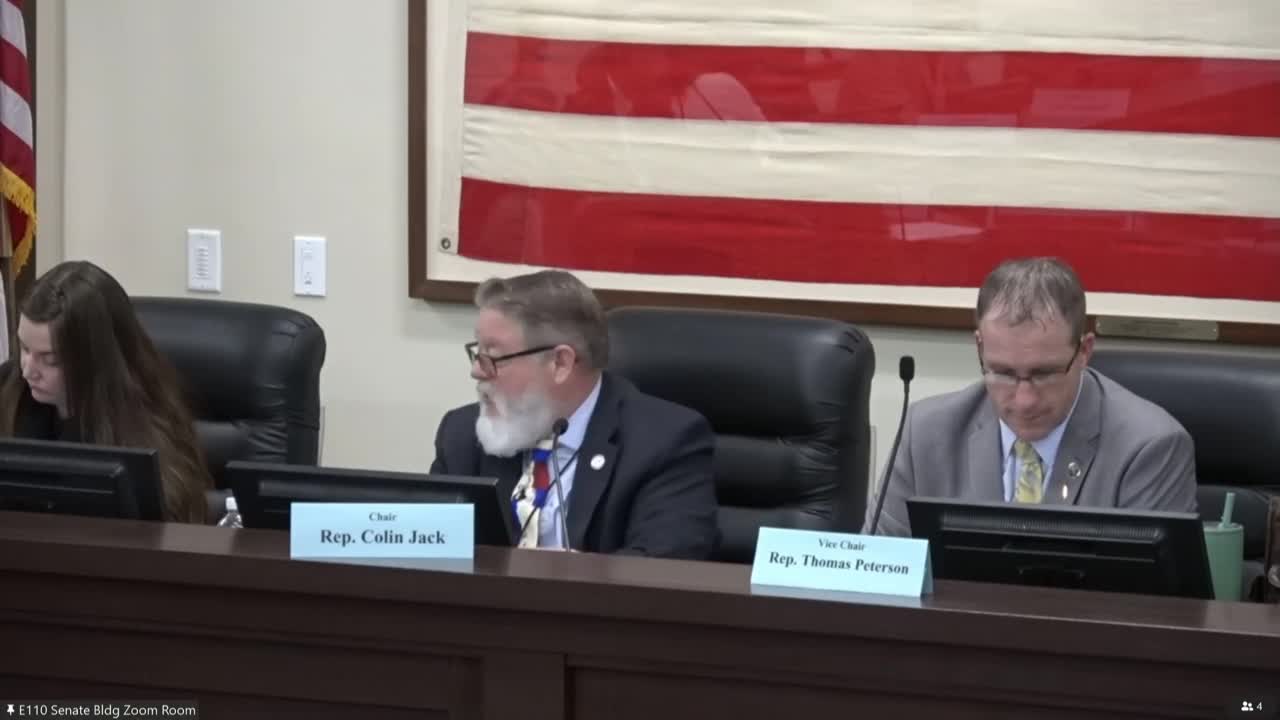
The committee moved the bill with a favorable recommendation by motion of Representative Albrecht. The chair announced the motion passed unanimously.
Committee discussion and testimony emphasized the bill’s narrow purpose: to allow the state to pursue Class VI primacy for geologic carbon sequestration if the division and industry choose to do so. The committee record shows proponents framed the change as enabling a state-level regulatory option rather than requiring sequestration activity.
Votes at a glance: HB 352 — favorable recommendation from the Public Utilities and Energy Committee; chair ruled the motion passed unanimously.