Get Full Government Meeting Transcripts, Videos, & Alerts Forever!
Get email alerts on the Neighborhood Matching Fund topic
No spam. Unsubscribe anytime.
Seattle Department of Neighborhoods details Neighborhood Matching Fund: $5,000–$50,000 grants, community match required
Summary
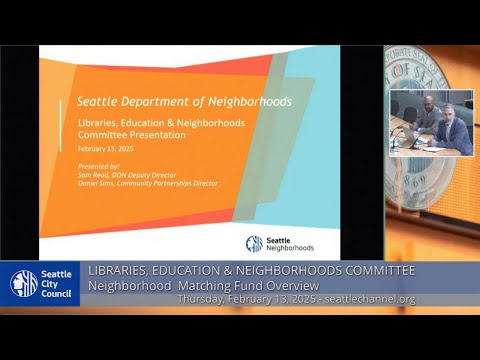
Seattle Department of Neighborhoods officials reviewed the Neighborhood Matching Fund at the Feb. 13 meeting of the Seattle City Council’s Libraries, Education and Neighborhoods Committee, outlining how residents and community groups can apply for project grants that range from Small Sparks awards up to $5,000 to Community Partnership Fund awards up to $50,000.
Seattle Department of Neighborhoods officials reviewed the Neighborhood Matching Fund at the Feb. 13 meeting of the Seattle City Council’s Libraries, Education and Neighborhoods Committee, outlining how residents and community groups can apply for project grants that range from small “Small Sparks” awards up to $5,000 to Community Partnership Fund awards up to $50,000.
The Neighborhood Matching Fund (NMF) is a long‑running program intended to support community‑led projects by combining city awards with volunteer labor, donated materials and cash match. “The community match is the heart of the Neighborhood Matching Fund concept,” said Sam Reed, deputy director of the Seattle Department of Neighborhoods. Reed said the program has operated for 37 years and that more than 5,000 projects have received roughly $64 million in awards, which communities matched with about $72 million in volunteer time, donated goods and cash.
Committee chair Councilmember Maritza Rivera and other council members framed the briefing as an accountability and outreach opportunity so constituents know how to access funds and technical support. “This is a program that is open to any group of constituents across the city,” Rivera said as she invited Department of Neighborhoods (DON) staff to describe eligibility, timelines and support services.
Key program details
- Two funds: Small Sparks (up to $5,000; rolling applications generally through Oct. 31) and Community Partnership Fund (CPF; up to $50,000; two cycles annually). The current CPF cycle is open through March 10; the second CPF cycle opens in July and closes Sept. 8.
- Match requirement: DON requires $0.50 in community match for every $1 awarded. For a $50,000 CPF award the minimum match expectation is $25,000, producing a $75,000 project total, officials said.
- Match types and valuation: volunteer time is credited at $35 per hour; donated professional services are accepted but capped at $100 per hour for match valuation; donated supplies/materials and cash are also eligible.
- Project requirements: projects must involve community members in planning and delivery, provide a public benefit that is free and open to all, occur within Seattle city limits and have property‑owner permission for site work. Physical improvements must meet the Americans with Disabilities Act accessibility requirements, DON staff said.
- Additional requirements: DON asks applicants for contingency budgeting (15% recommended for physical improvements), commercial general liability insurance (which can be supported by the grant), fiscal sponsorship for groups that are not 501(c)(3) organizations, and transparent processes for hiring or contracting. DON staff said they encourage use of women‑ and minority‑owned businesses where applicable.
Application review and technical assistance
Daniel Sims, Community Partnerships Director for DON, described the application and review process. Applications are first screened for eligibility, then forwarded to a community review team and, where required, to relevant city departments for technical review (for example, SDOT for traffic projects). The community review team scores applications on a 100‑point rubric: 50 points for building community partnerships and 50 points for project readiness.
DON offers multiple supports to applicants: project managers will review draft applications, provide technical assistance, present to neighborhood groups, and connect applicants to city departments and potential fiscal sponsors. DON also runs workshops (six virtual workshops annually), targeted outreach and social media promotion and maintains an email list of about 14,000 individuals and groups for announcements.
Community review team and equity goals
DON launched a community review team in 2024 to involve residents directly in award decisions. Reviewers receive a $1,000 stipend and are expected to contribute approximately 40–50 hours over eight weeks for orientation, application review and meetings. DON said it reviews geographic representation across council districts and seeks reviewers with experience working with diverse communities, including Black, Indigenous and people of color, immigrants, refugees, people with low incomes, people with disabilities, LGBTQIA+ residents, youth and seniors.
Budget and demand
Committee members asked about program funding. DON said the Neighborhood Matching Fund’s available balance fluctuates and is roughly $2.1 million to $2.3 million in awardable funds, including carry‑forward dollars. DON staff said demand typically exceeds available CPF dollars; Small Sparks demand is recovering after a COVID‑era pause.
How council offices can help
DON staff asked council members to amplify the program to constituents, highlight funded projects in their districts, and promote the community review team. Council members discussed using City Hall channels and their district networks to boost outreach.
Public comment
Two remote public commenters addressed the committee before the presentation. Alberto Alvarez thanked council members for “standing against the use of these so‑called nonlethal weapons without proper safeguards,” remarks the clerk later noted may not be related to the day’s agenda. David Haynes urged attention to library safety and sanitary conditions that, he said, impair residents’ ability to use the library as a public resource; his remarks were recorded during the public comment period for the committee that covers libraries.
Outcome and next steps
There were no formal committee actions or votes on the item. DON staff said award announcements for the current CPF round are expected in May and emphasized that staff will continue to provide hands‑on technical assistance, connect applicants to fiscal sponsors and to other departments (for example, SDOT for traffic‑calming projects), and use community outreach to increase equitable participation.
For applicants: DON’s Neighborhood Matching Fund web page has application instructions, eligibility criteria, and workshop dates. DON staff encouraged groups to meet with project managers early, secure property‑owner permission and identify fiscal sponsors if needed.
Ending
Committee chair Maritza Rivera closed the briefing by noting the program’s longevity and community impact and thanked DON staff for the presentation. The committee did not take action; it adjourned at 10:31 a.m. The next committee meeting is scheduled for Feb. 27, 2025 at 9:30 a.m.