Get Full Government Meeting Transcripts, Videos, & Alerts Forever!
Get email alerts on the Building Permitting topic
No spam. Unsubscribe anytime.
Seattle committee hears industry calls to speed permitting, reopen service desk and microfilm library
Summary
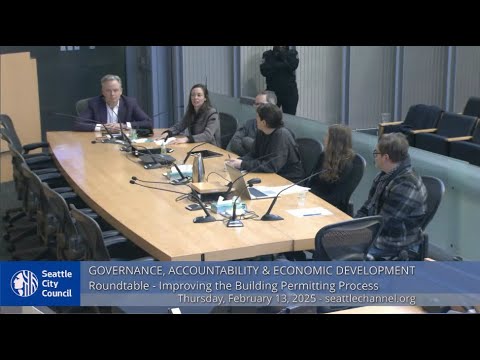
Seattle City Council’s Governance, Accountability and Economic Development Committee convened a roundtable Feb. 13 to hear architects, engineers, neighborhood leaders and small-business owners describe persistent delays and unpredictable requirements in the city’s building permitting process.
Seattle City Council’s Governance, Accountability and Economic Development Committee convened a roundtable Feb. 13 to hear architects, engineers, neighborhood leaders and small-business owners describe persistent delays and unpredictable requirements in the city’s building permitting process.
Committee President Sarah Nelson said the discussion is intended to help the council exercise oversight and to push on recommendations from a 2023 Office of the City Auditor report that found the city’s construction permitting “needs more customer focus and consistency.”
The meeting assembled private design professionals and neighborhood partners to describe where the Seattle Department of Construction and Inspections (SDCI) and other departments could improve customer service and predictability for homeowners, tenants and small commercial projects. Speakers gave concrete examples — from microfilm plan archives closed to the public to mid-review staff replacements that halted projects — and proposed short-term fixes (reopen in-person services, publish internal policies) alongside longer-term process changes (a standing work group and clearer rules for when tenant work triggers building-wide upgrades).
Design professionals said the end of the SDCI in-person service desk during the pandemic removed an important informal coaching channel. Architect Jim Graham said the desk allowed staff and applicants to look at drawings together and resolve questions immediately. “Reopening the service desk for in-person Q&A, and perhaps expanding online services to include video conference coaching, where drawings could be shared, would go a long way,” Graham said.
Structural engineer Francesca Renoir and other presenters also asked the city to restore public access, by appointment if necessary, to the microfilm/plan archive that design teams rely on to find historical drawings. They said the current email-based process produces lower-quality scans and takes longer to resolve, increasing soft costs for owners and tenants.
Several presenters described how small tenant improvements now trigger broad “substantial alteration” or energy-code upgrade requirements that can force tenants — not building owners — to pay for work affecting the whole building. Architect Michelle Linden and others argued that the city should adopt a more incremental or “stepped” approach to these upgrades and consider caps similar to those that apply to Americans with Disabilities Act improvements. They recommended allowing minor changes of use within the same occupancy group to be processed as over-the-counter permits rather than subject to full building review.
Speakers said pre-application conferences are inconsistent: although applicants can pay for coaching sessions, the guidance is not always binding on later reviewers and costs may be high (one presenter estimated about $270 per hour for a staffed pre-submittal conference). Jim Graham described a case in which a mid-project reviewer replacement led to conflicting geotechnical and land-use comments; the owner ultimately abandoned the project after spending “nearly $20,000” on reviews.
Don Blakely, executive director of the U District Partnership, described a $5,000,000 Washington State Department of Commerce grant his organization used to fund 40 storefront improvements during the pandemic and credited a temporary cross-department team with accelerating permits for those projects. Blakely suggested considering geographic pilot programs or standing “SWAT” teams for commercial districts with high vacancy rates; he cited the city’s current downtown vacancy estimate mentioned in the meeting as approximately 527 storefronts.
Public commenters echoed the themes. Small-business owner Eman Lou said the permitting experience has “become the norm… it’s gonna be hell,” warning that permitting unpredictability deters prospective restaurateurs and other entrepreneurs. Another commenter, Matt Greenup, described signing a lease only to learn that a parapet reinforcement requirement would make him responsible for upgrading the entire building — a burden he said could push him toward default or bankruptcy.
Councilmembers at the session expressed support for reforms. Councilmember Mark Solomon described a seven-month permitting experience for a backyard shed and said the city should make guidance clearer for residents who do not have professional assistance. Councilmember Teresa Kettle and Councilmember Andrew Rivera urged collaboration with SDCI and the mayor’s office; Nelson said the audit’s recommendation that the mayor lead a coordinated effort to document and evaluate permitting-related recommendations aligns with the committee’s goals.
Presenters and council members proposed a mix of near-term and medium-term actions: reopen or reopen-by-appointment the microfilm/plan archive; restore an in-person SDCI service desk (or offer live video coaching tied to plan review); publish internal SDCI policies and “tip sheets” for commonly delayed review areas (geotech, tree, addressing); create an online “how are we doing” feedback link for permit applicants; and form a standing work group with SDCI staff empowered to implement changes. Several speakers also suggested administrative fixes such as improved out-of-office protocols for reviewers and more robust coordination between reviewers to avoid conflicting comments.
There were no formal votes or legislative actions taken at the committee meeting. Instead, presenters asked the executive branch departments that manage permitting to implement a mix of administrative and process changes; committee members said they will press the mayor’s office and SDCI for follow-up and asked staff to provide information on implementation status at future meetings.
The committee closed the discussion by inviting continued collaboration and pledged to follow up; Nelson and other members said some recommendations do not require legislation and could be advanced through the executive’s administrative channels. The committee scheduled its next regular meeting for Feb. 27.