Get Full Government Meeting Transcripts, Videos, & Alerts Forever!
Get email alerts on the Cfec Modernization Permits topic
No spam. Unsubscribe anytime.
Commercial Fisheries Entry Commission briefs subcommittee on permits, IT modernization and records backlog
Summary
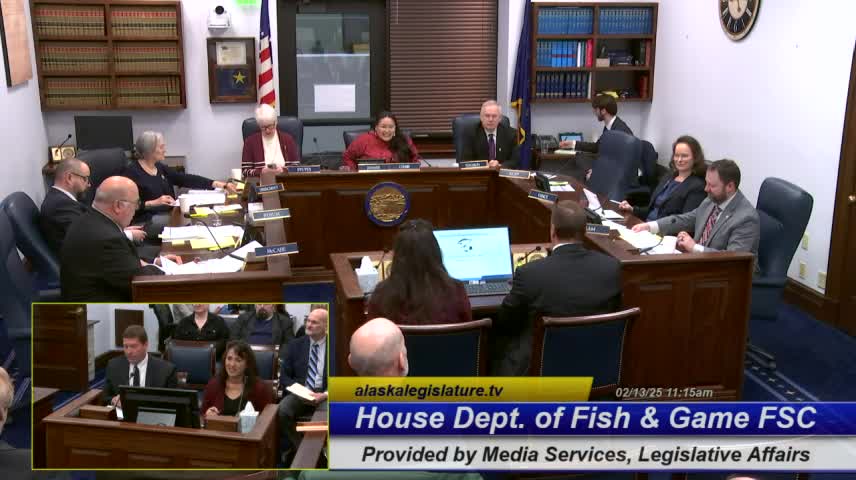
Glenn Haight, a commissioner with the Commercial Fisheries Entry Commission, and executive director Mele Makay briefed the Alaska House Finance Subcommittee on Fish and Game on Feb. 13, 2025, describing a plan to modernize legacy licensing IT systems and a records‑digitization effort supported by a three‑year $450,000 operating allocation.
Glenn Haight, a commissioner with the Commercial Fisheries Entry Commission (CFEC), and Mele Makay, the commission’s executive director, briefed the Alaska House Finance Subcommittee on Fish and Game on Feb. 13, 2025, on CFEC operations, research, licensing and a planned IT modernization.
The CFEC told lawmakers it is a small, quasi‑judicial state agency that issues permits and licenses required for commercial fishing in Alaska state waters; the commission reported it had 21 PCNs (positions) and key staffing vacancies while handling a broad research and adjudication workload. “We’re small. 21 PCNs,” Haight said, describing the staff footprint and understaffing pressures.
The commission described revenue volatility linked to the seafood industry’s ex‑vessel value; revenues historically rose when industry value increased and fall when it declines. Haight said the commission received $450,000 last year as a three‑year operating allocation to begin IT modernization and records reduction work; the funding is intended to support a multi‑year effort to modernize the licensing system, reduce paper records and stabilize operations. CFEC staff told lawmakers they currently have roughly 3,000–3,500 boxes of records in storage and about 3,000 fish tickets to process into electronic form.
Haight and Mele Makay explained that much of the modernization work will be contracted out while internal staff stabilize current systems. IT systems include legacy software developed in the 1980s (COBOL) and numerous add‑ons, which the commission described as a “spaghetti monster” that needs unraveling to produce a user‑facing licensing platform and public‑facing services.
The commission also discussed licensing practices including residency verification: nonresident permit holders pay an additional nonresident fee and applicants must certify Alaska residency and provide a physical address and driver‑license information. CFEC said the residency standard is set in regulation and the agency can and does validate residency documentation when applicants claim resident status.
On limited‑entry issues, CFEC summarized its role in issuing, adjudicating and periodically reviewing optimum permit counts (the so‑called optimum number studies). The commission said historic litigation and administrative backlogs have been reduced but one longstanding matter—resolving final permits in the Southeast shrimp fishery—remains complicated by old addresses and incomplete records; the commission reported it has taken steps to contact applicants and clear legacy cases.
Legislators asked about travel, research outputs and outreach; CFEC said it seeks to be more present around the state and that commissioners and staff travel to industry events such as the seafood expo when appropriate. The commission noted recent partnerships with Department of Labor and ISER (Institute of Social and Economic Research) to cross‑reference landing data for research while complying with confidentiality rules through data encryption and masking.
No formal votes or actions were taken; representatives invited CFEC to provide further details about the modernization plan, a travel and outreach report, and the residency regulation text for committee review.