Get Full Government Meeting Transcripts, Videos, & Alerts Forever!
Get email alerts on the Medicaid Finance Eligibility topic
No spam. Unsubscribe anytime.
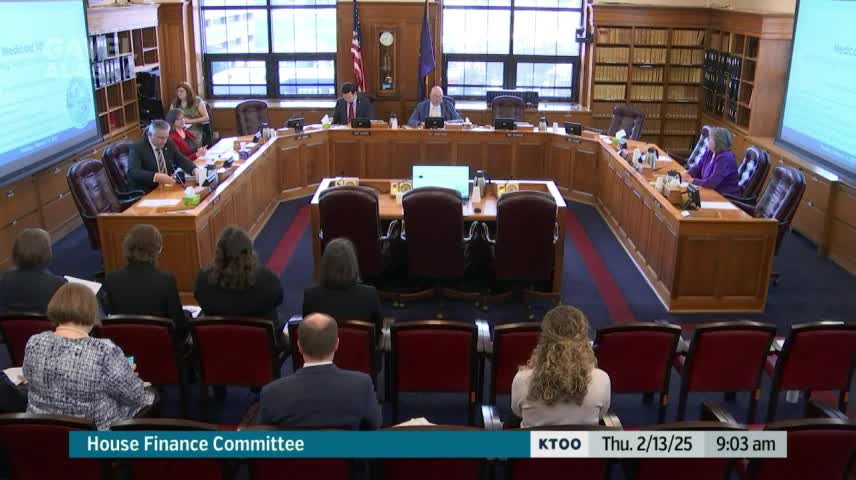
House Finance Committee hears Medicaid 101: program scope, funding and system challenges
Summary
Department of Health officials briefed the House Finance Committee on Medicaid’s size, how federal matching (FMAP) works, enrollment trends after redeterminations, provider payment issues and planned IT modernization.
Juneau — The Alaska House Finance Committee on Feb. 13 received a Medicaid 101 briefing from the Department of Health that outlined the program’s scale, how federal and state dollars flow through the system, recent enrollment trends and operational challenges.
The presentation, delivered by Deputy Commissioner Emily Ritchie of the Department of Health, included a summary of the program’s financial footprint: “Alaska’s Medicaid program is essential to Alaskans and to our health care delivery system,” Ritchie said, noting the program pays about $2.8 billion in federal and state funds annually and provides coverage for roughly 246,000 Alaskans.
Why it matters: Medicaid is both a major health insurer for low-income Alaskans and a large payer in the state economy. Committee members probed which parts of Medicaid are funded by federal dollars and which by the state general fund, how federal matching rates (FMAP) are applied, and how claims and payments are processed.
Most important facts — funding and flows - The Department said Alaska’s Medicaid program pays roughly $2.8 billion a year and distributes weekly provider payments in the hundreds of millions of dollars (department slide: about $252 million per week). Those payments are later reconciled with federal draws. - Federal Medicaid Assistance Percentage (FMAP) determines the federal share. Ritchie cited a regular FMAP floor for Alaska at about 51.54% for many services; certain services and populations (for example, some tribal health services) can receive higher federal matches. - The department told the committee it has reclaimed higher federal match in some cases (tribal reclaiming) and that effort yielded about $138 million in general‑fund relief in FY 2024.
Enrollment, eligibility and recent redetermination - Deputy Commissioner Ritchie and Deb Etheridge, director of the Division of Public Assistance, described how Alaskans apply (myalaska.gov, healthcare.gov, in-person offices, phone, mail, local “fee agents” in rural areas) and the two main eligibility buckets: disability-related categories and modified adjusted gross income (MAGI) categories. - The department showed enrollment changes since the COVID-era continuous coverage conditions: monthly enrollment peaked around 280,000 in FY 2024 on a yearly-count basis, but the department reported about 253,000 enrollees in April 2023 when redeterminations began and about 246,000 enrollees in December 2024. - On postpartum coverage, Ritchie confirmed the Legislature passed a bill extending Medicaid enrollment for mothers after birth from 60 days to 12 months; she said the child’s eligibility rules were unchanged and children were already eligible for the first year.
Operational issues raised by legislators - Provider payment timing and claims delays: several legislators said they hear frequent complaints that providers do not receive timely payments; the department acknowledged individual and systemic issues can occur and said some delays relate to upstream clearinghouse or data‑transmission problems rather than the MMIS itself. - IT modernization: Ritchie said the department is working on a Medicaid modernization plan that will include automation to reduce manual work and, officials said, should improve provider payment timeliness. The committee was told the department will return in the afternoon for a FY26 budget overview and to discuss proposed IT changes. - State plan amendments and statutory limits: Ritchie explained that changes to eligibility, covered services or administration typically require state plan amendments (SPAs) and sometimes statutory changes. She told the panel that some services listed as “optional” in state statute are effectively required in practice because of federal rules or system expectations. The department identified AS 47.07.030 and federal Medicaid authorities (Title XIX of the Social Security Act) as the legal framework that define mandatory and optional services.
Follow-up, data requests and next steps - Committee members asked the department to supply a written breakout of federal versus state expenditures by service category. The department agreed to follow up in writing. - The department said it will present more detailed IT modernization and FY26 budget materials later in the day.
Less-critical details and context - The department said about 31,000 providers are enrolled to receive Medicaid payments. It also noted that not every enrollee uses services each month; department charts showed a smaller “users” curve beneath total enrollment figures.
The committee adjourned after scheduling the department’s FY26 budget overview for the afternoon session.