Get Full Government Meeting Transcripts, Videos, & Alerts Forever!
Get email alerts on the Sport Fish Budget Hatcheries topic
No spam. Unsubscribe anytime.
Subcommittee reviews Division of Sport Fish FY26 budget, hatchery capital needs and invasive‑species monitoring
Summary
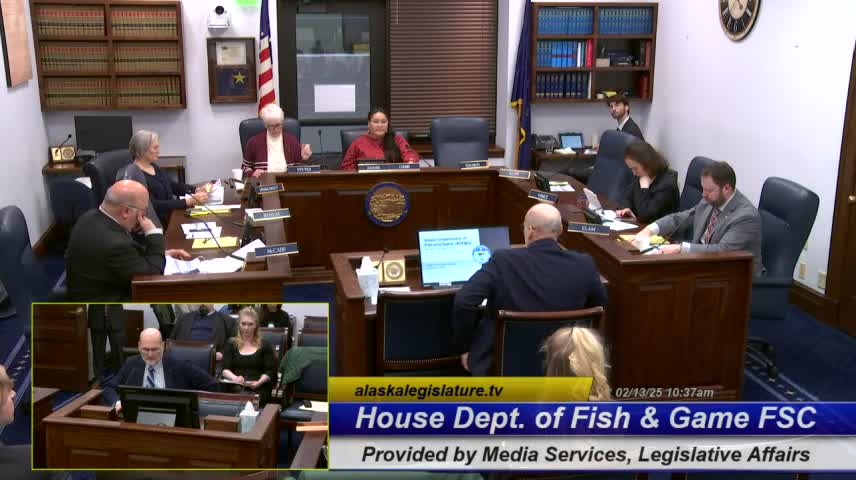
On Feb. 13, 2025, the Alaska House Finance Subcommittee on Fish and Game heard a presentation from the Department of Fish and Game’s Division of Sport Fish on the FY26 governor’s budget, staffing shortages at seasonal positions, nearly $10 million in hatchery capital needs and ongoing monitoring for invasive species including European green crab.
Tom Taube, deputy director of the Division of Sport Fish for the Department of Fish and Game, presented the division’s FY26 governor’s budget and program updates to the Alaska House Finance Subcommittee on Fish and Game on Feb. 13, 2025. The division told the panel the FY26 request for sport fish activities totals about $55.4 million across three RDUs (results delivery units) with the bulk devoted to sport fisheries operations and hatchery work.
The presentation matters to anglers, local economies and subsistence users because the division’s hatcheries and enhancement work provide many of the sport‑fishing opportunities available across the state and because federal and user‑fee funding that supports those programs fluctuates. “For the record, I am Tom Taube, deputy director of the Division of Sport Fish for the Department of Fish and Game,” Taube said at the start of the presentation.
Taube told committee members the division’s FY26 budget is split across the sport fisheries RDU (about 84% of the total), the Anchorage/Fairbanks hatcheries RDU (about 13%) and Southeast hatcheries (about 3%). He said the department is requesting a $200,000 increment in the Anchorage/Fairbanks hatcheries RDU to align fisheries enhancement activities to the correct RDU, and that most changes between the FY25 management plan and FY26 governor’s request reflect higher personal‑services costs (PERS increases and employer health contributions).
The division described nearly $10 million in capital appropriations for hatcheries, including roughly $4.1 million for Crystal Lake Hatchery in Southeast Alaska and about $1.5 million dedicated to Anchorage and Fairbanks hatcheries, with an additional $4.0 million available for hatchery needs statewide. Taube said some recommended energy‑system upgrades at William Jack and Ruth Burnett hatcheries are expected to run into the millions and could be financed in part by loans repaid from energy savings if the department front‑loads equipment replacement.
Division staffing has declined since FY15 from roughly 340 PCNs (position control numbers) to about 300 projected in FY26, Taube said, with most of the reduction in seasonal positions. He said recruitment and retention difficulties—especially in Southeast Alaska where high housing costs and lack of employer housing make seasonal postings hard to fill—are a primary cause. “In Southeast Alaska…we’re unable to provide housing. And so the pay isn’t enough for someone to find housing in those communities and…survive on our wages,” Taube said in response to lawmakers’ questions.
Representative Bentz asked whether the administration had studied offering stipends or short‑term housing to fill seasonal posts. Taube said the division has leased housing in some communities and built bunkhouses in others, and that staff can provide a written summary of housing options and costs. The division agreed to provide a written follow‑up on housing approaches and costs for filling seasonal positions.
Funding sources and constraints were a major topic. Taube reviewed the Dingle‑Johnson (Federal Aid in Sport Fish Restoration) program and the user‑pay model that channels excise taxes on fishing equipment and motorboat fuel into federal apportionments that states spend under specific rules. He said Alaska is a “maximum state” that receives 5% of annual DJ apportionments and that federal rules require at least 15% of the DJ apportionment be used for boating access projects. The division also described the Fish and Game Fund (revenues from license sales and king salmon stamps) and noted that DJ apportionments can fluctuate year to year; the division attributed recent swings to pandemic‑era changes in recreational fuel use.
Taube summarized the department’s aquatic invasive species work, saying the program is primarily grant‑funded (federal grants, State Wildlife Grants and other federal sources) and operates with a small staff: three permanent full‑time employees and four permanent seasonal employees for statewide coordination and eradication work. He listed recent efforts involving invasive tunicates near Sitka, signal crayfish on Kodiak, and northern pike projects on the Kenai Peninsula and Susitna drainage. On green (European) crab in Southeast, Taube said the division is currently monitoring and partnering with local tribes and federal partners; the program has not moved to large‑scale eradication because that would require substantially larger funding. “With the funds that we have, our program right now…is pretty much just monitoring,” he said.
Lawmakers pressed for more detail on several points: a list of creel‑sampler locations and counts, whether creel samplers can sample on private docks (the division said it does not have legal authority to place samplers on private property), and a historical look at staffing and in‑season management capacity. Taube said the division has the budget to run in‑season creel sampling but that hiring difficulties reduce the number of people available to collect that data.
The session closed without any formal committee actions or votes; the presentation concluded and lawmakers signaled follow‑up requests on housing options, sampler counts and revenue‑source breakdowns.
Ending: The subcommittee moved on to the next presentation after Taube’s briefing; the department agreed to provide follow‑up materials that lawmakers requested on housing solutions for seasonal hires, a count of creel samplers by region and a more detailed revenue breakdown for the Fish and Game Fund and DJ‑matched projects.