Get Full Government Meeting Transcripts, Videos, & Alerts Forever!
Get email alerts on the Mariculture Kelp Farming topic
No spam. Unsubscribe anytime.
Alaska mariculture advocates outline kelp-farming growth, grants and market challenges
Summary
Presenters from the Alaska Mariculture Alliance and Kodiak kelp farmers described rapid growth in kelp production, federal and state grants supporting industry development, and remaining barriers including markets, processing capacity and seed rules.
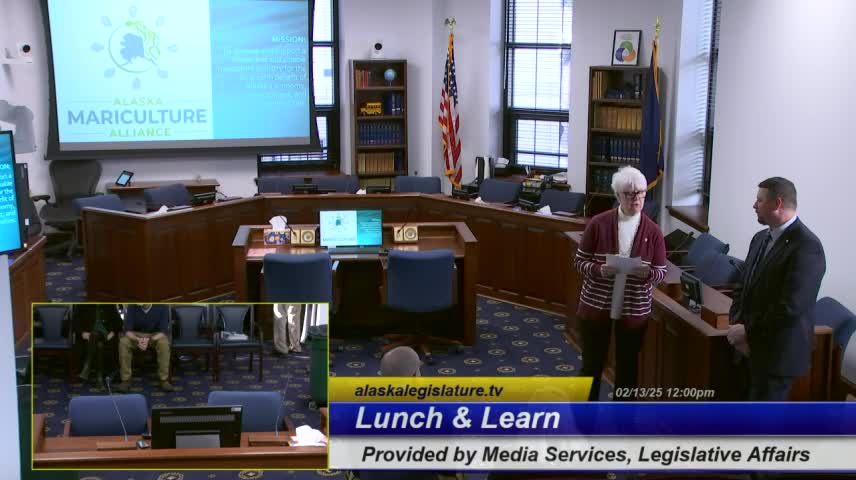
Jason, executive director of the Alaska Mariculture Alliance, and a Kodiak kelp farmer described the state’s expanding mariculture industry and its potential to diversify coastal economies and increase local food security.
The presenters told lawmakers and Southeast Conference attendees that kelp farms in Alaska have grown from a single small harvest in 2017 to nearly a million pounds of production in Kodiak among four farmers, and that 36 mariculture farms now hold permits statewide.
The Alaska Mariculture Alliance’s work and federal and state funding underpin the expansion, the speakers said. The alliance is administering portions of a federal Build Back Better award to Southeast Conference—described in the presentation as a $49,000,000 award—and a $5,000,000 Alaska legislative matching grant intended to attract private investment. Presenters said those funds support workforce development, research and equipment grants to farmers and processors.
Why it matters: presenters argued the industry can provide jobs and food closer to Alaskans, reduce reliance on imports and produce environmental co-benefits such as nutrient removal from coastal waters that can help address local acidification and support habitat.
Key details and claims
- Production and scale: The Kodiak presenter said his operation has harvested “over 900,000 pounds of kelp” over roughly eight years and described a 2017 single-line harvest of about 10,000 pounds as Alaska’s first commercial harvest. He said there are 36 permitted farms statewide; kelp farms account for roughly 2,370 permitted acres but “only 10% of that is being used,” while an estimated 785 acres figure referenced oyster permits (presenter said that number represents oyster permits and less than half of that is actively farmed).
- Grants and programs: Presenters identified a $49,000,000 Build Back Better award to Southeast Conference and a $5,000,000 state matching grant. They described that funding as supporting five local liaison contracts and rounds of equipment/technology grants to farms; the alliance said it has completed one round of awards and was in the middle of awarding a second round. The presentation also referenced an ARPA‑E/Department of Energy project and other federal research grants; the transcript included a DOE funding figure that could not be independently confirmed from the meeting record.
- Processing and markets: Presenters said some processors are paying near-salmon wages for kelp-handling work in-season and that markets include food ingredients, agricultural bio‑stimulants and livestock feed. One speaker summarized a feed trial (reported from a separate study) that he said showed a fermentation-processed kelp product improved sow production by about five additional live piglets per birthing cycle, reduced antibiotic use by about 50% and raised revenue by about $280 per sow per year; the speaker prefaced that description as reporting a study and not as his own technical claim.
- Technical, permitting and seed constraints: Presenters described tight permitting and engineering requirements (state DNR, Army Corps, NOAA and NMFS reviews), mandatory anchoring and site-specific design to withstand storms. They said growers must collect seed (sorus) from within 50 kilometers of a farm site and collect 50 fertile plants per collection event to maintain genetic diversity, creating seasonal and logistical constraints.
- Diversification and co-culture: The speakers described projects testing oysters over kelp lines, small experimental geoduck and abalone hatchery efforts, and trials to use kelp with shellfish and other species to extend production windows and permit year-round operations on some sites.
Representative presence and next steps
The presenters thanked Representative Stutes for hosting the briefing and encouraged lawmakers and attendees to contact Alaska Mariculture Alliance staff for follow-up. The alliance said it is two years into a four-year Build Back Better grant period and that the work includes workforce development, research and equipment grants and community liaisons in rural and Alaska Native communities.
Ending
Speakers emphasized the nascent industry remains grant-dependent in parts, needs additional processing capacity and market development, and expects to continue using state and federal grants to build infrastructure and private investment to expand markets and year-round production.