Get Full Government Meeting Transcripts, Videos, & Alerts Forever!
Get email alerts on the Dec Budget topic
No spam. Unsubscribe anytime.
House Finance subcommittee reviews Department of Environmental Conservation budget; $3 million accounting shift, $45,000 lab utility request
Summary
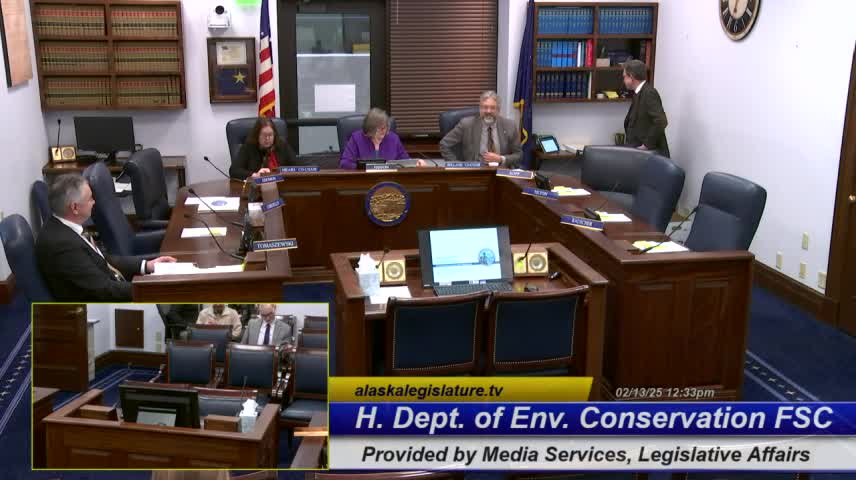
Juneau ' The Alaska House Finance Department of Environmental Conservation Subcommittee met Feb. 13 to review the Department of Environmental Conservation's proposed FY26 operating budget, focusing on a $3 million interagency receipt authority increase, a technical fund-shift for water fee authority, and a $45,000 utility increment for the department's Environmental Health Laboratory.
Juneau ' The Alaska House Finance Department of Environmental Conservation Subcommittee met Feb. 13 to review the Department of Environmental Conservation's proposed FY26 operating budget, focusing on a $3 million interagency receipt authority increase, a technical fund-shift for water fee authority, and a $45,000 utility increment for the department's Environmental Health Laboratory.
The review, led by Chair Kara Hannan and featuring Acting Commissioner Christina Carpenter and Administrative Services Director Megan Koehler, was framed as largely technical and structure-focused: department leaders said the $3 million change is an internal accounting authority to separate annual building lease, operations and maintenance costs rather than a new appropriation, and the $45,000 is a modest increment to cover higher utility costs at the Environmental Health Laboratory in east Anchorage.
Acting Commissioner Christina Carpenter summarized the department's workload and staffing during the presentation. She said DEC employed 556 funded positions and reported metrics for calendar year 2024 including more than 9,500 permits, approvals, certifications and plan reviews; roughly 3,100 inspections and site visits; and more than 29,000 staff training hours. Carpenter also described leadership turnover: she is the acting commissioner following the departure of former Commissioner Emma Pocan and noted the department's leadership has a mix of career state and private-sector experience.
Carpenter characterized the $3 million item as an "interagency receipt authorization" intended to consolidate and track building lease/maintenance authority inside the department. She said the request is structural rather than an added appropriation and described it as an accounting change related to FY25 legislative intent language. "This is not a request for funding," Carpenter said; "it's a structure change needed to allow us to move money into this allocation from the other division." (Christina Carpenter, acting commissioner, Department of Environmental Conservation)
Administrative Services Director Megan Koehler confirmed the vacancy snapshot the administration provided to the subcommittee: "The OMB provided the moment in time of our vacancy rate being 8% for December 15." Koehler said the 556 figure is funded positions and the 8% figure was the vacancy rate as of that date; she offered to provide updated vacancy numbers in writing. (Megan Koehler, administrative services director, Department of Environmental Conservation)
The subcommittee also reviewed a fund-cleanup request that would shift a previously fee-specific authority to general fund program receipt authority in the water division. Carpenter said last year the department made a similar technical cleanup in air quality and the current request for water is the same type of authority adjustment; there is no new funding associated with the change.
Members asked detailed follow-ups and requested additional information. Representative Tomaszewski asked how recent air-quality regulation changes affecting the Fairbanks North Star Borough would affect DEC's budget; Carpenter said reopening public comment on one item would not carry a budget increment and offered to provide written follow-up. Representative Holland pressed for information about backlog and permit timelines, and Carpenter said the department would provide permit-queue information to the committee in writing.
Law and reporting points discussed: by statute the annual Spill Prevention and Response (SPAR) report is to be delivered to the legislature within 10 days after convening of the session. Carpenter said the SPAR annual report has been drafted, is in final review and "we expect to have that delivered to the legislature in short order." She apologized for the delay and said the division had drafted the report and it was pending final review. The committee pressed for more detail on the SPAR program's fund projections; Koehler said the administration is "watching it very closely" but that the current projections do not include interest earnings and that, at present, she did not have concerns about solvency based on available projections. (Christina Carpenter; Megan Koehler)
Members also discussed a multiyear PFAS reimbursement program, which the department described as a multiyear grant originally recognized in prior years. Carpenter and Koehler explained line reversals in the budget reflect timing and multiyear accounting rather than a cut in services: the roughly $2.5 million figure represents multiyear reimbursement authority being carried forward for ongoing implementation and reimbursement to local entities for PFAS disposal; the program kicked off Jan. 1 and communities are beginning to submit requests. "We are using that funding," Carpenter said, adding that exact expenditure totals will be available at fiscal-year end.
Other operational points recorded in the meeting: - The department's Environmental Health Laboratory, located in east Anchorage off Martin Luther King Drive, performs regulatory testing including commercial shellfish testing; DEC invited members and staff for a tour. - A one-time relocation increment for the Juneau AirLab (described in the presentation as the Juno/Juneau AirLab) previously reversed is also noted in the budget presentation (about $87,000 one-time in FY25, described in presentation materials). - The division of administration includes allocations for the commissioner's office, administrative services, state support services (no PCNs), and a facilities rent non-state-owned allocation created to implement FY25 legislative intent language separating lease/operations costs.
Several committee members asked for follow-up information the department agreed to supply in writing: updated vacancy counts and timing, permit backlog and permit processing timelines, a breakdown of how much of DEC's budget is funded by fees and how fee-setting authority is exercised, the status and expected delivery date of the SPAR annual report, and clarification about recent landfill regulation questions (commercial waste asbestos/lead inspection requirements) raised during public comment. Carpenter offered to follow up with the Environmental Health Division on landfill regulation timing and public-notice history.
No formal subcommittee votes or motions were taken during the Feb. 13 meeting. The subcommittee scheduled a follow-up meeting for Feb. 20 at 12:30 p.m. in Room 120 to continue review, including an upcoming presentation on the cruise ship program.
Ending note: The meeting record shows the subcommittee's FY26 review was primarily technical and informational; members repeatedly requested written follow-ups and data to clarify accounting reversals, multiyear spending projections and operational capacity ahead of the full Finance Committee's development of a committee substitute.