Lifetime Citizen Portal Access — AI Briefings, Alerts & Unlimited Follows
House Energy Committee reviews Renewable Energy Fund Round 17; 18 projects recommended across Alaska
Loading...
Summary
At a Feb. 13 hearing, AEA staff described the Renewable Energy Fund's history, eligibility and Round 17 recommendations — 18 projects spanning rural and rail-belt communities — and noted the program's role in reducing diesel use and seeding later federal and private investments.
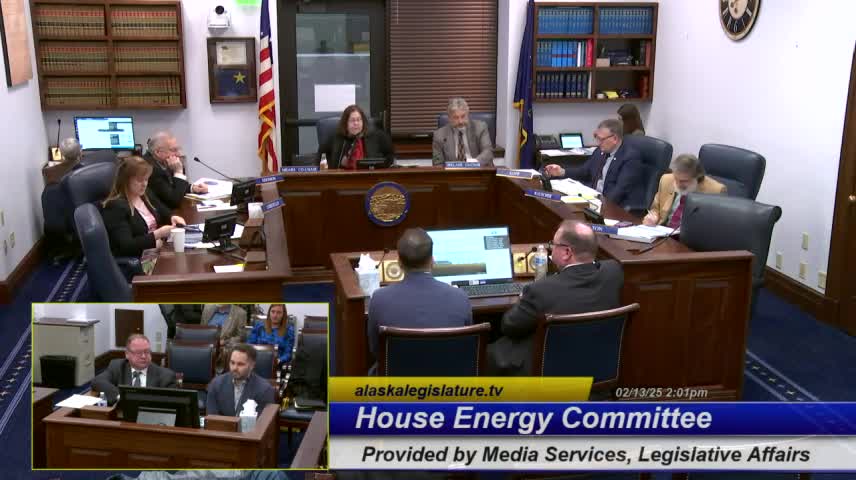
Connor Erickson, director of planning for the Alaska Energy Authority, told the House Energy Committee on Feb. 13 that the Renewable Energy Fund (REF) has helped launch projects across Alaska since its establishment in 2008 and that Round 17 includes 18 recommended projects covering multiple energy regions.
“...we started with just a couple of thousand when it was, when it was initially launched, but now there's over at this at this juncture, there's actually over, like, 14,000 documents that are made available,” Erickson said of AEA’s new electronic library used to centralize project files and historical studies.
Why it matters: the Renewable Energy Fund is a long-standing state program intended to support feasibility, design and early construction of projects that reduce reliance on diesel, enable local renewables and leverage federal/private investment. Erickson and AEA executive director Curtis Thayer told the committee REF projects have displaced diesel at large scale over time and that many recent rounds concentrate funding in rural Alaska.
Program details and Round 17 recommendations
Erickson summarized REF eligibility and evaluation: applicants may be public agencies, utilities or independent power producers (IPPs); matching funds are not required but can earn points; evaluations include technical, financial and public-benefit criteria and third-party reviews where appropriate. He said the REF Advisory Committee — statutorily created — reviews rankings before recommendations go to the legislature.
Round 17 includes a geographically diverse list of recommended projects; AEA presented project summaries and a governor-proposed funding cutoff line showing which recommendations are included in the executive budget. Examples from the list include a hydropower relicensing project in Pelican, a 1 MW solar and 1.5 MW battery proposal in Naknek’s Cape Swornoff, reconnaissance and potential dam-raise work at Goat Lake (Southeast), several wind-plus-battery projects, a district-heating biomass final phase in Nenana, and feasibility studies for additional wind and hydro projects in the Railbelt and interior regions.
Erickson emphasized that the REF process has helped de-risk projects that later attracted federal funds: AEA staff and legislators repeatedly noted that many IPPs and community projects used REF funds for early feasibility and then leveraged federal grants or private capital. Executive director Thayer told the committee, “If there's one project that truly has a success record, it's this program right here.”
Power Project Fund and loan thresholds
Erickson also reviewed the Power Project Fund loan program: AEA reported a current loan portfolio of about $31,000,000 spread across 15 loans and a fund balance of about $9,600,000 as of December. He summarized internal approval thresholds: loan committee authority for requests up to $2,000,000; loan committee plus board approval for $2,000,000–$5,000,000; and legislative approval required for loans above $5,000,000.
Committee questions and follow-up
Members asked for more accessible impact analysis and historical performance data. Erickson said AEA posts project information on its website and that an impact analysis from 2022 is available; staff offered to provide committee offices with multi-page write-ups on each Round 17 application. Representatives asked how REF scoring accounts for community benefit, project readiness and risk; Erickson said those factors are part of the multi-stage evaluation and that REF historically accepted some early-stage risk to seed nascent technologies.
Ending: AEA provided the committee with project summaries and said staff would circulate additional written details. The committee did not take votes on funding at the Feb. 13 meeting; members indicated they would use the materials to inform deliberations in upcoming budget and DCCED subcommittee hearings.