Get Full Government Meeting Transcripts, Videos, & Alerts Forever!
Get email alerts on the Behavioral Health Crisis Center topic
No spam. Unsubscribe anytime.
Department seeks $1.5 million to sustain 988 crisis contact center as use increases
Summary
Department of Health requested $1.5 million in FY26 to maintain the statewide 24/7 crisis contact center that handles 988 calls, citing increased utilization and expiring federal one-time funds; officials said federal grants will also support planning for certified community behavioral health clinics.
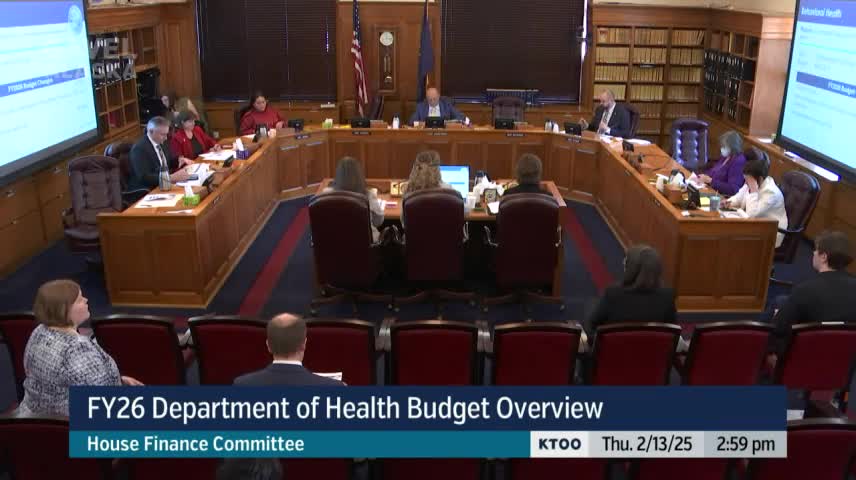
The Alaska Department of Health told the House Finance Committee on Feb. 13 it is requesting $1.5 million to maintain the statewide crisis contact center that answers 988 calls and related crisis contacts.
Pam Halloran, assistant commissioner, said the request comprises $750,000 in mental health trust receipts and $750,000 in general fund mental health authority. The current crisis contact center contract began in 2022 and is scheduled to end June 30, 2025; department witnesses said use has risen following national and statewide promotion of 988 and that portions of prior support came from expiring federal sources such as American Rescue Plan Act funds.
Why it matters: The call center provides a confidential, toll-free line for Alaskans at risk of suicide or in emotional distress; sustaining coverage is a direct public-safety and behavioral-health capacity issue.
Officials said the division will issue a new request for proposals for the contract. Deputy Commissioner Emily Ritchie told the committee the center's work has evolved from a traditional suicide line into a broader crisis contact center that supports text and follow-up services and can link callers to appointments or other crisis response elements where available. Ritchie said the department received roughly $1.6 million in federal grant funding in late 2024 to plan and develop certified community behavioral health clinic (CCBHC) capacity in Alaska, which the department said would support planning and initial development work.
Committee members noted that sustaining a statewide call center does not, by itself, expand local crisis-response capacity in rural communities. Representative Hannon, who serves on the State Suicide Prevention Council, said Alaska still lacks sufficient on-the-ground crisis stabilization and response in many locations and urged continued investment in services that connect callers to local care.
Ending: The department said it will issue a new RFP to continue the crisis contact center and recommended continued legislative attention to ensure the center is linked to on-the-ground crisis-response capacity and stabilization services across the state.