Get Full Government Meeting Transcripts, Videos, & Alerts Forever!
Get email alerts on the Transportation Infrastructure topic
No spam. Unsubscribe anytime.
DOT says construction pipeline weaker than desired; contractors, inflation and a handful of large projects spotlighted
Summary
The Alaska Department of Transportation and Public Facilities told the Senate Transportation Committee on Feb. 13 that the Statewide Transportation Improvement Program, or STIP, shows a smaller near‑term pipeline of new contract awards than the department and Alaska contractors would like, and that inflation and a handful of large projects are driving program decisions.
The Alaska Department of Transportation and Public Facilities told the Senate Transportation Committee on Feb. 13 that the Statewide Transportation Improvement Program, or STIP, shows a smaller near‑term pipeline of new contract awards than the department and Alaska contractors would like, and that inflation and a handful of large projects are driving program decisions.
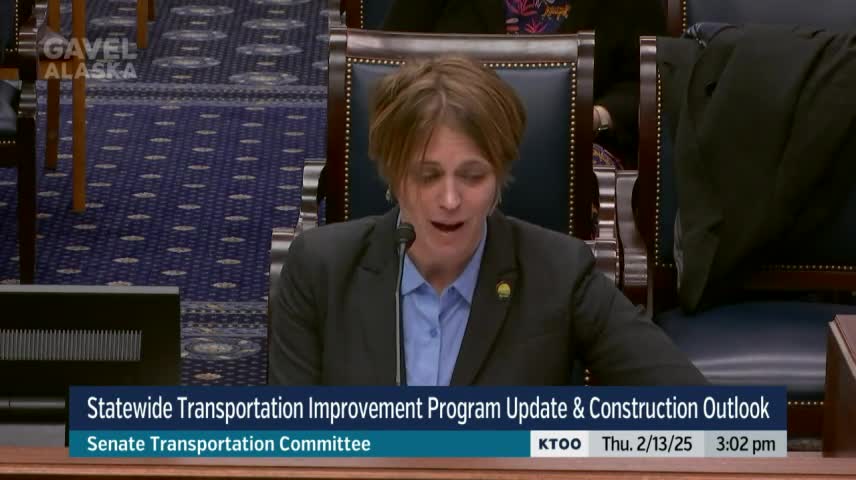
DOT Deputy Commissioner Catherine Keith summarized the department’s construction outlook and STIP update for the committee and said the department is seeing a mix of ongoing work and projects that must be accelerated to sustain contractor capacity. "We have our 2025 construction outlook maps available on the DOT website," Keith said, noting the department lists 45 projects for active construction in 2025 compared with 38 last year and that project listings and stages are available on the department’s Apex platform.
The committee pressed DOT for numbers and for clarity about contractor payments, award timing and the role of advanced construction. Dom Pinone, identified in the presentation as a Grama Manager and admin director with DOT, provided the department’s payment and pipeline figures and delivery metrics. "When we receive a payment invoice from the contractor in the last year our average payment time was 10 days," Pinone said. He said payments greater than 21 days made up about 7% of payments and payments over 42 days were about 2%.
Why it matters: contracting firms told the committee they are concerned about a shortage of new awards entering the pipeline for 2025 and the availability of work this summer. DOT officials said payments for already-awarded work remain substantial, but obligations and contract awards — leading indicators of future work — have declined compared with earlier years, and that trend could reduce future contractor payments if it continues.
Key figures and program notes cited to the committee - DOT listed 45 active construction projects in 2025, up from 38 in 2024. - The department estimated roughly $885 million in contractor payments expected in fiscal year 2025 (DOT described this as an estimate composed of payments on previously awarded contracts, CMGC second-stage construction payouts and new awards). - DOT identified about $609 million of payments as coming from awards or contracts with a high degree of certainty. - DOT said it expects payments to be made on roughly 276 projects this year (that figure describes projects with payments expected in FY2025, not the total contract value). - DOT estimated about $276 million in new work that can start in calendar year 2025.
Contract awards, concentration and the contractors’ concern DOT officials described a recent pattern in which a small number of large firms receive a disproportionate share of awards. The department presented data showing one company and its joint venture accounted for about 42% of contract award dollars in the four‑year window the department reviewed. Committee members and DOT discussed whether that concentration, bidding capacity, project size and mobilization needs are reducing opportunities for smaller Alaska firms.
The department reported its engineers’ estimates were, across roughly 505 awards over the review period, within about 3.5% of final award amounts overall, but DOT said rural airport projects have been notable outliers where bids returned well above the estimate.
Inflation, change orders and program timing DOT cited the Federal Highway Administration’s National Highway Construction Cost Index and the effects of inflation on project estimates. The department said the cost index has risen substantially since the pandemic and cited a roughly 67% increase since passage of the federal infrastructure law (Bipartisan Infrastructure Law) as a national metric affecting state programs. DOT officials said inflation and post‑award change orders have reduced the department’s available capacity to issue new awards because previously obligated funds and change orders absorb program dollars.
Advanced construction and federal timing DOT officials described advanced construction (AC) as a tool the department uses to put projects out earlier than federal fund tranches would otherwise allow. The department said its AC authorizations were roughly $400 million in 2022, rose to about $550 million in 2023 and were nearer $400 million in 2024, and that the department reduced the authorized balance by about $150 million between 2023 and 2024. DOT said AC can accelerate work but creates a future repayment obligation that can reduce award capacity in later years.
Spotlight projects discussed at length - Cape Blossom Road (Kotzebue area): DOT said three CMGC (construction manager/general contractor) contracts have completed preconstruction work and that negotiations over second‑stage construction packages are ongoing. DOT officials said an initial guaranteed maximum price presented for the second stage was about $140 million while the department earlier had estimated a lower construction estimate for that stage; negotiations are underway with the community partners and contractor. DOT also told the committee there is a congressionally delegated earmark of about $27 million for the project that must be obligated this year or the earmark could be lost.
- Cooper Landing Bypass (Sterling Highway): Committee members pressed DOT about the timing and STIP status of the Cooper Landing Bypass phases. DOT said the project to date has been funded largely with advanced construction rather than new obligated construction dollars and that the department has programmed preconstruction and archaeological work but currently has no new construction dollars in the next three years in the present STIP step for certain phases. DOT said it remains a priority for stakeholders and that some construction‑related activities (for example the Juno Creek bridge) are expected to continue through later years under the existing contract.
Requests and committee directions Committee members asked DOT to provide additional detail and follow‑up, including: a brief memo on inflation impacts and the national cost index as it relates to Alaska projects; data showing how often the tentative advertising schedule (TAS) dates change; the number of projects above or below the STIP amendment 20% threshold for estimates; and a clearer breakdown of payments expected in FY2025 versus awards to be made. DOT agreed to provide follow‑up information and said it has developed a dashboard tied to TAS that issues email notices to the leadership team when key schedule variables change.
What DOT asked from the legislature Deputy Commissioner Catherine Keith and Dom Pinone asked the committee for continued engagement and noted the department would work with stakeholders to address contractor concerns about project size, timing and distribution across the state.
Ending note: DOT framed the discussion as an operational update and asked the committee to help identify policy changes or budgetary options that could increase awards and work for Alaska contractors. Committee members said they want to assist in moving projects forward and requested additional DOT detail ahead of forthcoming STIP amendments and future hearings.