Get Full Government Meeting Transcripts, Videos, & Alerts Forever!
Get email alerts on the Federal Grants And Project Financing topic
No spam. Unsubscribe anytime.
Alaska Energy Authority: several federal grants paused; state bonds and short-term spending keep key projects moving
Summary
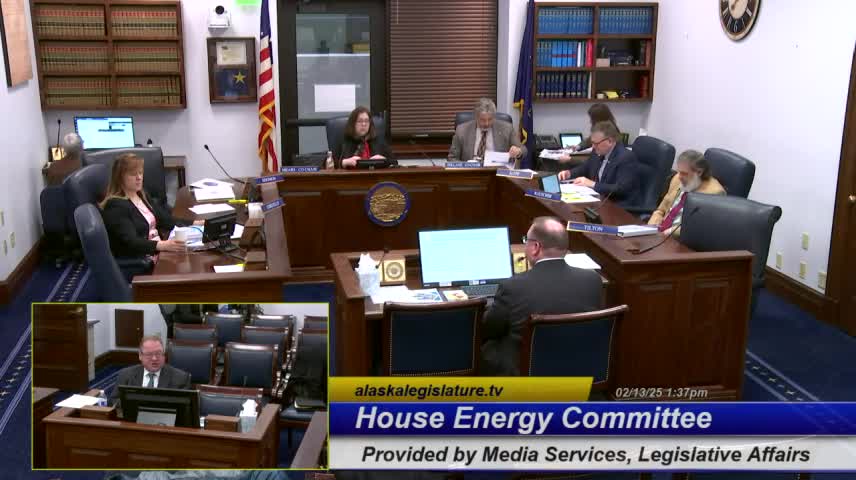
At a Feb. 13 House Energy Committee hearing, Alaska Energy Authority leaders said multiple federal grant programs remain on hold pending federal guidance, but state appropriations and bond proceeds are being used to preserve momentum on some projects, including initial engineering work for an HVDC transmission line.
Curtis Thayer, executive director of the Alaska Energy Authority, told the House Energy Committee on Feb. 13 that several federal awards Alaska had expected are paused pending guidance from the federal government, but that some work is continuing using state funds and AEA-owned bond proceeds.
The paused awards include conditional federal grants AEA received for home energy and electrification rebates (described as a conditional award received in January 2025) and a $62,000,000 “Solar for All” award received in April 2024. Thayer said, “this project has also been put on hold on on hold by the Trump administration.” He also said Alaska’s Grid Resilience Investment Program (GRIP) formula funding — about $60,000,000 to the state, with roughly $20,000,000 awarded to Golden Valley for three projects — is likewise on pause, though AEA has an executed grant agreement in place.
Thayer told legislators the National Electric Vehicle Infrastructure (NEVI) program’s $52,000,000 formula allocation to Alaska is currently suspended for further federal review; AEA expects guidance later in the summer. He also described a $15,700,000 Defense Community Infrastructure (Black Rapids) project delivered through the Department of Transportation that is not affected by the federal pause because it is DOT-managed.
Why it matters: the paused grants include awards Alaska planned to use to reduce diesel use, expand community solar and grid resilience, and install EV chargers. Lawmakers pressed AEA officials on what the pauses mean for match requirements, timelines and potential cost escalation if construction seasons are missed.
AEA is using state and bond funds to preserve project momentum. Thayer said the high-voltage direct-current (HVDC) transmission project has a $206,000,000 federal grant and that the state provided a $12,700,000 appropriation last year for the federal match. AEA also made $50,000,000 in bond authority available as part of a bonding program begun in 02/2022. Thayer said, “we are moving forward on it,” adding that AEA’s board authorized about $700,000 of engineering and early procurement work to continue over the next 30–90 days using state funds to avoid losing a construction season.
Thayer said there are nuances to the HVDC grant status: the grant agreement with the Department of Energy is signed and some reimbursements have been paid. “They did pay those bills yesterday,” he told the committee, describing receipt of partial reimbursements even while broader disbursements are paused.
AEA also described proposals in the governor’s budget language that would let AEA retain interest on state appropriations and to allow federal tax credits earned by AEA projects to be applied against those projects rather than reverting to the state general fund. Thayer said retaining interest and tax-credit value would lower project costs and benefit ratepayers.
Committee members asked for clarifications on project geography, bonding structure and how long AEA would keep moving forward without full federal certainty. Representative Holland (co-chair, House Energy Committee) and other members pressed staff for specifics about how far a transmission line would extend and how AEA is structuring bond proceeds; Thayer described past decisions that produced about $166,000,000 in bonding capacity and an internal allocation plan that set aside $90,000,000 for a Sterling to Quartz Creek upgrade and $28,000,000 for battery energy systems.
Discussion versus formal action: the committee heard updates and asked questions; there were no committee votes recorded on Feb. 13. Several committee members urged AEA to provide written updates on reimbursements, the federal guidance schedule, and any increases in projected costs if projects are delayed.
Ending: Thayer said AEA will keep the committee updated and that federal guidance later in the year will be determinative for the paused awards. The committee’s next meeting was set for Feb. 18; no formal decisions on the paused grants were taken at the Feb. 13 hearing.