Get Full Government Meeting Transcripts, Videos, & Alerts Forever!
Get email alerts on the Snap Backlog It Modernization topic
No spam. Unsubscribe anytime.
Alaska officials report progress on SNAP backlog, but warn IT, staffing reversals and rural access remain issues
Summary
Department of Health and Division of Public Assistance officials told the House Finance Committee on Feb. 13 that they have reduced long-standing application backlogs but face ongoing technical, staffing and rural-access challenges.
Department of Health and Division of Public Assistance officials told the House Finance Committee on Feb. 13 that they have reduced long-standing application backlogs but face ongoing technical, staffing and rural-access challenges.
Director Deb Etheridge and Commissioner Heidi Hedberg said the division originally faced roughly 36,000 outstanding applications across public assistance programs in early 2023. Hedberg said a combination of business-process redesign, staffing and temporary contractors addressed much of that need; Etheridge told the committee the apparent backlog figure in the agency's systems remains elevated because of duplication and legacy-system artifacts.
Why it matters: SNAP and Medicaid processing speed affects food security and health coverage for tens of thousands of Alaskans. Lawmakers pressed the department on whether ending one-time appropriations will reintroduce delays.
Key numbers and operations
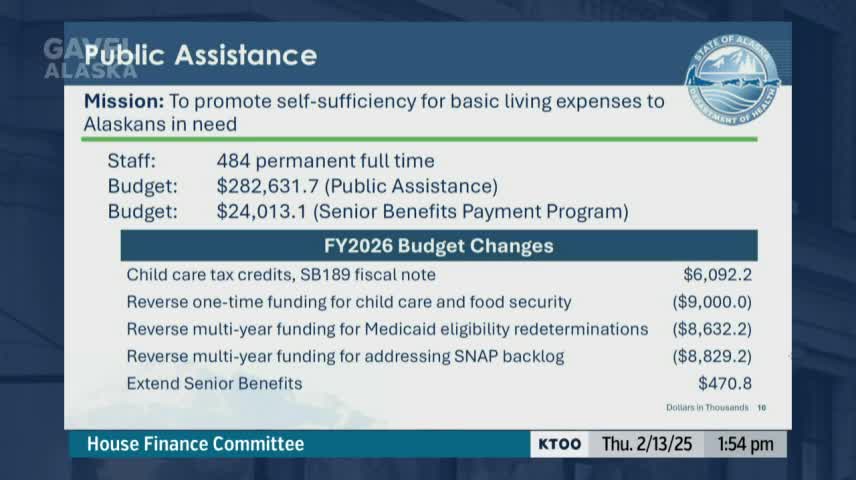
- SNAP recipients: department presentation listed 65,778 monthly SNAP recipients. - Timeliness: Hedberg said timeliness was 28% in March 2023 and has risen to a range of about 60% to 90%. - Backlog counts: Hedberg and Etheridge described a figure of roughly 29,000 outstanding items across programs; Etheridge said about 21,000 of that total appeared in the Medicaid (MAGI) queue but that data duplication and system handoffs inflate the number. - Staffing changes: Committee members were told two separate multi-year appropriations supported long-term nonpermanent staff: approximately 30 long-term nonperms associated with SNAP work and another ~30 tied to Medicaid eligibility determinations. Hedberg said those long-term nonperms and some contractual supports are ending when multi-year funding reverses. - One-time grants: The department said a $7.5 million childcare grant appropriation was distributed to providers in January/February and a competitive food-security RFP was awarded to the Food Bank of Alaska.
IT and process modernization
Officials described several technology and process changes intended to sustain improvements: smart, multi-program online forms; a phase 2 client portal launching in summer to let users update demographics, view notices and check benefit amounts; expanded texting reminders to clients; a "one-and-done" intake model to process multiple benefits in one contact; and automated ex parte processes for some Medicaid redeterminations.
Etheridge explained that the department's ARIES system and legacy EIS can leave applications in a state that looks like an open application even when benefits are active because of interrupted handoffs. The department plans RFPs in 2025 to migrate non-MAGI Medicaid categories and SNAP off the mainframe and estimated completion of the integrated eligibility effort by 2028.
Rural access
Members from rural districts emphasized connectivity and phone access in villages. Etheridge described the fee-agent model for remote communities, under which a local fee agent (a trained delegate) can collect applications and preserve filing dates; the department said fee agents are paid about $25 per application and that those payments are state expenditures.
Committee follow-up and uncertainties
Lawmakers asked for additional information on current telework levels, exact staffing numbers, and more precise backlogs after the department's internal deduplication and data-cleaning. Hedberg and Etheridge promised follow-up: departmental staff said they would provide more detailed numbers and written responses to the management-letter items noted in a recent Legislative Budget and Audit management letter.
Ending: Department officials said they will continue to triage staffing and technology needs and will provide follow-up material to the House Finance Committee as requested.