Get Full Government Meeting Transcripts, Videos, & Alerts Forever!
Get email alerts on the Agriculture Research topic
No spam. Unsubscribe anytime.
UAF tells Senate Arctic Affairs Committee it needs $5M to expand Arctic agricultural research; highlights kelp trials, LED greenhouses and new grain varieties
Summary
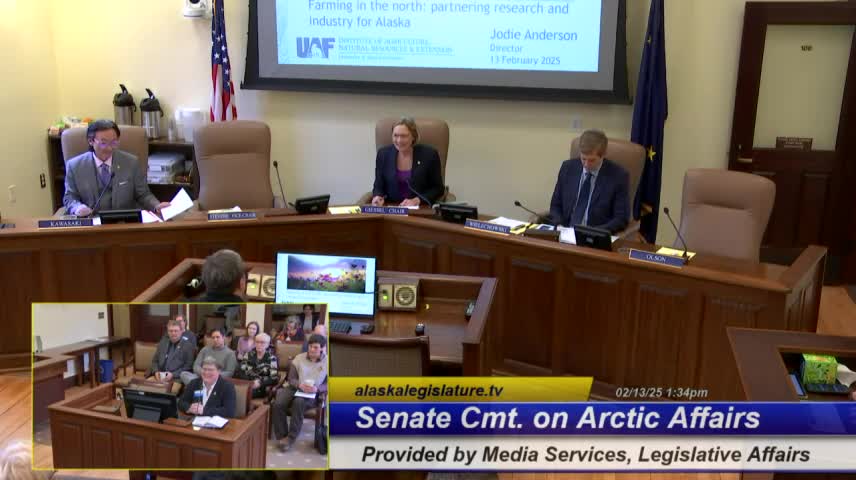
Jody Anderson, director of the Institute of Agriculture, Natural Resources and Extension at the University of Alaska Fairbanks, told the Senate Arctic Affairs Committee on Feb. 13 that UAF needs $5 million in capital funding and a $200,000 program increase to expand Arctic-focused agricultural research and staffing.
Jody Anderson, director of the Institute of Agriculture, Natural Resources and Extension at the University of Alaska Fairbanks, told the Senate Arctic Affairs Committee on Feb. 13 that the university is rebuilding its agricultural research capacity and is seeking new state investment to sustain gains.
Anderson said UAF has advanced greenhouse and field work — including LED-light greenhouse trials that raised tomato productivity, kelp variety trials supported by federal research funds, and new small-grain breeding lines — and requested $5 million in FY26 capital research funding and a $200,000 program increase to expand staff and facilities.
The request aims at specific hires and projects Anderson listed: a food-safety specialist, a horticulture researcher, an outreach position and expanded 4-H capacity. Anderson also described the institute's federal-match constraint: capacity funds require a 1:1 state match, and most state fund receipts are currently used as that match.
Anderson described several research highlights. In controlled greenhouse trials led by horticulture staff, adding LED lights lower in the canopy increased tomato yields from roughly 4 kilograms per plant under standard lighting to over 6 kilograms per plant in the LED-mixed configuration, she said. The institute has shifted to full-LED greenhouses to improve year-round production efficiency.
On soils and cropping, Anderson said UAF is testing cover-crop species and mixes that provide both soil-health benefits and intermediate market value to improve farmer uptake. She described work to trap and manage slugs and other pests that are increasing as invasive species move north with climate change.
Anderson also outlined successes in plant breeding. A recently hired breeder has been crossing germplasm with partners across the Circumpolar North; she presented comparative data showing new barley entries outperforming the state standard (the “check”) by large margins in early trials and producing longer heads and larger seeds. Anderson cautioned the varieties are still unnamed and experimental.
Mariculture and kelp were singled out as a crossover priority. Anderson said the kelp variety trials at UAF are among the first in the United States to receive federal research dollars for kelp variety evaluation. A newly hired livestock nutritionist will pilot feeding dried kelp as a micronutrient supplement to calves, Anderson said, noting the approach is intended as a supplement rather than a full feed replacement.
Anderson described institutional capacity gains since FY23: a 55% increase in indirect-cost recovery, a 262% increase in competitive grant funding and a 70% rise in capacity-project participation since she became director. But she warned that past attrition left the institute with far fewer specialty researchers than it had in the late 20th century; many positions (ag engineers, soil scientists, forestry specialists) were lost to retirements and not refilled.
On funding mechanics, Anderson said federal capacity funds require a 1:1 state match and that much of the institute’s state fund (Fund 1) is already consumed as that match; she estimated 94–95% of state funds may be used for matching in FY25–FY26 depending on timing. Anderson asked the committee to consider a standing state budget line to cover the federal-match requirement, noting that is common in other states.
Senators on the committee asked about reliance on federal grant programs and whether federal grant freezes present a risk. Anderson said the institute’s funding has come largely from USDA and that she was not seeing an immediate freeze in USDA support based on current activity versus public discussion.
Anderson closed by emphasizing collaboration with circumpolar partners, the need for more subject-matter hires, and the goal of making Alaska a leader in Arctic agricultural research if matching state support is available.