Get Full Government Meeting Transcripts, Videos, & Alerts Forever!
Get email alerts on the Opioid Settlement And Response topic
No spam. Unsubscribe anytime.
Burke County commissioners direct staff to focus on Option A opioid strategies, approve three-year lead position and back Partners' capital plan
Summary
Burke County commissioners on Feb. 14 voted unanimously to fund a three‑year opioid settlement coordinator, to prioritize Option A strategies under the state memorandum of agreement, and to direct Partners Behavioral Health to advance a $6.25 million state capital grant plan for local behavioral‑health capacity.
Burke County commissioners on Feb. 14 agreed to keep their immediate focus on Option A strategies under the state memorandum of agreement for national opioid settlements, approved funding for a dedicated settlement coordinator for three years, and gave Partners Behavioral Health direction to pursue a state capital grant to create local behavioral‑health space.
The votes at the board’s recessed meeting in Morganton were unanimous. Commissioners approved a three‑year funded coordinator position reporting to the county manager, directed staff and the new hire to prioritize the MOA’s Exhibit A (Option A) strategies, and authorized Partners to move forward with plans to use a $6.25 million LME‑MCO capital appropriation for brick‑and‑mortar behavioral‑health capacity. The board also approved applicants to a newly formed opioid advisory committee.
The decisions come as county staff and outside advisers described local data and recent programs supported by settlement and other grants. “It’s roughly 24 and a half million dollars,” County Manager Brian Eppley said in a presentation summarizing Burke County’s baseline opioid settlement allocation, noting the amount will be paid over roughly 18 years and could grow with later settlements. Nitty Sachdeva, who leads the North Carolina Association of County Commissioners’ opioid settlement technical assistance team, told commissioners the MOA creates two tracks of eligible work — Option A, an evidence‑based short list communities can start immediately, and Option B, a longer list that requires a formal collaborative planning process to “unlock.”
Why it matters: The board framed the work as long‑term infrastructure building to reduce overdoses, expand pathways to recovery and improve coordination among law enforcement, emergency medical services (EMS), public health, treatment providers and community organizations. County health director Danny Scalise described casework and outreach already underway and credited local partners with harm‑reduction results: “Since working with our partners in Olive Branch, their programs responded, and they’re responsible for curing over 200 people in Burke County with hepatitis C in the field,” Scalise said, and the group has “enrolled over a hundred people into a Suboxone clinic with peer support follow‑up.”
What the board directed and approved - Coordinator position: Commissioners voted to fund a full‑time position to coordinate opioid settlement work for three years, to report to the county manager. The motion was made by Commissioner Baron and passed 5‑0. The job will be paid from opioid settlement revenue; the exact salary and hiring details were recorded as "not specified" in the board packet and will be set by staff during recruitment. - Partners capital plan: The board gave Partners Behavioral Health authorization to finalize and submit a scope for the $6.25 million LME‑MCO capital grant (original appropriations: roughly $3.25 million in 2021 and $3.0 million in a supplemental appropriation) and to return to the board with more detailed facility options. The county expects title to any facility improvements to remain with the county while Partners would operate and coordinate in the space. - Option A focus: Commissioners directed staff and the incoming coordinator to prioritize Option A strategies under the North Carolina MOA (examples: evidence‑based medications for opioid use disorder, naloxone distribution, post‑overdose response teams, syringe‑service programs, recovery housing and peer supports) and to bring any recommendation to pursue Option B back to the board for approval. The motion passed 5‑0. - Advisory committee appointments: The board established a 13‑member opioid advisory committee and appointed representatives from government, health care, law enforcement, employers, community groups and people with lived experience. Appointments and votes were recorded in the minutes.
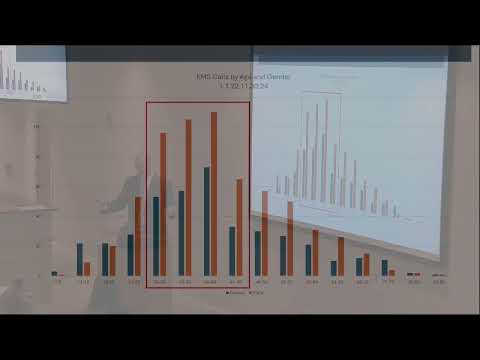
Discussion and data presented County staff and outside consultants reviewed local overdose data, settlement rules and early local work. Eppley and health department staff showed an ArcGIS heat map of 911 calls flagged for suspected opioid overdoses from January 2022 through November 2024; Eppley noted repeated addresses and a concentration along the I‑40 corridor. The county’s EMS and 911 coding flag suspected overdoses on dispatch, giving staff a dataset intended to support targeted prevention. Eppley told the board the county is “approaching the intersection of really a lot of valuable information” to guide where services should be deployed.
Nitty Sachdeva of NCACC/OSTAT described the state MOA’s reporting requirements and the differences between Option A (immediately eligible, higher‑impact, person‑centered strategies) and Option B (broader system and prevention strategies that require a documented collaborative planning process). She described the settlement funding as a multi‑year, mostly front‑loaded stream that allows counties to plan for sustainability rather than one‑time grant cycles.
Community partners and consultants also briefed the board. Tony Young, executive director of Community Education Group, urged a broad, syndemic approach that links behavioral health, infectious disease (hepatitis C, HIV) and workforce development. The Fletcher Group is completing a regional recovery ecosystem analysis for the county and nearby jurisdictions; that report was described as forthcoming.
Implementation and next steps Commissioners asked staff to return with specific recommendations and cost estimates for the Partners capital plan, including options to reuse existing public buildings or school facilities if feasible. Partners and county staff said they will develop a more detailed project plan and a funding/lease structure to present to the board.
The county will continue the collaborative strategic planning steps required by the MOA before seeking to expand into Option B. Staff reported $1.7 million in grant awards obtained to date to seed several local efforts; those grant funds were used before tapping settlement revenue in several pilots.
Votes at a glance - Approve agenda: motion by Mr. Trout; outcome recorded as unanimous (procedural, early in meeting). - Fund opioid settlement coordinator for three years (reporting to county manager): motion by Commissioner Baron; outcome 5‑0. Salary and recruitment details not specified in the motion record. - Direct Partners Behavioral Health to develop facility plan for $6.25M LME‑MCO capital funds and to submit scope to the state: motion by the chairman; outcome 5‑0. County retains title to any facility improvements; Partners to propose operating/lease options. - Direct staff and new coordinator to prioritize Option A strategies and return to board before pursuing Option B: outcome 5‑0. - Establish and appoint a 13‑member opioid advisory committee: multiple nominations and votes; appointments recorded as unanimous for each seat. (Full list of appointees and vote tallies in the meeting minutes.)
What the record does not specify The board approved direction and initial funding for a coordinator but did not record a salary, manager‑level job description, or an immediate hire date; those operational details were left to county staff. The Partners plan was approved in concept; the precise site, procurement approach (lease, purchase or rehab) and final project budget were to be developed and returned to the board for formal approval.
Context and caution Nitty Sachdeva emphasized the MOA’s constraints: settlement funds must be used for opioid‑related strategies (the MOA explicitly prioritizes people with opioid use disorder, while allowing services for co‑occurring conditions where opioid history is present) and require ongoing public reporting through the North Carolina settlement dashboard (ncopioidsettlement.org). Commissioners and staff repeatedly noted the need to combine short‑term lifesaving actions (naloxone distribution, EMS‑linked post‑overdose response) with longer‑term recovery and housing supports.
Ending note Commissioners said they want frequent updates, quick movement on high‑impact pilots, and a transparent process for the Partners capital plan and coordinator hiring. The board asked staff to return with concrete, line‑item proposals once Partners completes a site and scope analysis.