Get Full Government Meeting Transcripts, Videos, & Alerts Forever!
Get email alerts on the Beach Nourishment Easements topic
No spam. Unsubscribe anytime.
Pinellas County urges property easements to move Sand Key beach nourishment forward
Summary
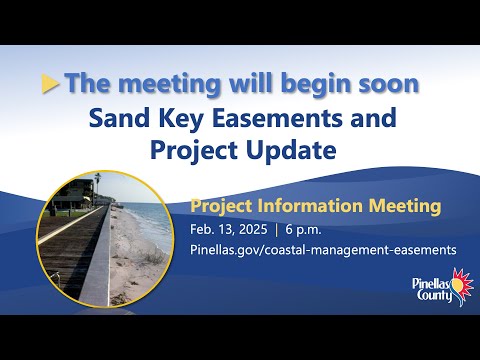
Pinellas County officials on a public webinar said the county cannot begin full beach renourishment on the Sand Key segment unless property owners sign construction easements that permit design, construction and periodic maintenance.
Pinellas County officials on a public webinar said the county cannot begin full beach renourishment on the Sand Key segment unless property owners sign construction easements that permit design, construction and periodic maintenance.
"Plain and simple, we need to get our beach nourishment projects done," Pinellas County Commissioner Kathleen Peters said. "We need sand for storm protection, for property values, for tourism." Peters urged residents to sign easements and to press neighbors and city officials to do the same.
County Public Works Director Kelly Hammer Levy and coastal management coordinator Dr. John Bishop explained why easements are required and how gaps are blocking a constructible project. Bishop said the county currently needs 208 easements in the Indian Rocks Beach–Indian Shores–Reddington Shores section and that existing holdings leave insufficient continuous rights to build the full project. "If we don't have enough easements to have a constructible project, then we can't build a project," Bishop said.
Why it matters: The Sand Key project is part of a federally authorized program the Army Corps of Engineers historically cost-shared at about 65 percent; county staff said the federal office has not yet issued guidance under the Water Resources Development Act of 2024 that might allow a one-time federal nourishment. Without the Corps, the county is preparing a parallel, county-led project funded primarily with tourist development (hotel bed) tax revenue and whatever grant funding the county can secure.
What officials say the easements permit: Levy said the county is seeking construction easements that allow ingress/egress for contractors, placement of sand, periodic nourishment, monitoring and related work but — unless a property owner signs dune language — do not grant public access or public use rights. "If it doesn't say public access and use, then public access and use isn't in there," Levy said. County staff said the mailed easement packages included a cover letter explaining how to request a version that excludes dune construction.
Project timing and scope: Staff said design and permitting typically take two to three years, construction of the full Sand Key segment can take roughly a year once underway, and periodic nourishment cycles recur about every five to six years. Bishop described a typical engineered profile: a broad beach berm at about 5 feet elevation and an optional dune crest near 10 feet, with shoreline advance on the order of roughly 200 feet from the waterline in many locations. The county identified Egmont Shoal as the planned offshore borrow area used in recent Sand Key projects.
Deadlines and process: County staff said they mailed easement packages in December and are aiming to have signed easements in hand by the end of the month to meet contracting and permit timelines; Commissioner Peters said the county could put the project out to bid as early as March if easements and permitting align. Staff also said they have a draft emergency permit and that an emergency permit normally gives one year to complete the work, requiring the county to move rapidly if permitted.
Options and limits: Panelists said the Army Corps has been consistent in requiring easements landward of the erosion-control line for future nourishment, and that temporary easements used previously are not acceptable for ongoing nourishment. Levy said eminent domain has been used elsewhere but that the scale here—more than 200 parcels—makes that approach impractical. If easements remain unsigned in sections, the county would be able to place sand only where continuous easements exist, producing gaps that reduce the protective benefit.
Environmental and permitting notes: Staff said dredged-borrow areas and construction are regulated and require biological monitoring (sea turtles and shorebirds were cited). They said past nourishment activity correlated with increased turtle nesting in years when a full project existed, and that county contractors coordinate with Clearwater Marine Aquarium during nesting season.
How to sign or check status: County staff directed property owners to signforsand@pinellas.gov and to a public dashboard (Pinellas County Coastal Management project page) that shows properties color-coded: green for prior Army Corps easements, blue for the new county-requested easements (no public-access language), and red for properties without easements. Staff said notaries are available and that city halls may host signing events by arrangement.
Community context and next steps: Commissioner Peters and staff repeatedly urged residents to talk with neighbors because continuous stretches of signed easements are needed for dune construction and for a constructible beach. Officials said they will continue to press the Army Corps for federal guidance while preparing the county-led funding and contracting path if necessary. No formal vote or new ordinance was taken during the meeting.