Get Full Government Meeting Transcripts, Videos, & Alerts Forever!
Get email alerts on the Housing topic
No spam. Unsubscribe anytime.
Madison officials set aggressive housing goal, unveil public tracker and funding tools
Summary
City planning staff told the Plan Commission the administration seeks 15,000 new homes in five years with one-quarter legally committed as long‑term affordable; staff demonstrated a public housing tracker and outlined financing tools including the Affordable Housing Fund, TIF, and CDA activity.
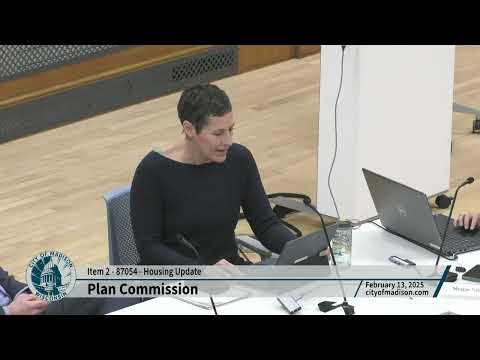
Heather Strouder, a planner with the City of Madison Department of Planning, Community and Economic Development, told the Plan Commission that city staff have set “a really aggressive goal for the next five years” to add 15,000 new homes and that roughly one quarter of those should carry long‑term affordability commitments.
The update, delivered at a Plan Commission meeting, included a demonstration of a public housing tracker that staff said will show units under construction and units completed, and a discussion of the city’s financing and regulatory tools — notably the Affordable Housing Fund, tax increment financing (TIF), and Community Development Authority (CDA) projects.
The goal and tracker are intended to respond to what Strouder described as “pretty dramatic housing need in the city and the county, actually,” and to raise Madison’s vacancy toward a healthy 5–6 percent level. Staff said the city is counting all housing units (apartments, condos, accessory dwelling units) toward the 15,000‑unit target for the five‑year period through 2030, and that the city’s working definition of long‑term affordability is commitments stretching multiple decades (commonly 30 to 40 years).
Strouder highlighted recent city investments: “In the past three years alone, we’ve committed nearly $60,000,000 as a city to developers to support 1,700 long term, affordable rental homes,” and staff reported the city has secured properties expected to support roughly another 1,700 affordable homes. She said the mayor’s update to the Housing Forward initiative includes a proposed commitment of $32,000,000 from the city’s Affordable Housing Fund over the next two years.
Matt Wachter, director of the Department of Planning, Community and Economic Development, summarized tools the city can use and important legal limits. “We can’t do anything that looks at all like rent control. So this is in the Wisconsin Constitution,” he said, describing the local legal environment as “carrot only” — meaning the city must rely on incentives, subsidies and regulatory incentives rather than direct price controls. Wachter described how layered financing typically works: federal low‑income housing tax credits are often the largest source of subsidy, and city funds or TIF can fill remaining financing gaps.
Staff demonstrated the housing tracker and said it draws primarily on building permit data from the city’s Building Inspection Division. At the time of the presentation staff noted about 100 homes completed so far this year and roughly 4,400 units under construction; the tracker’s three pages show an overall progress gauge, a map of projects by location and a page summarizing legally limited affordable housing added over the last decade.
Commissioners asked several technical and policy questions during the discussion. Staff acknowledged limits in the permit data — the permits do not reliably distinguish condos intended for ownership from rental projects — but said the tracker can display ownership type when the information is available from other sources and that accessory dwelling units are now being tracked in more detail (tracking for ADUs began in 2024). Staff also said they are experimenting with visualizations that show building sizes, the location of city‑supported affordable housing, and the mix of funding sources used on projects.
Wachter described additional financing mechanisms the city uses: TIF for infrastructure and, in some infill districts, to acquire and bank parcels for future housing; direct down‑payment assistance and small owner‑repair loans that target individual households; and projects where the city or CDA acts as developer or long‑term owner (the CDA’s Triangle site was cited as preparing to break ground). He noted the city’s Affordable Housing Fund has helped scale production — prior to the fund the city averaged roughly 10–15 affordable units per year; with consistent funding, production has increased to hundreds per year in recent years as tax credit deals and other large projects come online.
On public housing, staff said the CDA is beginning a phased approach to evaluating the city’s public housing portfolio and has engaged outside consultants to help assess which sites should be redeveloped and how federal program rules might be applied to preserve long‑term affordability while financing redevelopment.
Staff concluded by inviting Plan Commission members and the public to use the housing tracker and to provide feedback on data or display improvements. They said the tracker will continue to be refined and that staff will update population projections and other inputs as regional planning work progresses.