Get Full Government Meeting Transcripts, Videos, & Alerts Forever!
Get email alerts on the Air Quality topic
No spam. Unsubscribe anytime.
Southwest Ohio Air Quality Agency warns Middletown may face federal PM2.5 nonattainment; local monitors show overnight spikes
Summary
Carrie Caslin of the Southwest Ohio Air Quality Agency briefed the Middletown Board of Health on monitoring around local steel and coke facilities, noted a tightened federal PM2.5 standard that could push the area into nonattainment, and described recent enforcement and complaint activity at Cleveland-Cliffs, Middletown Koch and Stein.
Carrie Caslin, an environmental specialist with the Southwest Ohio Air Quality Agency, told the Middletown Board of Health on Feb. 11 that recent monitoring near local steel and coke facilities shows elevated fine particulate levels and overnight spikes that may push parts of Hamilton and Butler counties into nonattainment for the updated federal annual PM2.5 standard.
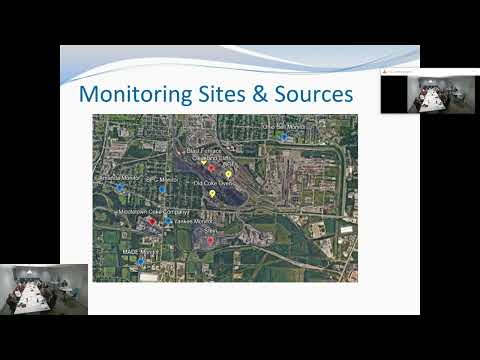
Caslin said the U.S. Environmental Protection Agency last year revised the annual PM2.5 standard from 12 micrograms per cubic meter to 9, and that the Yankee Road and BPG monitors in Middletown “are above [the] annual standard right now,” making the region look likely to move toward nonattainment. She said that determination would trigger additional actions the state and local air agencies must take.
Why it matters: Nonattainment status would require statewide and local planning and could bring new regulatory and mitigation steps — historically including motor-vehicle controls or inspections — that affect industry, transportation and public programs. Caslin said many industrial emissions have fallen over decades, and that the next large sector for emission reductions is mobile sources (cars, trains, planes).
Caslin described recent enforcement and compliance history around Middletown facilities. She said Cleveland-Cliffs received a notice of violation about a year ago after failing a required stack test but subsequently submitted an action plan, retested and returned to compliance. Middletown Koch recently received a notice of violation after failing a stack test for particulate from a heat-recovery coke oven and a pushing/changing machine. Stein, which processes slag from Cleveland-Cliffs, has been the subject of nuisance and record-keeping violations in the past; its enforcement case required an operations-and-maintenance plan, installation of high-definition cameras and a civil penalty of $40,500 that the agency said goes to Ohio EPA and local air program improvements.
Caslin said the agency operates multiple monitoring sites in Middletown because of emissions from Middletown Koch, Cleveland-Cliffs and Stein. She described resources the public can use — the agency website’s real-time mapping and the Air Quality Index (green/yellow/red guidance), EnviroFlash and EQS — and urged residents and the health department to use the data when deciding whether to limit outdoor activity on high-pollution days.
Board members asked about possible remedies if the area is designated nonattainment. Caslin emphasized that decisions about broad control measures (for example, vehicle inspection programs or other mobile-source strategies) would be made at the Ohio EPA or state level; local air agencies would implement and enforce any resulting rules. She also said that many major industrial emissions have already declined over decades and that future reductions are likely to come from cleaner vehicles and fuels.
Caslin described complaint response work in Middletown: last year the agency recorded roughly 31 complaints attributed to Cleveland-Cliffs and about 20 complaints related to Middletown Cove, most involving odor. The agency is forming an internal “Middletown work group” to coordinate complaint response, ambient monitoring and inspections; she said staffing changes and retirements require training new inspectors to enter and inspect large facilities. She offered the agency as a partner to the Middletown Health Department for complaint referral and public communication.
The presentation closed with Caslin reiterating that air pollution carries health risks — asthma, cardiovascular impacts and premature death — and that the long-term regional trend has been declining pollutant concentrations but is flattening; the agency will continue monitoring and enforcement work as standards tighten.