Get AI Briefings, Transcripts & Alerts on Local & National Government Meetings — Forever.
Senate committee advances 'Ricky and Alyssa's Law' to require classroom panic alarms and school mapping
Loading...
Summary
A Senate committee advanced Senate Bill 17, dubbed "Ricky and Alyssa's Law," which would require wearable panic alarms in classrooms and create a school-mapping program for first responders; state emergency-management officials and public-safety groups urged careful technical standards and attention to 9-1-1 center readiness.
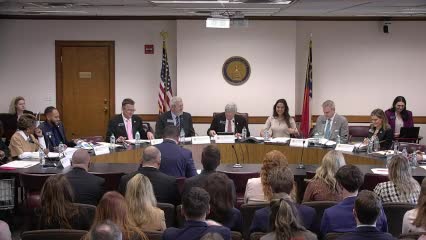
Senate Bill 17, known in committee as "Ricky and Alyssa's Law," was advanced out of the Senate Education and Youth Committee after sponsors and multiple witnesses described two core requirements: mobile/silent panic alarms for classrooms and a statewide school-mapping program to help first responders find rooms, equipment and access points during emergencies.
The bill’s author said the wearable alarm systems, which can be triggered discreetly, connect directly to public-safety answering points and are already in use in more than half of Georgia schools and in the state capitol. The author told the committee the mapping component would include building floor plans, aerial imagery and labeled locations of utility boxes, AEDs and other key infrastructure so that responding agencies can access that data quickly.
Why it matters: supporters said the measures shorten response time in active-threat and medical-emergency situations and improve situational awareness for responders who may be unfamiliar with a campus. "Time equals life," Bridal Hadeff, founder of the nonprofit Make Our Schools Safe and mother of Alyssa Alhadeff, said in testimony in support of the bill.
What supporters told the committee: Bridal Hadeff, who identified herself as Alyssa’s mother, said the wearable alarms "directly links to law enforcement in a life threatening emergency" and that the devices "help not only during active-threat situations, but also during medical emergencies, weather events, and other essential notifications." Shaina Aspinwall, who identified herself as the wife of Ricky Aspinwall and a classroom teacher, said teachers "want safer schools" and supported the bill as an educator and parent.
Technical standards and 9-1-1 readiness: witnesses urged careful specification of technical formats and data-sharing so maps are interoperable with public-safety systems. William McCullough of GeoComm urged use of the civic location data exchange format to ensure interoperability with 9-1-1 systems and recommended removing a requirement that only third-party contractors validate maps, saying school staff are best positioned to update ground truth. Alicia Wright, deputy executive director for the Georgia Emergency Communications Authority with GEMA Homeland Security, said maps should be available in multiple formats (printed and electronic) because many local 9-1-1 centers still lack next-generation 9-1-1 infrastructure and might need workarounds to use advanced formats.
GEMA and legal issues: committee counsel and GEMA staff explained the bill includes immunity language they retained from prior drafts that, according to the author, shields public, private and local government entities from some civil liability related to the mapping piece. Anna Burton, general counsel for GEMA Homeland Security, said that if a school system outsources security to a private contractor, that contractor would be considered an "authorized emergency first responder" under the bill as drafted and should be included in school safety plans so local law enforcement and schools know the vendor will respond.
Public-safety endorsement and implementation concerns: Butch Ayers of the Georgia Association of Chiefs of Police and Alex Carney of Critical Response Group described mapping as a practical operational tool for incident command, daily event planning and routine emergencies as well as active-threat responses. Carney emphasized the value of on-site walk-throughs to keep floor plans accurate; he and other witnesses warned that inaccurate maps can create operational risk at a scene.
Budget and rollout: the bill’s sponsor referenced state school-safety funding included in recent budgets and the governor’s FY25 proposals for additional one-time funding. The sponsor said there is base budget funding for school safety infrastructure and a proposed $50 million addition in the governor’s amended budget; the sponsor characterized the panic-alarm technology and mapping as relatively low-cost compared with the potential benefit of saving lives. Specific grant or allocation procedures are not specified in the committee record.
Action: the committee took a motion to advance the bill. Senator James moved that SB 17 be reported favorably; Senator Sam seconded. The motion carried and the bill was advanced out of committee. The transcript does not record a detailed roll-call tally in the committee minutes provided.
Next steps: supporters and several technical witnesses recommended follow-up amendments in committee to clarify mapping formats, validation processes and definitions for "neighboring properties," and GEMA staff said they are available to refine technical language before floor consideration.