Get Full Government Meeting Transcripts, Videos, & Alerts Forever!
Get email alerts on the Broadband Deployment Bead topic
No spam. Unsubscribe anytime.
State broadband update: Georgia reports major federal funding, thousands of BEAD-eligible locations
Summary
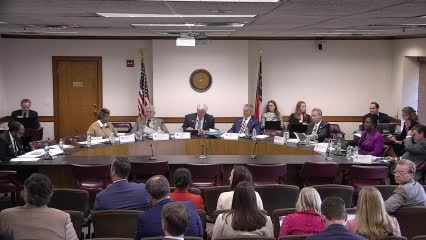
State broadband officials told the Senate Regulated Industries and Utilities Committee on Feb. 14, 2025, that Georgia has assembled a mix of federal and state funding and is targeting tens of thousands of locations for high-speed upgrades.
State broadband officials told the Senate Regulated Industries and Utilities Committee on Feb. 14, 2025, that Georgia has assembled a mix of federal and state funding and is targeting tens of thousands of locations for high-speed upgrades.
Jessica Simmons, representing the Georgia Technology Authority, said Georgia has received a BEAD (Broadband Equity, Access, and Deployment) allocation of just over $1.3 billion and had identified 71,776 BEAD-eligible unserved locations and 93,298 underserved locations after the statemapping and challenge process. Simmons said the statealso currently has roughly $660 million in projects already in flight from earlier state allocations (federal ARPA-funded State Fiscal Recovery Funds and a capital projects fund) and that those programs, plus anticipated BEAD awards, put Georgia close to covering the remaining eligible locations.
Simmons outlined the stateprocess: Georgia updated a mapping platform (latest iteration released in June of the prior year), ran a challenge process so providers and local governments could correct coverage claims, secured NTIA (National Telecommunications and Information Administration) approvals for planning and grant documents, opened BEAD Round 1 applications on Dec. 1 and closed them in January, and is currently scoring applications. She said the state used $5 million in BEAD planning funds for operations and deliverables and expects to announce Round 1 awardees in spring.
Simmons said prior state actions included an ARPA allocation of roughly $415 million (about $254 million disbursed so far) to serve roughly 75,000 locations and a capital projects fund of $246 million (about $20 million disbursed so far) to serve roughly 80,000 locations. Those combined awards and matching private funds produced about $1.2 billion of projects already underway, she said. Projects from those earlier programs must complete by the end of 2026, she said.
Georgiaofficials emphasized technology standards and program rules. For prior state-funded grants, the program requirement was 100 Mbps symmetrical; the BEAD program requires proposals to meet a minimum of 100/20 Mbps but the state is evaluating proposals for higher tiers (many proposals aim for gigabit or multi-gigabit service and fiber builds). Simmons cautioned that BEAD includes a high cost-per-location threshold that could require negotiations, alternative technologies, or later funding rounds to address locations deemed financially infeasible for fiber.
Representatives of electric membership corporations (EMCs), rural telephone companies and private ISPs described deployment activity and partnerships. Jason Bragg of Georgia EMC said 25 of the states 41 EMCs are now providing broadband services in some form; EMC-associated projects currently pass roughly 267,000 homes and businesses, with about 80,000 current subscribers and about 28,000 miles of fiber built to date. Bragg estimated planned EMC investment at roughly $1 billion (noting inflation could raise costs) and said most EMC projects are fiber-based.
Rhonda Chatham of the Rural Telephone and Broadband Association (GTBA) said association members reported substantial fiber deployment: association-wide, roughly 80% of passed locations are fiber to the home and many members now offer multi-gig service. She reported association data showing growth in "locations passed" from 92,000 in 2022 to 361,000 in 2024 (association figures) and said the group is focused on sustainable, resilient builds in rural areas.
Michael Fore of Windstream said the company has invested heavily in Georgia and expects to complete an additional build of about 100,000 homes this year as part of a multibillion-dollar company investment plan. Fore and other providers praised state coordination and the Georgia Technology Authorityfor negotiation and program design.
Officials noted risks and next steps: BEAD requires additional federal guidance from NTIA to finalize some program rules; permitting (including potential NEPA processes) and supply-chain constraints could affect schedules; and the state will use negotiations and a possible second, targeted funding round where needed to reach more costly locations. Georgia also received about $22.5 million for a State Digital Equity Capacity Grant, officials said, to support adoption, devices and training.