Get Full Government Meeting Transcripts, Videos, & Alerts Forever!
Get email alerts on the Energy Infrastructure topic
No spam. Unsubscribe anytime.
Columbia Gas presents pipeline replacement, regulator station plans at Upper Arlington hearing; residents press safety and routing concerns
Summary
Columbia Gas of Ohio told Upper Arlington City Council on Jan. 27 that federal safety rules require replacement of a transmission-class pipeline and installation of updated regulator stations at Brandon Road and Ridgeview; residents urged rerouting, questioned notice and school proximity.
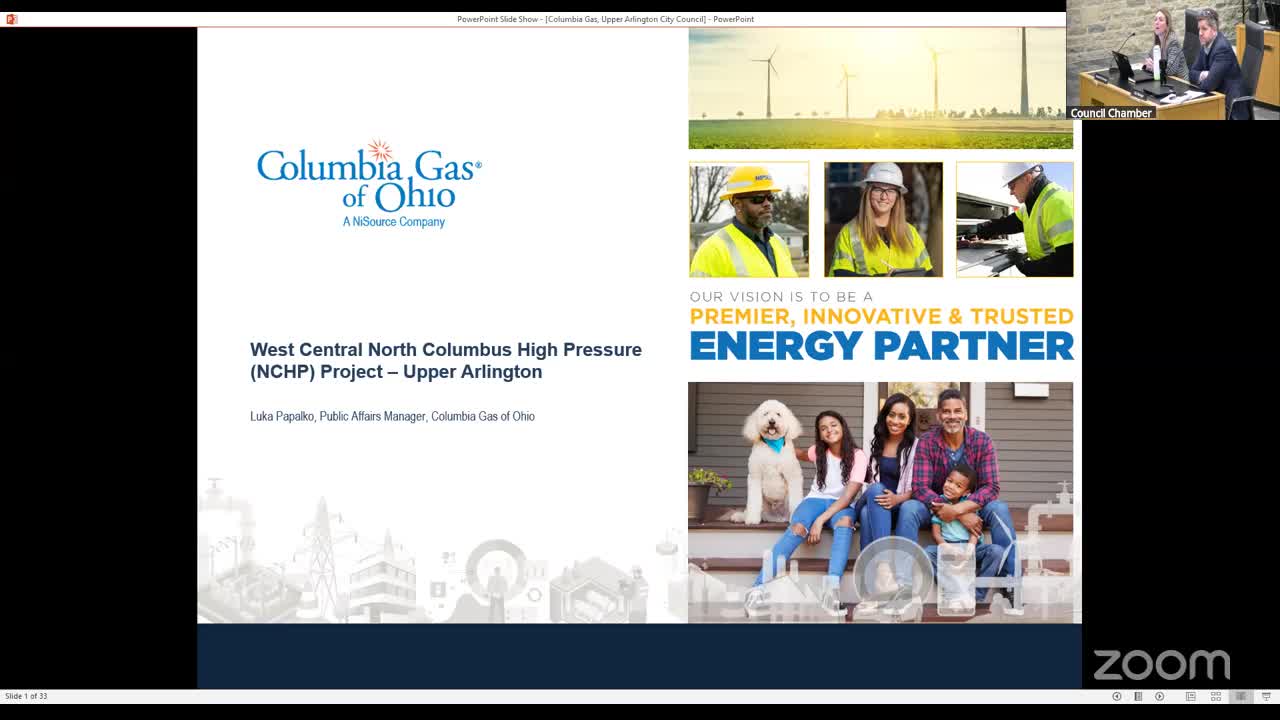
Columbia Gas of Ohio said the company will replace about 2.4 miles of transmission-class pipeline through Upper Arlington and build updated regulator stations at Brandon Road and Ridgeview, company spokesman Luca Papelco said during a Jan. 27 city council hearing. The project, the company said, is driven by federal pipeline safety rules and is intended to add modern safety and monitoring equipment.
The company, joined by City Manager Steve Shoney and Community Development Director Chad Gibson, presented a project overview and schedule and answered questions from council and residents. Columbia Gas said the work stems from new requirements issued by the U.S. Pipeline and Hazardous Materials Safety Administration (PHMSA) and the Ohio Power Siting Board (OPSB). "This is not an elective project. This is a compliance based project," Papelco told council.
The company said the replacement pipe will be the same nominal diameter as the existing line (20 inches) and that normal operating pressure will be similar to today’s levels; the new material and site upgrades will increase the pipeline’s tested maximum operating pressure, which the company described as additional margin rather than higher routine pressure. Columbia Gas described several safety upgrades required by PHMSA: inline inspection capability (so-called "pigging"), automatic shutoff valves at intervals along the pipeline, computerized monitoring and leak detection, and more rigorous inspection and cathodic protection. "These shutoff valves essentially say if the pressure is above or below a certain level, we automatically shut off," Papelco said.
City staff outlined the local review steps. Community Development Director Chad Gibson said utility stations are a conditional use in several residential districts under an ordinance the city adopted in 2020; a conditional-use review by the Board of Zoning and Planning (BZAP) will evaluate site design, setbacks, screening and nine general standards plus four utility-specific standards. "We distinguished between utility stations and utility structures," Gibson said. He described a process that includes a third‑party architect review of renderings and master plan examiner review of building plans as part of the city permit process.
Public service director Gary Wolfong described the city’s role on right‑of‑way permitting, traffic maintenance plans and inspection during construction. He warned that the city’s pavement policy — generally no new cuts in recently paved streets for five years — required coordination with the city’s capital projects, and said Columbia Gas agreed to reimburse the city for additional maintenance costs on certain streets because the city adjusted its schedule to avoid repeated pavement work.
Columbia Gas said it has filed the pipeline application with OPSB (filed Nov. 26) and that the company plans public office hours and design feedback sessions. Papelco said the company will hold construction outside the school year where possible and will stage construction equipment offsite. He also said the company purchased property at Ridgeview and holds a purchase agreement for the Brandon Road parcel; after construction the company said it expects to abandon (cut, cap and retire in place) older pipe segments.
Residents who spoke during public comment urged the city and Columbia Gas to consider alternative routes, and several speakers voiced concern about the Ridgeview regulator station’s proximity to Upper Arlington High School and to nearby homes. Derek Ensign called regulator stations "bombs" and questioned mechanical fail‑safes; Susan Miller and Dennis Bethel said they first learned project details from surveyors and state filings rather than early outreach. Sally Francis, citing the PHMSA definition of a "high consequence area," asked that Columbia Gas reroute the line away from the high school. Several residents criticized notification and early community engagement.
City council members pressed Columbia Gas on why two regulator stations are proposed rather than one and on safety and oversight. Columbia Gas representatives said the Brandon and Ridgeview facilities serve separate functions: Brandon will be repurposed to provide inline inspection (pig launcher/receiver) while Ridgeview will include inlet/outlet pressure reduction, monitoring, an automatic shutoff valve, a heater and other safety equipment. The company said the facilities are sited for connectivity to the distribution network and for lot size and setback requirements, not for operational expansion in local demand.
Regarding oversight, Columbia Gas and its consultant said the project must comply with PHMSA rules; the company also described coordination with the Ohio Power Siting Board on the pipeline application and said the Public Utilities Commission of Ohio and the OPSB review design and safety details. An engineer representing Columbia Gas, design consultant Corey Oliver, said he is a professionally licensed engineer and will sign off on the station designs. Community Development Director Gibson said BZAP will apply the city’s conditional‑use standards and that building plans would also be reviewed by a master plan examiner (a certified commercial/industrial plan reviewer) before permits are issued. The city also said it will require third‑party inspection and will seek reimbursement for inspection costs as part of the permit and right‑of‑way agreement.
Columbia Gas offered site renderings and said it is working with a local architect for aesthetics; the company said typical noise estimates for the Ridgeview site at maximum operating conditions would be about 40 dB at the property line, comparable to a refrigerator. Company representatives said they intend to screen sites with landscaping and to avoid excessive security lighting and that heaters and other exposed equipment require fencing and access controls; Columbia Gas said it typically secures exposed equipment with fences but has offered to work on fence design with the city and community to reduce visual impacts.
What happens next: Columbia Gas said the pipeline application remains under OPSB review; the company said it will submit a right‑of‑way permit and maintenance‑of‑traffic plan to the city, and it will pursue BZAP conditional‑use approval and building permits for the regulator stations. City Manager Steve Shoney told council the city has formally intervened in the OPSB case to preserve the city’s right to file comments or objections through that state process.
Columbia Gas and city staff said they will continue community outreach, including office hours at the library and feedback sessions on design. Council members and staff encouraged residents to use the project website and the company’s project hotline and email for direct questions.
Residents and council members asked the city to track any third‑party reviews, permit conditions and post‑construction inspections closely and to make reports available to the public.
Ending: Columbia Gas emphasized the replacement is being driven by federal safety rules and framed the work as an upgrade rather than a capacity expansion. City staff said the formal local review will center on site design and public‑safety compliance under city code, with federal and state agencies responsible for pipeline safety oversight. Council and staff told residents they will continue to seek more detail and inspections as permit applications move forward.