Get Full Government Meeting Transcripts, Videos, & Alerts Forever!
Get email alerts on the Housing topic
No spam. Unsubscribe anytime.
Westerville staff seek council OK to update community plan, prioritize South State Street and housing pilot
Summary
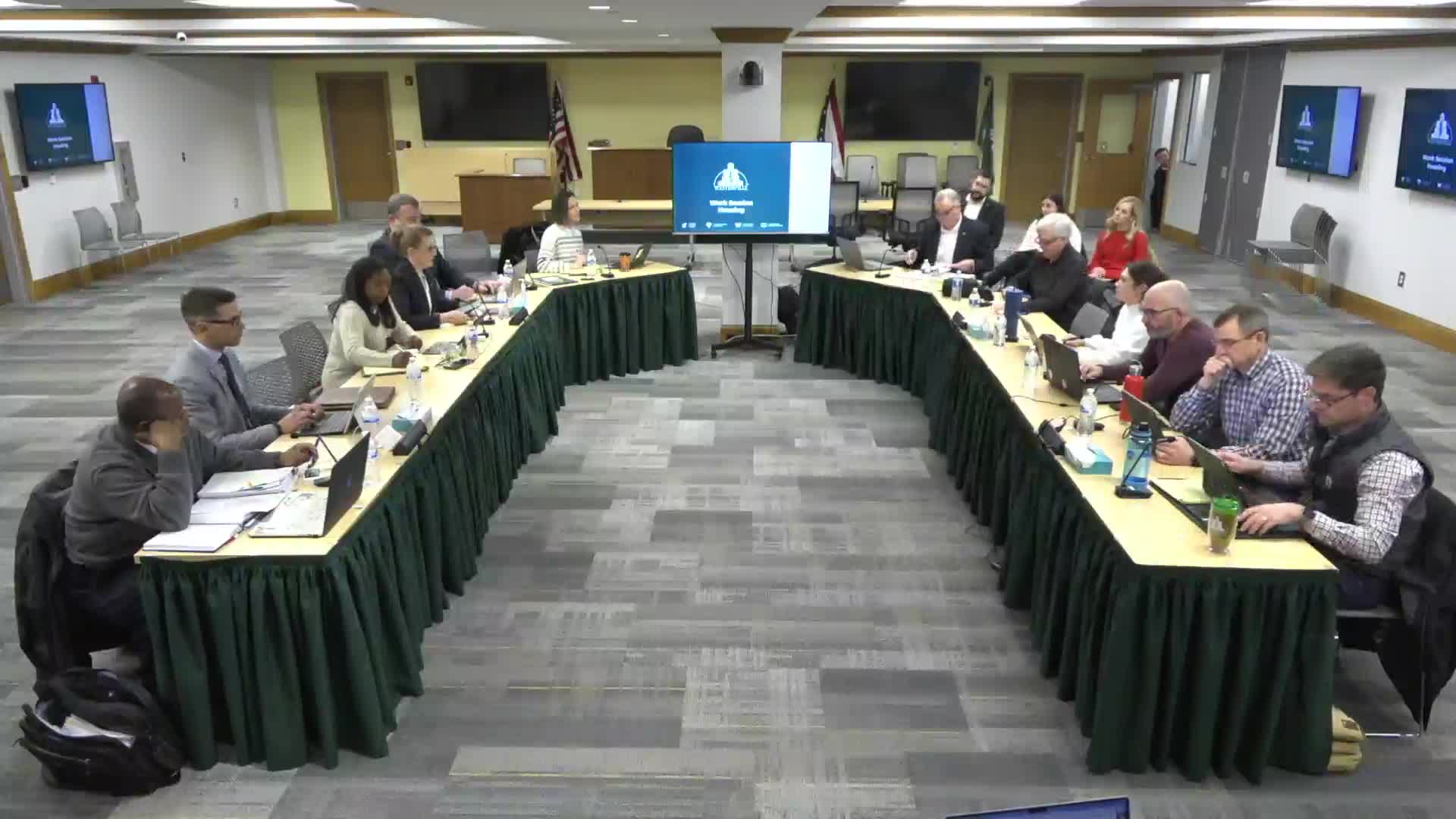
At a Feb. 11 work session, Westerville planning staff summarized recent housing work — from ADU changes and a home-repair grant pilot to regional coordination — and asked council to endorse a three-phase community plan update with South State Street as the first focus area.
Westerville planning staff told the City Council at a Feb. 11 work session that they are prepared to update the city’s comprehensive plan and pursue targeted zoning changes and focus-area planning, starting with the South State Street corridor, to help preserve naturally affordable housing and expand housing options as the region grows.
Staff said the effort will run in three parallel tracks: a phased update to the 2016 comprehensive plan, a South State Street focus-area plan to be done concurrently with phase 1, and a set of targeted zoning code fixes and pilot projects (including the home-repair grant). The presentation laid out recent local housing data, existing tools such as the density-bonus planned-unit district, and barriers developers report on infill and mixed-use projects.
The city frames the work as a mix of preservation and production: keep older, naturally affordable homes in good repair while testing targeted ways to add missing-middle and mixed-use housing in defined areas where market momentum exists. "We hope that by the end of this presentation, you will agree with us that we have made progress on our policy housing policies," Staff member Monica said, asking council for direction to proceed with the parallel planning and code work.
Staff and data highlights - Local housing stock and affordability: Staff reported roughly 15,878 housing units in Westerville, about three-quarters owner occupied and one-quarter renter occupied. Staff said about 220 Westerville residents use housing choice vouchers and the market contains roughly 250 units financed through the Low Income Housing Tax Credit (LIHTC) program. - Naturally occurring affordable housing (NOAH): Presenters emphasized that much of Westerville’s affordability is tied to older housing stock. "The emphasis on preservation of our housing stock is part of affordable housing solutions," Deputy Director Ben Keppel said during his summary of the speaker series and grant work. - New housing and projects: Staff estimated recent development has added about 1,600 new housing units in the last several years and noted a cluster of additional units awaiting development, including a potential apartment project on the city-owned 64 East Walnut Street site. - Home-repair grant pilot: The city launched a locally funded home-repair grant program intended to preserve aging units. Staff reported 74 households have entered the program queue so far and five projects have completed work. The program was described as a five-year pilot with direct payments to contractors rather than reimbursements.
Zoning, ADUs and targeted code changes Staff urged a limited set of zoning code changes that could make accessory dwelling units (ADUs) and small-scale infill easier without a full rewrite of the code. Planning staff member Elise Schellen identified three near-term priorities: eliminate a legacy 10-foot separation requirement between principal and accessory structures, reduce certain rear-yard setbacks (for example, from 20 feet to 15 feet in R-1), and raise accessory-structure height limits to allow second-floor ADUs above garages. "These items come up again and again at the Board of Zoning Appeals for variances," Schellen said, adding that the changes would cut approval time for small projects.
Focus-area approach and South State Street Council and staff agreed to use a focus-area approach that produces granular, site-specific guidance for redevelopment. Staff proposed South State Street as the first focus area because of existing market momentum and the city-owned 64 East Walnut Street parcel, which staff said could act as a catalyst. "We think that by having South State Street as the focus area and doing that granular work…that could domino effect the rest of South State Street," Dave (staff member) said when describing the timing and sequencing.
Staff outlined a three-phase timeline: (1) a 12–18 month assessment of the existing comprehensive plan and immediate focus-area planning for South State Street; (2) demographic updates and additional focus-area planning (Brooks Edge was suggested as a next possibility); and (3) a full community-plan update with public engagement and recommended implementation tools. Staff said some strategic zoning updates would be brought forward in the next 12–18 months rather than waiting for a full code rewrite.
Jobs-housing ratio and regional perspective Presenters reviewed the jobs-to-housing discussion and the limits of using that ratio for local policy. Staff noted the metric is most useful at a regional scale and that Westerville functions inside a larger labor shed: the city has concentrated employment centers and a broad regional commute field that private employers use when recruiting. Rachel Ray (planner) explained how 20- and 30-minute drive sheds are used as a proxy for employer site selection.
Regional coordination and funding challenges Staff described a regional housing coalition initiative and said the city has participated in regional strategy work. Presenters and council members discussed federal funding programs such as Community Development Block Grant (CDBG), HOME, and LIHTC. Staff cautioned there is uncertainty in federal grant programs and that LIHTC is highly competitive; they stressed that locally administered tools such as the home-repair grant can be more flexible.
Council response and next steps Multiple councilmembers signaled support for the three items staff requested: confirmation that progress is being made, agreement that the direction aligns with city goals, and approval to proceed with the budgeted work plan for the plan update, South State Street focus area, and targeted zoning changes. Councilmember Ken (Councilmember) raised concerns about affordability for lower-income households and quoted the study finding that "households earning below $40,000 a year likely would have extreme difficulty finding a place to live in Westerville," underscoring the staff emphasis on preservation and grant assistance for older housing.
Staff said they would begin the South State Street focus-area work concurrent with the phase-1 assessment, bring the targeted zoning code changes to council in the next 12–18 months, and return with periodic updates on the home-repair pilot. The council did not take a formal recorded vote during the work session; staff recorded a clear direction from council to proceed with the proposed parallel approach.
Ending Staff will start the South State Street focus-area work concurrent with the phase-1 comprehensive-plan assessment and return to council with draft zoning proposals and program updates for the pilot grant at regular intervals during the budget cycle.