Get Full Government Meeting Transcripts, Videos, & Alerts Forever!
Get email alerts on the Fourth Amendment topic
No spam. Unsubscribe anytime.
East Lansing training summarizes Fourth Amendment standards, surveillance tools and police stop rules
Summary
At a community training in East Lansing, lawyer and Independent Police Oversight Commission member Kathy Swedlo reviewed Fourth Amendment basics — what counts as a search or seizure, when warrants are required, common warrant exceptions, and emerging questions about GPS, thermal imaging, license-plate readers and phone data.
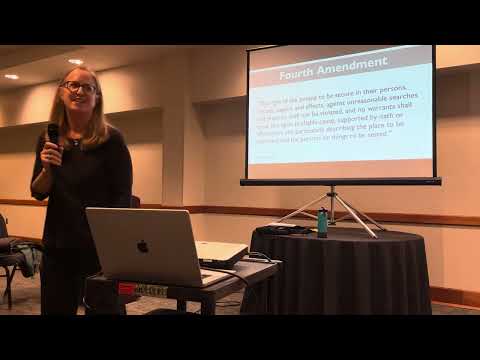
Kathy Swedlo, a lawyer and member of the East Lansing Independent Police Oversight Commission, led a community training that compressed core Fourth Amendment law into a two-hour session and walked attendees through how courts decide when police may search or seize people, places or things.
The training focused on why the Fourth Amendment matters locally: it governs when searches and seizures are “reasonable,” and it is the constitutional standard the U.S. Supreme Court uses to judge claims of excessive force. "The Fourth Amendment only cares about unreasonable search and seizure activity," Swedlo told the group. "If you have an interaction with a police officer and it does not meet the definition of search or does not meet the definition of seizure, the Fourth Amendment doesn't care."
Swedlo laid out the two core parts of the text — the reasonableness clause and the warrant clause — and the three-step factual approach courts use: (1) Was there a search or seizure? (2) If so, was it reasonable? (3) If it was unreasonable, what remedy applies? She emphasized that many common police encounters do not become Fourth Amendment events unless they meet the legal definitions of search or seizure.
On what courts count as a "search," Swedlo reviewed the Katz expectation-of-privacy test (an individual's subjective expectation of privacy that society recognizes as reasonable) and the Jones trespass test (a physical intrusion into a constitutionally protected area). She cited U.S. Supreme Court decisions in Graham v. Connor, Kyllo (thermal imaging), United States v. Jones (GPS tracking) and Gates to illustrate how courts apply those concepts. Swedlo noted that tactics that once felt novel — for example, using a thermal imager or long-term GPS tracking — have produced distinct lines of case law, and that courts weigh the technology's capabilities when deciding whether a search occurred.
Swedlo reviewed the main ways police can legally obtain evidence without a warrant and the limits on each: exigent or emergency exceptions (hot pursuit, imminent destruction of evidence, risk to safety), plain view and related senses (sight, smell), consent (must be voluntary and free of coercion), searches incident to arrest (limited to the arrestee's wingspan and not a substitute for a phone warrant), the automobile exception (probable cause that evidence is in the vehicle), inventory searches under local policy, and administrative inspections (for example, rental housing inspections authorized by local codes).
On phones and digital data, Swedlo said courts treat a phone differently from ordinary containers. "When you're dealing with searches incident to arrest, you can go inside the bag. But when you're dealing with a phone, it's qualitatively different," she said, adding: "We can't search phones without warrants." She also described the exclusionary rule and the "fruit of the poisonous tree" doctrine: evidence obtained from an unreasonable search is generally suppressed, and later evidence that stems from the initial unlawful search may also be excluded unless the chain of causation is broken.
Attendees raised local concerns about automated tools. Swedlo discussed thermal imaging, aerial surveillance, license-plate–reading systems and error rates. She flagged two practical issues raised by participants: first, whether license-plate scanning tied to error-prone data (for example, outdated registration records) can produce unconstitutional stops; and second, whether aerial or sensor-based surveillance that uses devices akin to the thermal-imaging technology the Supreme Court has considered would count as a "search" today. She advised that reliability and error rates in automated systems can affect whether continued reliance on a scan or dataset is reasonable in practice.
Swedlo also addressed stops and seizures: custodial arrests require probable cause; brief investigative stops (Terry stops) require reasonable, articulable suspicion; and frisks require a reasonable belief a person is armed and dangerous. She noted the Supreme Court’s emphasis on an objective standard (what a reasonable person would believe) while pointing out that some state courts have applied broader standards under state constitutions to account for systemic biases.
On police practice and local policy, Swedlo said a few practices can change Fourth Amendment outcomes: whether officers obtain a warrant quickly, whether local inventory policies are followed when property is impounded, and whether officers create or rely on exigencies. She also mentioned the good-faith exception to suppression when officers act on a warrant they reasonably believed valid, and she said Michigan has seen local debates about no-knock warrants and state bills that would have restricted them.
Before ending, Swedlo directed attendees to follow-up materials, including an ACLU handout on protests and interactions with police. She encouraged residents to study the case names and local codes — "it's 2025, you can Google anything," she said — and to ask questions about how East Lansing’s ordinances and department policies interact with federal and state constitutional protections.
Swedlo's session foregrounded practical takeaways for residents: consent to searches can be waived and often is, but waivers must be voluntary and free from coercion; routine interactions may not trigger Fourth Amendment protections unless they rise to the level of a search or seizure; and emerging surveillance technologies raise new legal and factual questions about expectation of privacy and the reasonableness of police reliance on automated data.