Get AI Briefings, Transcripts & Alerts on Local & National Government Meetings — Forever.
SLED: New forensic lab cut overall backlog but DNA and firearms testing still strained
Summary
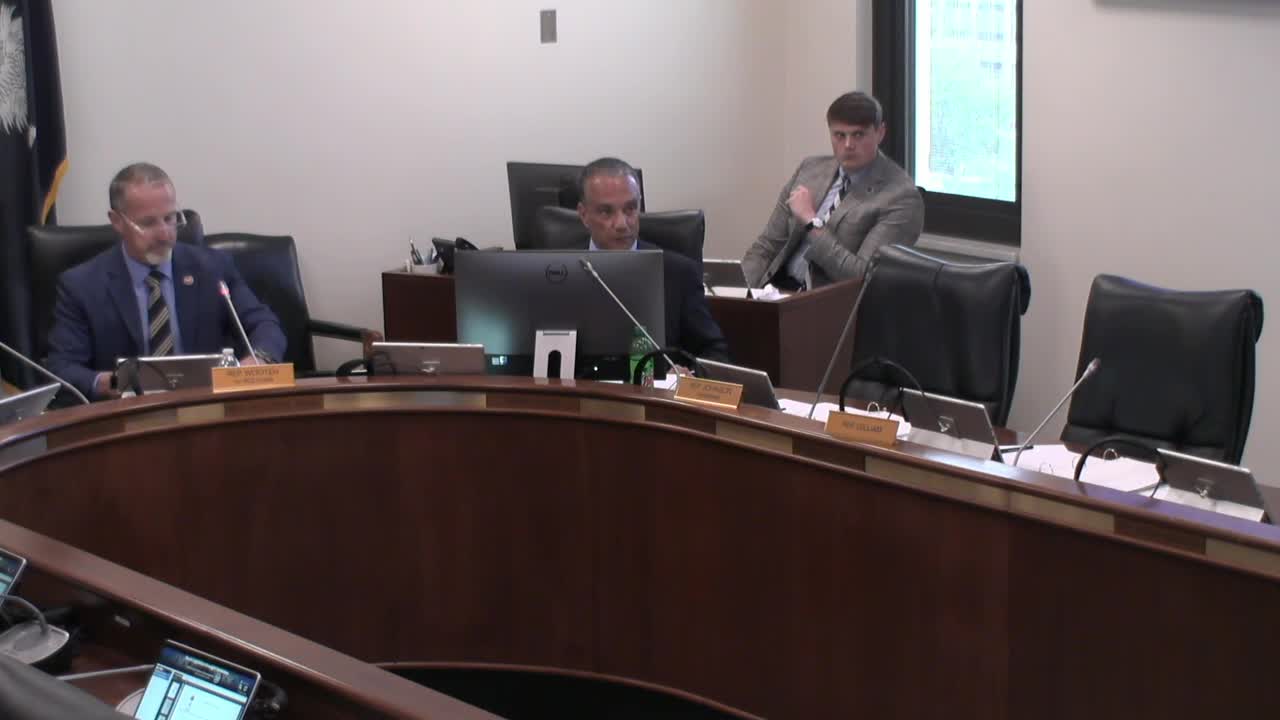
SLED Chief Mark Keel told the House Law Enforcement and Criminal Justice Subcommittee on Tuesday that the agency’s new forensic laboratory — brought online in December 2022 — has substantially increased throughput but still faces persistent backlogs in firearms and DNA analysis.
SLED Chief Mark Keel told the House Law Enforcement and Criminal Justice Subcommittee on Tuesday that the agency’s new forensic laboratory — brought online in December 2022 — has substantially increased throughput but still faces persistent backlogs in firearms and DNA analysis.
Keel said the laboratory completed 25,298 cases in fiscal 2024, up from 19,341 in fiscal 2023 — a 30.8% increase — and highlighted a 95% reduction in gunshot-residue backlog in the trace-evidence unit and a maintained 30-day turnaround in toxicology. “It has done just what we had hoped it would do,” Keel said of the new facility.
The improvements matter for investigations and prosecutions across South Carolina: the SLED lab receives roughly 25,000 new cases a year, Keel said, and those cases can include many pieces of evidence routed to several different forensic units. “One case could have 100 pieces of evidence,” he said, explaining why counts of cases, submitted items and laboratory assignments differ.
Keel told the committee that two laboratory disciplines still carry significant backlogs: firearms/tool mark analysis and DNA casework. He described ongoing hiring and training to address DNA capacity, saying the department was authorized for 15 full-time positions in a recent budget, and that when all authorized positions are filled the DNA casework unit will total 30 full-time equivalents, with 22 forensic scientists trained for DNA analysis, up from eight previously. Keel said most of those positions have been filled and that the remaining new hire is awaiting a start date.
Keel also described how case and evidence flows operate at the laboratory. Evidence is pre-logged through the agency’s iLab system or logged by evidence technicians when submitted, secured in an evidence vault with restricted access, and assigned to forensic scientists who document chain of custody at every step. On evidence retention, Keel said statutory provisions determine how long SLED must hold evidence for appeals and other legal processes.
On the combined DNA index system, Keel said the CODIS repository is working but noted a recurring operational problem: some detention facilities are not consistently sending required buccal swabs for qualifying arrestees. “The law says that they must provide a sample if they qualify,” Keel said, adding that the lab has produced training materials, held meetings with sheriffs and jail administrators and urged better compliance because the samples “no doubt … lead to solving crime in their jurisdictions.”
Keel defended SLED’s accreditation and quality systems. He told lawmakers that the agency’s laboratory has been accredited by national forensic accreditation organizations since 1994 and more recently under an ANSI-recognized body. Todd Huey, identified in the hearing as SLED’s laboratory director, described quality-control checks on breath-testing instruments and the agency’s practice of verifying equipment performance quarterly and via built-in self-checks.
The committee heard details on several other forensic and operational programs: firearms and the National Integrated Ballistic Information Network (NIBIN); computer/digital forensics; trace evidence and toxicology; latent prints; a statewide sexual-assault-kit tracking rollout; the crime-scene unit and a 24/7 operations desk that also serves as a recruiting pipeline for college students; the fusion center and alert systems including AMBER and the state’s Blue Alert; and the South Carolina Law Enforcement Assistance Program (SC LEAP) for officer wellness.
Keel summarized NIBIN performance metrics for fiscal 2024: 7,172 cases entered, producing 10,512 correlations and 2,559 investigative leads. He said SLED has consistently ranked among the top programs in the nation on entries and leads, and urged agencies to submit recovered firearms and shell casings because “we can at least contact those two agencies and say, ‘hey, the same firearm … was used in Richland and in Lexington.’”
Keel also addressed the sexual-assault-kit tracking project. He told the committee SLED had contracted with Envita Healthcare Technologies and began knowledge-transfer and customization work after procurement, and he pushed back on a Legislative Audit Council (LAC) report that criticized the agency’s timeline and stakeholder outreach. “We did not meet the deadline,” Keel said, “but we were also very transparent about that in every report that we did to House Judiciary, Senate Judiciary and to the governor's office.” He added that the statute creating the tracking requirement was passed “without any funding, without any dedicated personnel or resources” and that SLED’s procurement and customization work had required taking laboratory staff off casework to support the effort.
On equipment and funding, Keel said SLED plans to seek a statutory increase in the fee that supports maintenance of breath-testing instruments, noting the current fee had been $25 for a long time and that the agency plans to request $100 to sustain equipment and video systems used at testing sites. He told the committee that statutory change will be required to raise the fee.
Committee members pressed on workforce and retention. Asked by Representative Cambriel Garvin about turnover and recruitment, Keel said SLED’s turnover rate is lower than the state average and that the agency recruits statewide, including historically Black colleges and universities. He argued that changing the state’s “return-to-work” cap for retirees would help retain experienced officers. “I do believe that we would retain more experienced law enforcement officers for a longer time,” Keel said.
The chief answered questions about technologies such as license-plate readers: when asked if removing them would harm investigations, Keel replied, “It would be absolutely detrimental to law enforcement,” and described multiple cases in which readers provided critical direction of travel for missing persons or suspects.
Other numeric details Keel gave the committee during the presentation included: the SLED concealed-weapons-permit count of 511,186 active holders and a NICS (background-check) population of 131,974 records; the state’s sexual-assault kit tracking pilot had 1,754 kits entered as of Feb. 10; and SLED’s sex-offender registry had 11,536 active registrations.
What the committee asked SLED to follow up on: committee staff will collect outstanding information from SLED and schedule the subcommittee’s next meeting to continue the agency study.
Speakers quoted in this article appear in the committee transcript and are listed in the accompanying metadata.