Get Full Government Meeting Transcripts, Videos, & Alerts Forever!
Get email alerts on the School Construction topic
No spam. Unsubscribe anytime.
Bristol Warren committee recommends municipal water for athletic irrigation, reprioritizes construction alternates and advances 60% design submission
Summary
After a test well produced lower-than-expected yields, the Bristol Warren building committee recommended relying on the municipal water connection for athletic-field irrigation, approved a new order of construction alternates and agreed to submit the 60% construction documents to the state.
Bristol Warren building committee members on Feb. 13 reviewed design and cost updates for the district's high school projects, heard results from an irrigation well test that undercut expectations, and voted to reorder prioritized construction alternates before approving a recommendation to submit a 60% design package to the Rhode Island Department of Education.
The committee’s engineers reported a test well drilled to more than 600 feet produced far less flow than hoped for, leaving on-site irrigation wells unlikely to be a cost-effective single solution. The firm’s life-cycle cost analysis showed that, over a 20-year horizon and under the assumptions the team used, a municipal water connection was the most economical option compared with drilling multiple wells or installing large recovery tanks. “That is our recommendation,” said Chad, a building committee member, summarizing the team’s analysis.
Why it matters: the decision affects capital costs, long-term operating expense and the feasibility of keeping seeded athletic fields and landscape plantings established during the first years after construction. Committee members also re-ranked a list of construction alternates — like press box/bleachers, tennis-court lighting and geothermal heating — which will determine the order in which add-on work would be accepted if bids leave room for extras.
Design and irrigation findings
Per the presentation, the test well yielded flows significantly below expectations at depth. The irrigation consultant and hydrogeologist estimated an attainable yield at the site of roughly 15 gallons per minute (gpm), while the project needs about 8 gpm to irrigate landscaped areas and fields. The team cautioned that a single 15-gpm well would be marginal: meeting the district’s demands would likely require multiple wells or a large storage-and-pumping tank.
The life-cycle comparisons presented to the committee included these examples (figures provided by the design team): a municipal-water approach with anticipated rate escalation over 20 years had a comparative cost in the presentation of about $750,000; a solution using two 15-gpm wells plus a roughly 50,000-gallon storage tank had a 20-year modeled cost of roughly $1.5 million; drilling five or six wells to achieve higher continual yield was modeled at about $1.9 million over 20 years. The team also reported an annual irrigation demand estimate of about 1,900,000 gallons and noted pump replacement costs could exceed $30,000 per pump. The presentation noted these life-cycle totals did not include electricity or ongoing maintenance in all scenarios and that actual drilling outcomes can vary (the test well did not reach the optimistic 15 gpm in practice).
Given those tradeoffs, the project team recommended proceeding with a municipal water connection for irrigation infrastructure and carrying the on-site well options as higher-cost contingencies. Chad conveyed that recommendation to the committee: “That is our recommendation.”
Budget, design and CHIPS scoring
The design team reported work progressing toward a 60% construction-document submission. The team said they are tracking about 71 points on the state energy/CHIPS scorecard (with a target to move higher as more items are documented) and noted the recently adopted 2024 IECC energy code added scope that influenced mechanical and envelope design. The architects described targeted cost adjustments in the 60% CD set — for example, optimizing skylights and reducing some curtain-wall area to control cost while preserving daylighting — and said they planned to finalize drawing coordination to allow a March bid procurement.
Alternates and a committee vote
The committee reviewed a list of about 30 prioritized alternates (items bidders would price if base bids leave enough room). After discussion about timing, schedule impacts and the potential availability of federal incentives for geothermal systems, committee members moved and seconded a motion to reorder the top alternates. The committee approved the following sequence for alternates (approved by committee vote):
1) Press box, grandstand and toilet/concession facilities at the track and field 2) Tennis-court lighting 3) Baseball fields (including fencing, backstops, dugouts) as an alternate package 4) Toilet/concession facility for the baseball field 5) Ground-source geothermal heating/cooling (moved down in priority)
The vote to adopt that sequence passed with no recorded opposition or abstentions.
Other procurement and schedule items
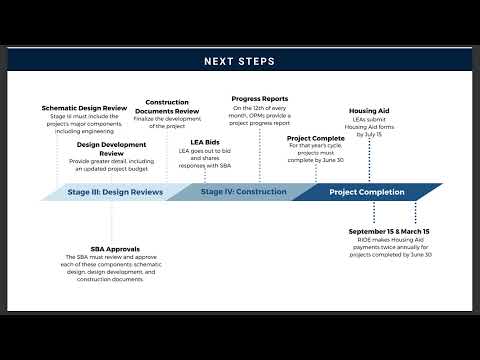
The project team also outlined a two-step contractor procurement: a request for qualifications (RFQ) to identify qualified contractors, followed by an invitation to bid for qualified firms. The team said it planned to post the RFQ shortly and anticipated issuing bid documents after the 60% submission cycle; an initial five-week bid period was expected but teams should plan for six to seven weeks because extensions are common. The committee agreed to recommend submission of the 60% design package to RIDE.
Next steps and follow-ups
The committee directed the design team to proceed with the recommended municipal-water approach for irrigation planning, to continue refining the 60% CD set for RIDE review and to schedule engineers back to the building committee to explain comparative heating strategies (air-source electric heat pumps versus the ground-source geothermal alternate) and operating implications. The committee’s recommendation of alternates and the 60% submission will be forwarded to the full school committee for final consideration.