Get Full Government Meeting Transcripts, Videos, & Alerts Forever!
Get email alerts on the Rulemaking Process topic
No spam. Unsubscribe anytime.
Building Code Council committee outlines path for CR102 filings, flags EV charger and embodied-carbon proposals for more review
Summary
At its Feb. 14 meeting, the Building Code Council27s BFRW committee identified code-change proposals to move toward CR102 rulemaking, directed further economic analysis on several items and said it will form correlation groups to resolve cross-code issues.
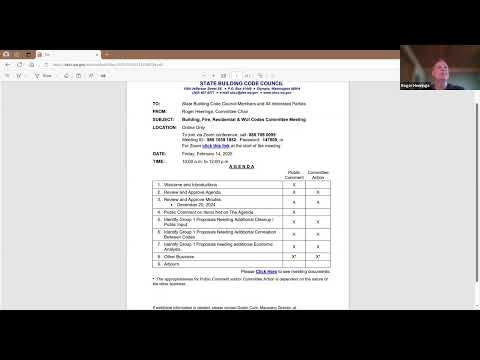
BFRW chair Roger Guringa and council chair Todd Aberther told members on Feb. 14 that the committee will catalogue code-change proposals and push most that are "ready" toward CR102 publication this summer while flagging several for additional public input and economic analysis.
The committee's immediate work is to sort group-1 petitions (including IBC, IFC, IMC and IFGC items) into three buckets: (1) those ready for CR102 filing, (2) items needing correlation across code books, and (3) items requiring additional economic or small-business analysis. Dustin (staff member) told the committee the council expects CR102 publication in the June27July time frame and has asked standing committees to manage remaining cleanup and public comment before filing.
Why it matters: the CR102 is the formal public-notice step that opens rule proposals to broader public comment and helps the council assess economic impacts before a final decision. Several proposals the committee discussed could change requirements that affect builders, local jurisdictions and small businesses statewide.
Key points from the meeting
- Next steps and timing: Dustin (staff member) said staff will begin packaging proposals that do not need further work for CR102 preparation and that the committee will hold a March 14 meeting (10 a.m. to noon) to finalize the list and schedule deeper review sessions. Committee members suggested a public deadline in early March for parties to flag additional proposals for the standing committee to consider (participants mentioned March 7 and March 12 as potential cutoff dates during the discussion).
- Items flagged for additional review: The committee specifically flagged an embodied greenhouse-gas proposal (proposal 118) for a dedicated meeting and additional economic analysis; members agreed to fast-track economic review where that analysis is likely to materially affect outcomes. Several EV-charging petitions were also flagged for further economic review and for a coordinated approach because multiple competing proposals exist for similar code changes. As Dustin said, "the economic impact analysis should be fast tracked because it might inform the additional decision." (Dustin, staff member).
- Correlation committee: Members discussed forming a correlation committee (a special council committee) to resolve cross-code conflicts (for example, items that touch both the IBC and IFC or that might touch IMC/IFGC). Todd Aberther described the council's intent: "The council now has directed this group to do this additional work." (Todd Aberther, council chair). The committee agreed to invite tag chairs and interested, approved tag members and technical experts to correlation sessions; the official voting membership will be the committee's designated correlation members.
- Process and public notice: Multiple participants asked for clearer public notification of open proposal windows. Patrick Hanks, representing the Building Industry Association of Washington, urged clearer public notices and a single web page listing active windows so stakeholders know when they can submit proposals and comments.
Votes at a glance
- Motion to approve the meeting agenda: moved by Council chair Todd Aberther; seconded by Dan Young; voice vote recorded as "Aye"; outcome recorded as approved (voice vote). (See transcript for timing.)
- Motion to approve minutes of the Dec. 20, 2024 meeting: moved by Dan Young; seconded by Council chair Todd Aberther; voice vote recorded as "Aye"; outcome recorded as approved.
What remains open
Committee members agreed the standing committee will schedule one or more follow-up meetings: a March 14 session to finalize the list of items needing work and to set meeting dates for deeper public-input sessions (the committee indicated it will hold at least one meeting devoted to proposal 118). The committee also planned to accelerate the economic-impact work group to produce analyses that can inform the standing committee27s recommendations to the full council.
Ending note
The committee emphasized that it is implementing a more formal, transparent workflow to comply with the RCW, WAC and the council27s bylaws, and to give the public clearer opportunities to flag items for further review before the formal CR102 notice is published.