Get Full Government Meeting Transcripts, Videos, & Alerts Forever!
Get email alerts on the Building Code Affordable Housing topic
No spam. Unsubscribe anytime.
SB 5747 would let jurisdictions offer older code cycles for affordable housing; SBCC members warn of administrative chaos
Summary
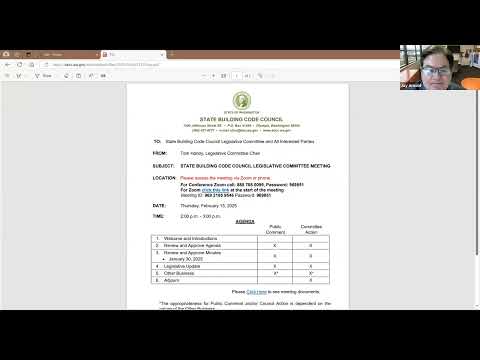
At a February legislative committee meeting of the State Building Code Council in Olympia, members discussed Senate Bill 5747, a proposal that would permit affordable‑housing projects to be constructed, altered or repaired to any of the four prior state building‑code cycles rather than only to the current code.
At a February legislative committee meeting of the State Building Code Council in Olympia, members discussed Senate Bill 5747, a proposal that would permit affordable‑housing projects to be constructed, altered or repaired to any of the four prior state building‑code cycles rather than only to the current code.
The council’s legislative staff, Dustin, summarized the bill as one that would "allow jurisdictions to choose which code they would like to implement," and members spent the bulk of the discussion laying out likely administrative impacts if the measure moves forward.
Why it matters: Council members warned that the bill would create a patchwork of codes across jurisdictions, complicating plan review, inspection and training and increasing requests for code interpretation. That could raise costs and slow permitting, members said — effects that would undercut the bill’s intent to speed affordable housing.
Several members said the measure applies only to projects that meet the bill’s definition of affordable housing. One member who had read the bill later in the meeting clarified, "the ability for a jurisdiction to choose a previous iteration of the code only applies to the new definition of affordable housing." That point narrowed the scope but did not allay procedural concerns.
Practical and technical concerns
Roger Haringa, chair of the BFRW committee and a structural engineer, said using different code cycles across neighboring jurisdictions would be "a total mess" for engineers and building officials because firms and reviewers are organized around current model‑code packages and associated design spreadsheets. He added that older cycles would force practitioners to reassemble older general‑note packages and calculation methods.
Another member asked aloud, "Who gets to choose which code to use?" and pointed out the training burden that would fall on local building officials if enforcement could vary by project or jurisdiction. Damon Doyle, MBPE committee chair, read the bill language as saying the change is tied to encouraging affordable housing and that decisions would rest with jurisdictions or their officials rather than applicants.
Angela, speaking as a building official, said the bill in effect would create a lower safety level for people in affordable housing and described it as "just a bad bill." Others countered that cost pressures on housing are real and said legislative solutions must balance safety and affordability.
Administrative pathway and next steps
Members discussed how the bill would interact with Washington Administrative Code (WAC) numbering and the Administrative Procedure Act. One staff explanation noted that restoring prior code cycles for optional enforcement would not be as simple as "rolling back" WAC entries; the state would likely need to create separate WAC numbers for each code cycle and follow the administrative rulemaking process to make those cycles available for optional use.
The bill was scheduled for a hearing next Wednesday at 10:30 a.m. in the Senate Committee on Housing. The committee voted to ask Council Vice Chair Jay Arnold to "inform" (provide neutral, administrative testimony) at that hearing about the operational and administrative challenges the bill would create for the SBCC, building officials and designers; the request will be run by the SBCC executive committee before the testimony is filed.
The committee did not take a legislative position on the merits of the policy; members repeatedly limited their requested testimony to describing administrative and implementation issues.
Ending: The committee will monitor SB 5747’s movement and the March hearing schedule; staff and committee members said they would prepare concise talking points for executive‑committee review before any testimony is offered.