Get Full Government Meeting Transcripts, Videos, & Alerts Forever!
Get email alerts on the Special Education topic
No spam. Unsubscribe anytime.
Ohio Deaf and Blind Education Services seeks $36.1M–$36.9M in executive budget and requests tactile braille displays
Summary
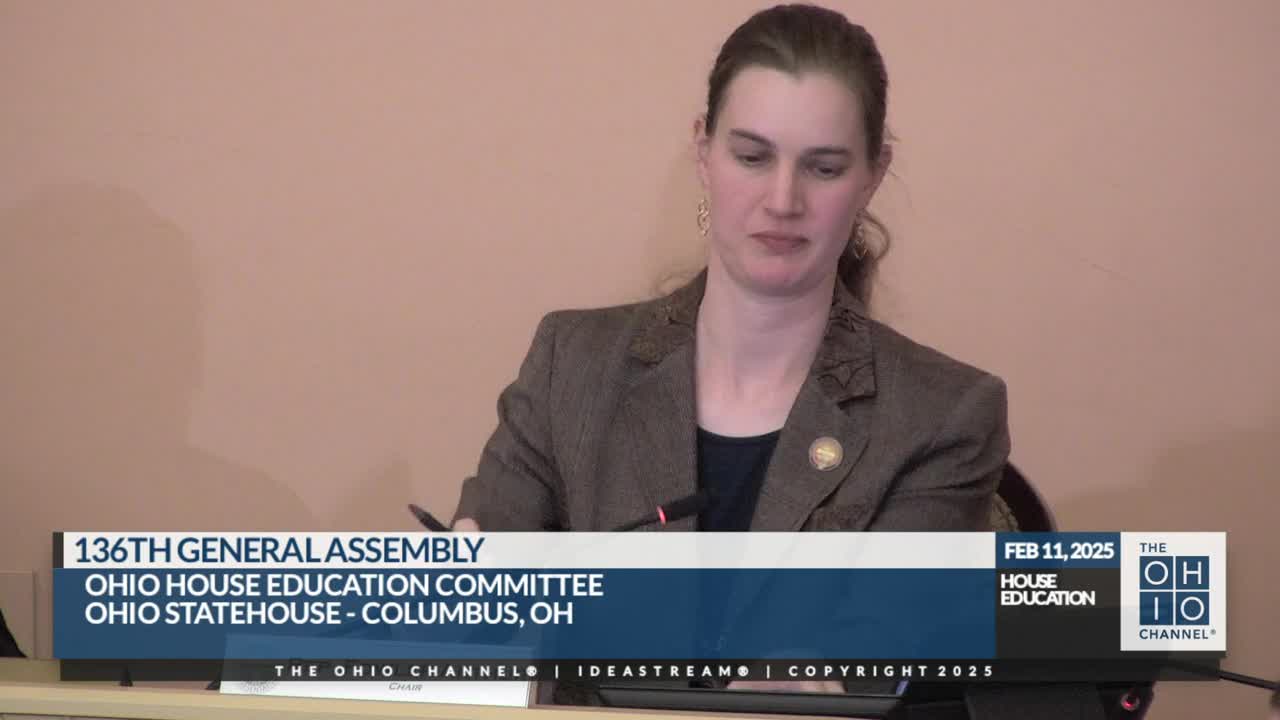
Lou Manous, superintendent of Ohio Deaf and Blind Education Services, told the House Education Committee the agency seeks roughly $36.1 million in FY 2026 and $36.9 million in FY 2027 to maintain services and purchase classroom tactile-braille technology.
Lou Manous, superintendent of the Ohio Deaf and Blind Education Services (ODBES), told the House Education Committee the agency’s executive budget request would sustain statewide day, residential and early-intervention services and fund technology to improve access for visually impaired students.
Manous said ODBES operates two state schools — the Ohio School for the Deaf and the Ohio School for the Blind — plus early-learning and statewide outreach services. He reported the blind school served 113 students on campus this year representing 66 districts in 37 counties, and the deaf school served 29 students on campus representing 69 districts and 36 counties; ODBES also supports 24 deaf‑blind students and hundreds of children in early intervention across the state.
The superintendent described strategic priorities including “future-ready” teaching and learning environments, workforce-readiness partnerships with business and state agencies, and community engagement. He said the executive budget recommendation appropriates approximately $36.1 million in FY 2026 and $36.9 million in FY 2027 — increases the agency said are necessary to maintain current services, adopt new technology and support strategic priorities.
One specific request in the written testimony and committee discussion is $100,000 to acquire five multi-line braille displays with tactile-graphics capability. School leaders called the technology a “game changer,” saying it would allow immediate classroom access to tactile graphics and complex content that previously required out‑sourcing and delay. Principal Michelle Wagner told committee members the devices would ideally be available in every classroom, and administrators said the agency would use devices both on campus and to loan to districts across the state.
Manous explained that students who live on campus are supported by residential programs and that districts typically retain funding for students’ home districts while the state school provides specialized services; the agency receives the bulk of its funding from the GRF and only limited federal funds through special-education programs. Committee members asked how enrollment and waiting lists are managed; Manous said classroom sizes are limited and waiting lists are usually small, commonly under 10 students.
Why it matters: State schools for deaf and blind students provide intensive, specialized instruction and statewide consultative services; technology investments that increase classroom access to tactile graphics could materially change instructional options for visually impaired students across Ohio.
What the committee heard: ODBES asked for modest increases to maintain and expand services, highlighted partnerships for workforce readiness and encouraged committee members to visit campus to see new technology in action.