Get Full Government Meeting Transcripts, Videos, & Alerts Forever!
Get email alerts on the K 12 Education topic
No spam. Unsubscribe anytime.
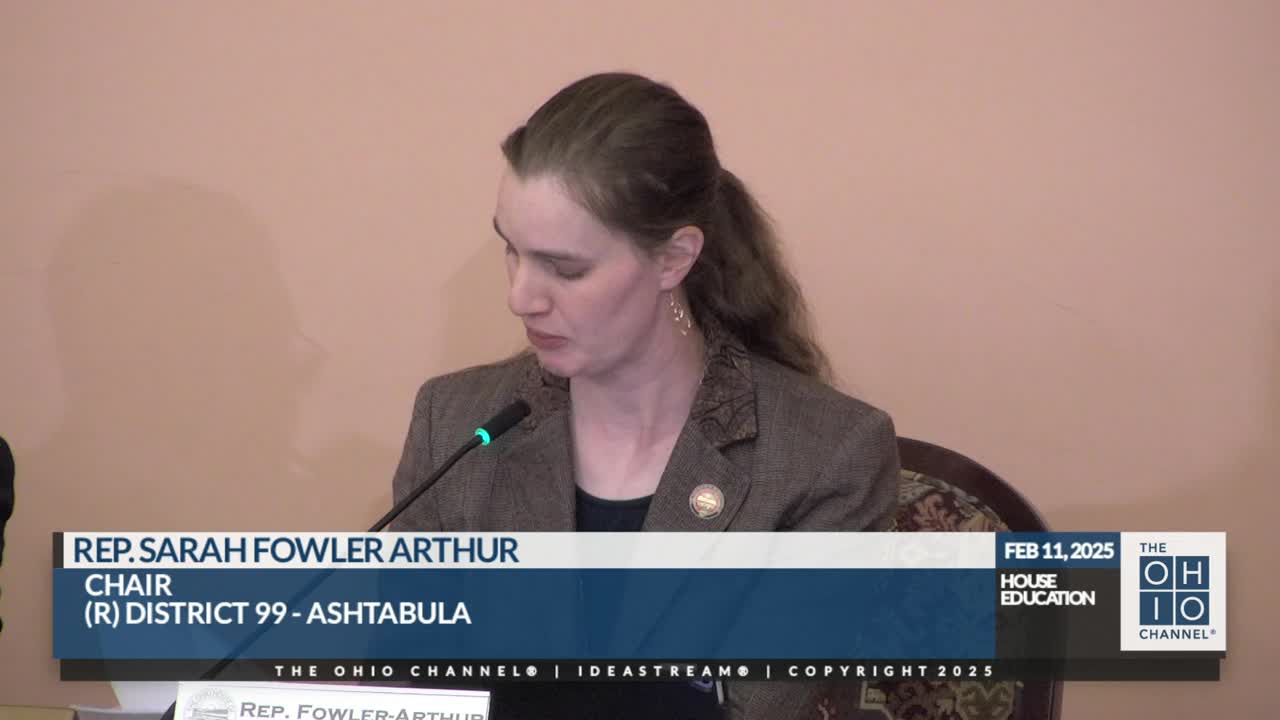
House Education Committee adopts substitute to allow Ashtabula waiver after Lakeside High roof collapse
Summary
The Ohio House Education Committee on an initial hearing approved a substitute to House Bill 43 that would allow the Ohio Department of Education and Workforce to waive up to 24 hours of instructional time for the Ashtabula Area City School District after a winter roof collapse rendered Lakeside High School temporarily unoccupiable.
The Ohio House Education Committee on an initial hearing approved a substitute to House Bill 43 that would allow the Ohio Department of Education and Workforce to waive up to 24 hours of instructional time for the Ashtabula Area City School District after a winter roof collapse rendered Lakeside High School temporarily unoccupiable.
The substitute — adopted by the committee without objection at the first hearing and later favorably reported — is written as an uncodified measure applying only to Ashtabula for the current school year; it includes guardrails intended to prevent the waiver from becoming a precedent for routine calamity-day relief and requires graduating seniors to demonstrate competency under existing state graduation pathways.
Committee members said the measure is narrowly tailored to avoid broader changes to the state’s instructional-time rules. Vice Chair Odioso, who moved to adopt the substitute, told the committee the bill “provides additional guardrails” and that the department “would be authorized to waive no more than 24 hours for the state of emergency, ensuring that this waiver does not become a free for all or waive any traditional calamity days.” The Legislative Service Commission staff confirmed the substitute creates an uncodified, one-year carve-out for Ashtabula only.
Superintendent Lisa Newsome of Ashtabula Area City Schools and Lakeside High Principal Doug Weatherholt testified in support, describing damage to the high school and the district’s emergency response. Newsome said the district had relocated high school students to multiple temporary sites and that staff worked during days when students did not report, noting the district’s one-to-one Chromebook program and remote-learning efforts during the displacement. “The staff, they’ve worked endlessly on those 3 days,” Newsome said. She told the committee an extension of the school year to replace the missed days would cost the district roughly $400,000 and that attendance for added make-up days would likely be low given the district’s 84.6% free- and reduced-price lunch population.
Weatherholt described the December collapse and the logistical work to restore in-person instruction, saying the roof failure followed an unusual accumulation of snow and left the building unsafe. “The district immediately began ordering all necessary supplies and preparing these buildings for occupancy by high school students,” he said. He emphasized the district’s priority of returning students to in-person learning, noting the outage of Internet and phone service because servers were located in the damaged building.
The substitute explicitly distinguishes the waiver from ordinary calamity days and requires graduating seniors to show competency “by meeting one of the state's existing graduation standards, either by assessment or a credential.” Committee discussion confirmed the department — not individual families or the district — would implement the flexibility automatically under the substitute’s language.
Representative Miller asked whether the provision was a narrow carve-out “to make the school district whole” and was told the intent is to preserve eligibility for state funding for the next school year, subject to any calamity days the district still must make up. Representative Byrd pressed for confirmation that the change applies only to Ashtabula and only to the current school year; LSC staff responded that the measure is uncodified and limited as described.
The committee voted to favorably report HB 43 as a substitute and recommended it for passage. The roll call, as recorded in committee, produced 10 affirmative votes and no negative votes; the committee chair announced the bill was favorably reported out of committee.
Why it matters: The substitute aims to prevent Ashtabula from losing eligibility for state funding in the 2025–26 school year because of instructional time lost while the district relocated students and repaired the building. By pairing the waiver with an academic competency requirement for seniors, the substitute seeks to balance relief for the district with assurance that students meet state graduation standards.
What remains unresolved: The substitute is an uncodified, one-year measure limited to Ashtabula; it does not change the state’s calamity-day rules or the broader instructional-hour statutory framework. Any future similar requests from other districts would require separate legislative action or an analogous uncodified carve-out.
Votes at a glance: The committee recorded the substitute as favorably reported with a tally of yes: 10, no: 0, abstain: 0. (Names recorded in the roll call are reflected in committee minutes.)
Reporters’ note: The committee specifically limited the substitute to the Ashtabula Area City School District and to the current school year; the Legislative Service Commission confirmed the provision is not codified into permanent law.