Get Full Government Meeting Transcripts, Videos, & Alerts Forever!
Get email alerts on the Childcare topic
No spam. Unsubscribe anytime.
Ohio lawmakers pitch $10 million grant program to spur employer-linked childcare
Summary
Sponsors of House Bill 41 told the House Children and Human Services Committee the bill would create a $10 million grant program — capped at $750,000 per site — to help employers, community groups and providers build on-site or near-site childcare through public‑private partnerships and a state-supported “design lab.”
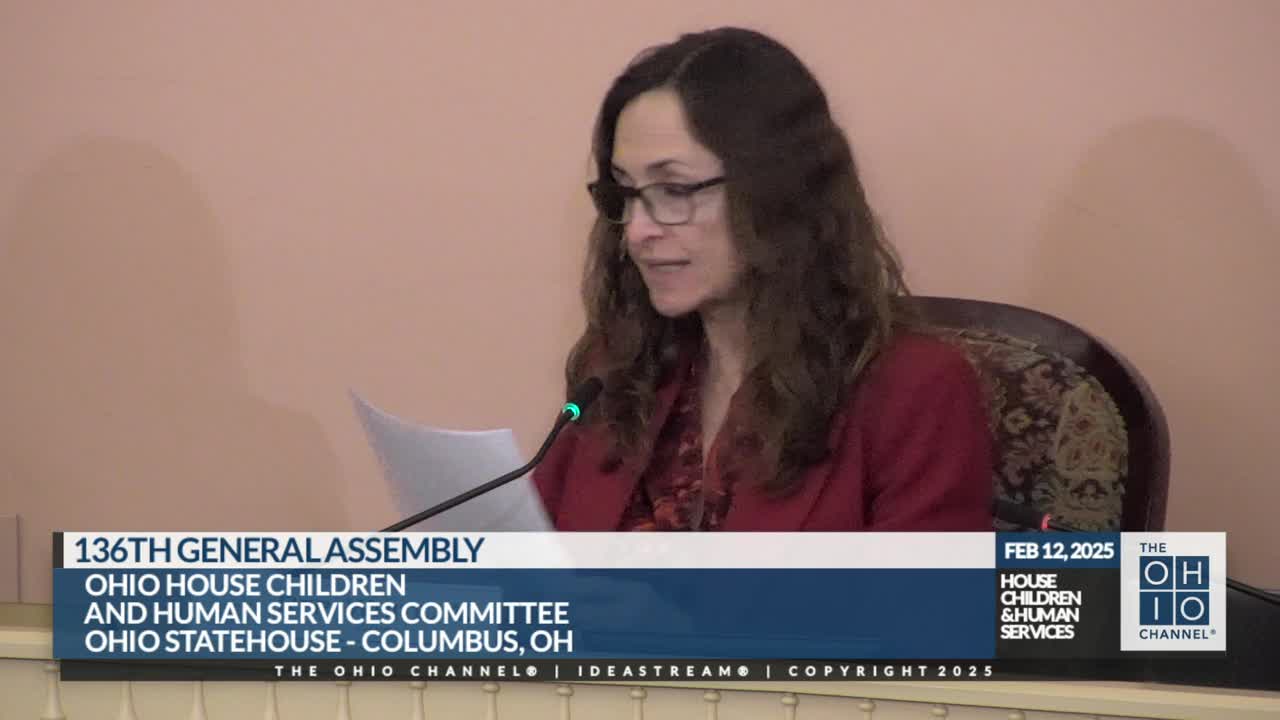
Representatives White and Romer on Thursday asked the House Children and Human Services Committee to consider House Bill 41, a proposal to create a $10 million state grant fund to support public‑private partnerships that expand on‑site or near‑site childcare.
The bill would establish a state-administered grant program — overseen by the Department of Children and Youth in coordination with JobsOhio and the Department of Development — to pay start‑up costs for retrofits, equipment, new construction or other capital needs. "The start up investment that we're requesting is $10,000,000," Representative Romer told the committee, adding the grants would be "capped at a maximum, and again I'll stress a maximum, of $750,000 per site." The proposal includes a design‑lab component intended to provide technical assistance to employers and communities planning facilities.
Sponsors said the measure targets childcare deserts and employers who want to partner with providers, nonprofits or local governments to increase capacity and make care more convenient and affordable. Representative White described local examples where businesses and philanthropy teamed with cities and nonprofits to build centers — citing Ashland and an unnamed Sugar Creek Packaging project paired with the nonprofit HomeFull — and argued an infusion of startup funding would make similar projects feasible in other communities.
Committee members asked how HB 41 differs from other proposals and how sustainability, prioritization and geographic distribution would be enforced. Representative White said the bill emphasizes an upfront, time‑limited infusion of capital and technical assistance rather than permanent operating subsidies. She said the JobsOhio regional structure in the bill requires at least one project per JobsOhio district and that the program could favor projects that demonstrate sustainability after the grant period. Representative Pickle Antonio and others asked for comparisons with models in Colorado and Michigan and whether the grants could support initiatives similar to Kentucky's scholarship program for childcare workers; sponsors said the statute does not explicitly preclude such pilots but that preference would likely be given to projects that show an ongoing commitment after initial funding.
Representative Lett pressed sponsors on measurable capacity goals. Romer offered a rough example during questioning, saying if the program awarded maximum grants to 13 sites and each site averaged 50 new slots, the state could add roughly 650 childcare slots — a math exercise sponsors framed as illustrative rather than a guaranteed outcome.
Supporters told the committee the bill is intended both to reduce parents' out‑of‑pocket costs and to increase employer productivity by reducing employee absences tied to childcare gaps. No formal vote or motion was recorded during the hearing; the session was a sponsor testimony and Q&A hearing.
Ending: The committee concluded the HB 41 sponsor testimony after extended questions and indicated further committee discussion and follow up would be needed to finalize program details and funding priorities.