Get Full Government Meeting Transcripts, Videos, & Alerts Forever!
Get email alerts on the Education topic
No spam. Unsubscribe anytime.
Advocates urge stronger state action on math and reading interventions during committee hearing on Senate Bill 19
Summary
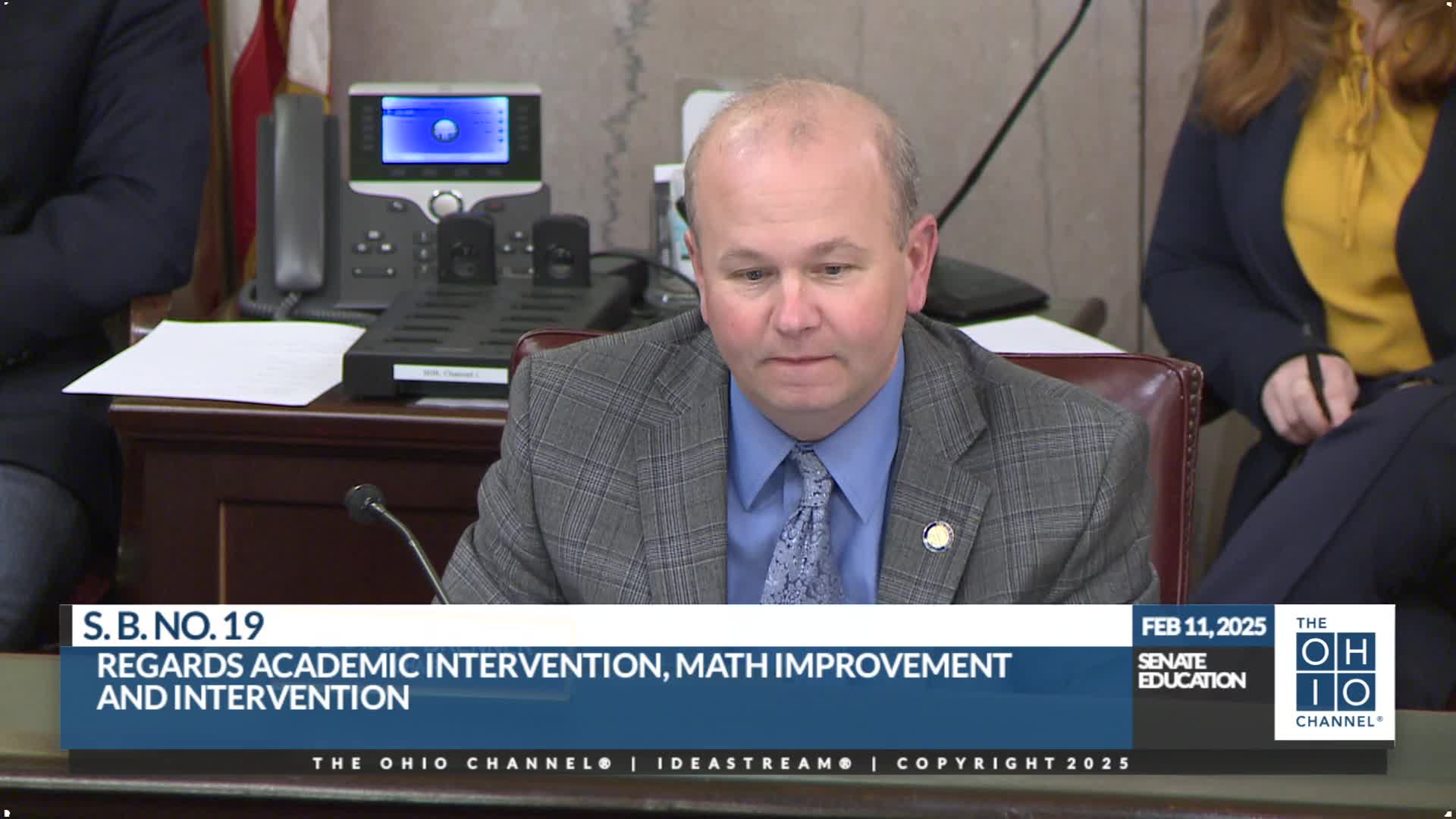
A representative of the Thomas B. Fordham Institute testified in support of Senate Bill 19, urging the committee to strengthen the bill's provisions on math curricula reporting, mandatory interventions, high-dosage tutoring, screening in K-3, and teacher content standards for elementary math.
Chad Aldis, vice president for Ohio policy at the Thomas B. Fordham Institute, testified in support of Senate Bill 19 and urged the Senate Education Committee to strengthen the state's approach to math and English language arts interventions. Aldis said the bill focuses on evidence-based academic interventions for students who score at the lowest levels on state assessments and outlined strengths and additional recommended actions.
Aldis described key provisions he supports in the bill: required reporting on math curricula and intervention programs; mandatory academic plans and interventions for students who score limited on state math or ELA exams; district improvement plans if more than half of students fail to demonstrate math proficiency; EMIS reporting on intervention efforts; and promotion of high-dosage tutoring. He recommended strengthening the bill to require high-dosage tutoring during the school day and suggested pay-for-performance contracting for tutoring vendors if state funds are used.
Aldis recommended additional state actions beyond the bill text: a state review and list of high-quality math instructional materials; state report cards identifying which curricula schools use; universal math screening in grades K-3 with parent notification and math improvement plans; a standardized screening tool for K-3 paid for by the state; establishing a minimum passing score for the math subsection of the elementary licensure exam for new teachers; and a policy to place qualified eighth graders into Algebra I with a parental opt-out provision. Aldis said research indicates seventh graders who score "accomplished or above" and take Algebra I in eighth grade have a 95 percent likelihood of scoring proficient or above in Algebra I.
Committee members thanked Aldis and discussed the feasibility of proposals such as a minimum math subscore requirement for elementary licensure and coordination with higher education and the budget process. Aldis said his organization recommends prospective changes be applied prospectively to new teachers and noted implementation would require coordination with teacher-preparation programs. The testimony concluded as the committee closed its second hearing on Senate Bill 19 with no committee vote.