Get Full Government Meeting Transcripts, Videos, & Alerts Forever!
Get email alerts on the Education topic
No spam. Unsubscribe anytime.
Senate committee holds first hearing on bill to require historic documents in every classroom
Summary
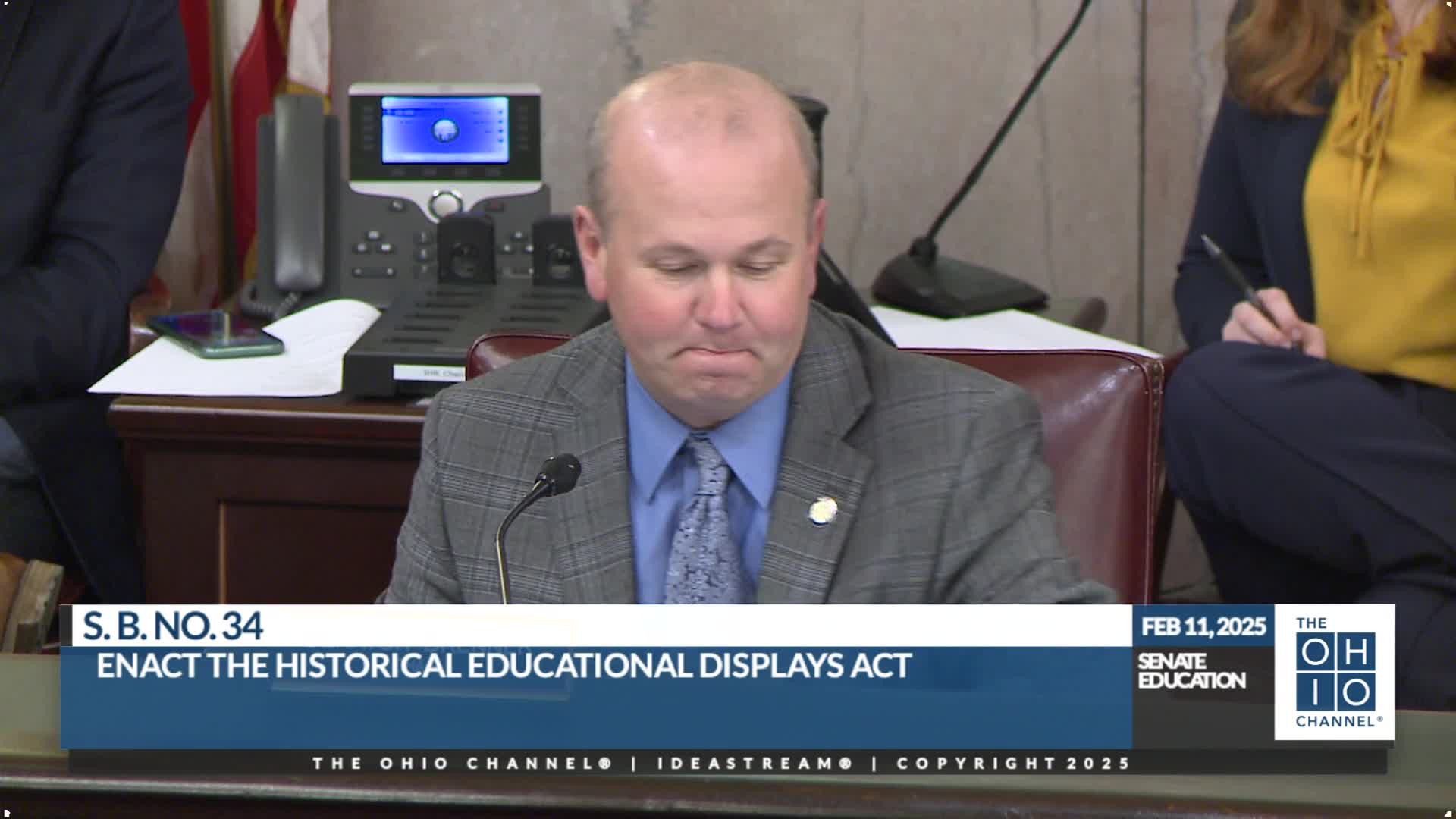
Senate Bill 34, sponsored by Senator Johnson, received its first hearing before the Senate Education Committee. The bill would require each public school classroom in Ohio to display at least one listed historical document and an accompanying explanatory description.
Senator Johnson, sponsor of Senate Bill 34, told the Senate Education Committee that the bill would "require public schools to display 1 of a variety of historical documents in each classroom" to expose students to texts the sponsor described as "the backbone of our legal and moral traditions." The legislation lists allowable items including the Mayflower Compact, the Declaration of Independence, the Northwest Ordinance, the mottos of the United States and the State of Ohio, the Ten Commandments, the Magna Carta, the Bill of Rights, the U.S. Constitution and the Articles of Confederation, and would require each display to be accompanied by a description explaining the historical importance of the document.
The bill, as explained in sponsor testimony, would leave selection of the specific document for display to local boards of education and authorize the Ohio Department of Education and Workforce to post formatting and educational materials on its website to assist districts and teachers. The sponsor said the requirement "ensures that no public funds will be required to be expended for the cost of these displays, although public funds may be used," and that districts could accept donated funds or donated displays. The sponsor suggested many displays could be as small as an 8.5-by-11 printout and that larger documents might require more complex formatting but should be "reasonably visible."
Committee members questioned the sponsor about inclusion of the Ten Commandments among listed documents and whether the list should be broadened to include other religious traditions' texts or versions of the "golden rule." Senator Ingram asked why the Ten Commandments were listed as a historical document; the sponsor replied that the sponsor considered the Ten Commandments one of the foundational documents influencing the formation of American moral codes and that "this harmonizes well with the other documents" on the bill's list. Senator Smith asked whether versions of the golden rule from other faiths should be included; the sponsor replied the bill focuses on documents the sponsor believes were "central to the founding of America." The sponsor acknowledged the list is not necessarily exhaustive and said other documents could be added if a historical case was made.
The sponsor also explained that the department's website guidance might include formatting options such as QR codes linking to explanatory material, and that teachers would have discretion over how elaborate displays became in classrooms. The committee recorded this as the first hearing on Senate Bill 34 and took no vote.
The hearing record shows questions from multiple senators regarding potential religious implications, local control over display content, and the bill's cost implications. No formal motion or vote occurred during the hearing; the bill was presented for the committee's first hearing and will return for further consideration if scheduled by committee leadership.