Get Full Government Meeting Transcripts, Videos, & Alerts Forever!
Get email alerts on the Transportation topic
No spam. Unsubscribe anytime.
Residents and Canyon Guard press Alta council on Little Cottonwood Canyon congestion and alternatives to a gondola
Summary
Public commenters and Canyon Guard representatives urged the Alta Town Council to press for near-term transit and road improvements, raised safety concerns about roadside parking and gridlock, and urged study of keeping the canyon mainline open during peak exit periods rather than pursuing a gondola as the only solution.
Public commenters and stakeholders used Alta’s Feb. 12 council meeting to renew calls for solutions to Little Cottonwood Canyon congestion and safety issues, emphasizing short- and medium-term transportation measures over a single large infrastructure option.
Vicky Smith, a University of Utah student and Canyon Guard intern who said she grew up in Little Cottonwood Canyon, told the council the community should put the ecosystem and canyon users at the center of planning and urged the town to "make your voice heard" on canyon transportation choices.
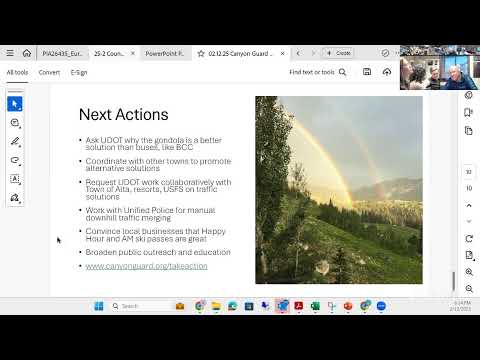
Craig (town treasurer and Canyon Guard chair) and Charlie Luke, Canyon Guard’s newly hired executive director, presented the organization’s shift from opposition to solution syndication. Charlie Luke said Canyon Guard will focus on near-term options — expanded shuttle service, vehicle-occupancy approaches, reservation systems and other demand-management strategies — and on coordinating municipalities, resorts and businesses.
Why it matters: speakers said no single option currently in hand will eliminate road closures or long delays during storms and avalanche control work. Multiple presenters urged work on mainline reliability and on managing roadside parking that residents and business representatives said has increased vehicle counts and created safety risks.
Key points raised by public speakers and presenters:
- Safety and gridlock: local resort and operations representatives said this winter produced multiple “gridlock” days when traffic stalled for hours and emergency vehicle movement was impaired. They urged keeping the canyon mainline open during peak exit periods where possible and improving merge points to avoid hour-plus delays.
- Roadside parking and Forest Service role: speakers said roadside parking had shifted from parallel to 45-degree parking in some areas, increasing parked vehicles. Several suggested the Forest Service has been reluctant to expand formal parking but should enforce master-plan limits where roadside parking is occurring.
- Demand-management alternatives: Canyon Guard advocated pursuing near-term measures, including reservation systems applied across multiple lots, high-occupancy vehicle strategies, more coordinated bus service and possible metered merges to smooth flows. Speakers said tolling raises equity concerns for employees and residents if not designed carefully.
- Traction law and state action: presenters said a traction law had passed locally and related legislation (identified in meeting discussion as HB 456 in the state legislature) moved through the legislature; they noted further state engagement is needed to implement consistent traction checks and enforcement.
Ending: Council members and staff said they will continue joint work with Canyon Guard, the ski areas and state and federal agencies to pursue a mix of short- and long-term solutions; no final policy decision was made at the Feb. 12 meeting.