Get Full Government Meeting Transcripts, Videos, & Alerts Forever!
Get email alerts on the Mental Health Response topic
No spam. Unsubscribe anytime.
Clearfield proposes statewide pilot for uniformed mental‑health officers to reduce repeat crisis calls
Summary
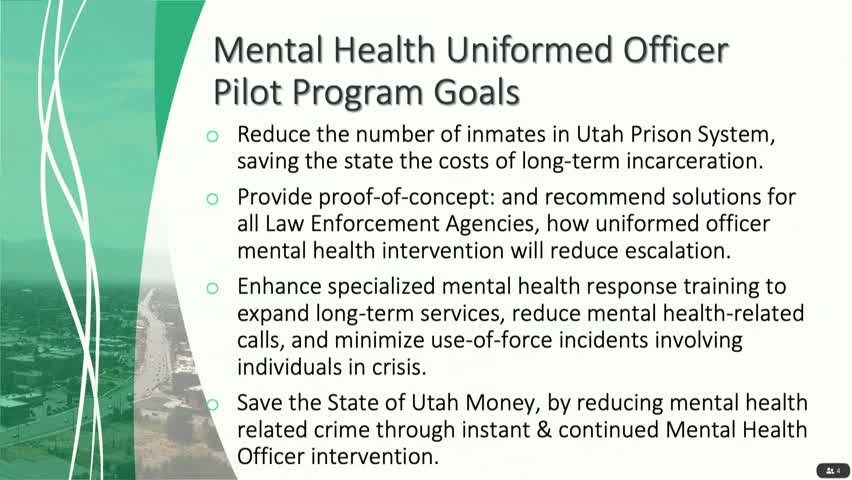
Clearfield City asked the Criminal Justice Appropriations Subcommittee to fund a three‑year pilot placing trained, uniformed mental‑health officers in participating police agencies statewide to reduce repeat crisis calls and increase diversion to treatment.
Clearfield City officials asked the Criminal Justice Appropriations Subcommittee to fund a three‑year pilot that would place trained mental‑health officers in uniform with participating police agencies to reduce repeat mental‑health crisis calls, provide follow‑up and improve diversion to treatment.
Chief Kelly Bennett, Clearfield Police Department, described the proposal and its aims.
Why the pilot was proposed
“We are increasingly responding to more and more mental‑health calls, specifically repeated calls to individuals who are in crisis,” Chief Kelly Bennett told the committee. He described cases in which repeated contacts escalate and said a dedicated, trained officer who builds sustained relationships with individuals can improve de‑escalation and referrals to treatment. Bennett described the pilot as a way to pair “mental health officers in uniform” with ongoing follow‑up and training duties for other patrol staff.
Plan details and scope
- Structure: Bennett said the LFA proposal envisions a three‑year pilot that would approve four law‑enforcement agencies statewide through a grant application process; participating agencies would apply for and be selected to receive funding.
- Duties: Mental‑health officers would be uniformed, receive specialized training, act as a liaison with behavioral‑health providers and conduct one‑on‑one follow‑ups with high‑need individuals and group homes. In periods when the officer is not responding to initial calls, they would focus on follow‑up and case‑management tasks rather than traditional 24/7 patrol duties.
- Diversion and services: Bennett said officers could help divert people committing low‑level offenses toward community treatment, citing Davis Behavioral and the Davis adult receiving center as local examples of partners who can provide services.
Questions from legislators
Several legislators asked whether officers should wear uniforms or plain clothes when engaging people in crisis. Bennett said his department’s experience is that the repeated one‑on‑one contact and relationship with an officer matters more than the uniform itself, and that uniformed presence also protects clinicians and family members in volatile situations. He said: “If we have that officer who is trained and knows these individuals and becomes more acquainted with them, I believe the uniform is second nature.”
Representative Lisenby (presenting the RFA) said the pilot would be a grant open to any interested agency and confirmed the program’s plan to choose four sites statewide.
Support and testimony
Representative Lisenby and other members praised the prevention focus. One legislator recounted a family tragedy involving a constituent’s adult son and suicide attempts that, in the member’s view, illustrated the need for trained, connected responders who can route people to receiving centers rather than emergency rooms.
Next steps
Committee staff did not take a vote at the hearing. If the subcommittee or appropriations leadership includes the pilot in the chairs’ list, agencies will be able to apply for grants in the program described.
Ending note
Proponents asked the committee to prioritize the pilot as a prevention‑oriented investment that they say would improve outcomes for people with repeated mental‑health crises and reduce repeated patrol responses.