Get Full Government Meeting Transcripts, Videos, & Alerts Forever!
Get email alerts on the Traffic Calming Signals topic
No spam. Unsubscribe anytime.
Committee recommends traffic‑calming options, speed humps and left‑turn signal changes at several intersections
Summary
After petitions about speeding, dangerous turns and left‑turn delays, the committee recommended speed humps on Vassar/Cornell, supported adding leading/lagging left‑turn phases at select intersections and asked staff to study intersection improvements and markings.
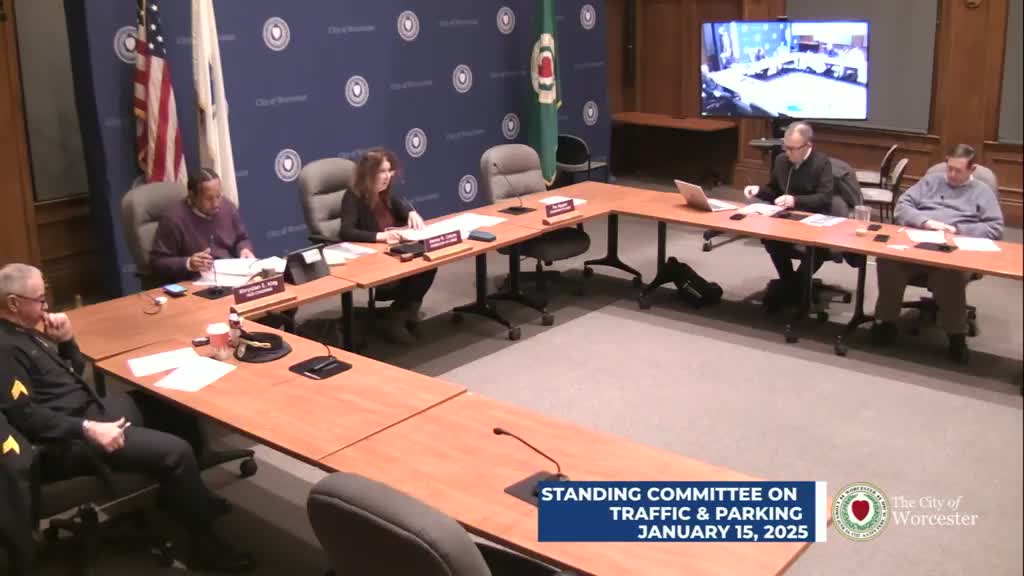
The Worcester City Transportation & Mobility Standing Committee on Oct. 12 reviewed multiple petitions seeking traffic‑calming measures, stop sign changes and signal timing modifications. Staff recommended alternatives in several cases, and the committee directed follow‑up action.
Vassar/Cornell: petitioners asked for a four‑way stop at Russell and Cornell (Vassar area) because of speeding and children playing in the neighborhood. Staff said the location does not meet federal stop‑sign warrants in the Manual on Uniform Traffic Control Devices (MUTCD) but confirmed the site is a strong candidate for traffic calming. The committee directed staff to recommend speed humps to the district councilor and to support a neighborhood traffic‑calming approach. Petitioner James Sylvia and neighbors described frequent speeding through the residential grid and asked for quicker installation of speed humps; staff noted speed humps are the most expedient and effective option in constrained residential streets where curb/drainage changes make curb extensions expensive.
Left‑turn signals: the committee reviewed petitions for left‑turn signal phases in multiple corridors. At the Park Avenue/Levi Street area and other locations, staff recommended adding leading or lagging protected left‑turn phases — a less invasive first step than constructing dedicated left‑turn lanes — and the committee approved the signal‑timing modifications. For Hayward and Greenwich Streets, staff recommended a leading left‑turn phase because a full left‑turn lane is not feasible in the available right‑of‑way.
Other measures: staff recommended additional pavement markings, supplemental signage and lane‑marking changes at complex rotaries and intersections (Airport Drive rotary, Pleasant Street approaches) that had previously been the subject of neighborhood petitions; several of those items were filed as complete after staff reported implementing lane‑marking changes and planned supplemental signage in the spring.
Councilors and staff emphasized that some engineering fixes (curb extensions, lane reconfiguration) can be costly and require drainage or sidewalk work, while alternatives such as speed humps, pavement marking changes and signal‑phase adjustments are often faster to implement.