Get Full Government Meeting Transcripts, Videos, & Alerts Forever!
Get email alerts on the Handicap Parking topic
No spam. Unsubscribe anytime.
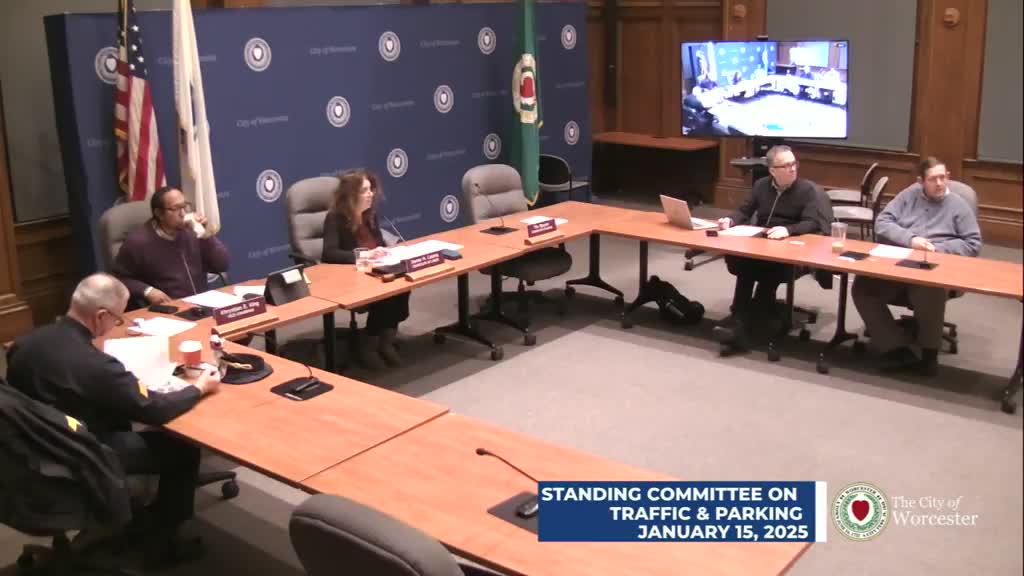
Worcester committee approves series of handicap parking changes across city streets
Summary
The Worcester Transportation & Mobility Standing Committee approved multiple requests to add, remove or adjust handicap parking spaces at addresses across the city after brief testimony from residents; the committee recorded roll-call approvals for each petition.
The Worcester City Transportation & Mobility Standing Committee on Oct. 12 approved a batch of petitions to add, remove or modify handicap parking spaces at addresses across the city following short in-person and remote testimony from residents.
Committee members approved individual petitions by roll call after staff recommendations. The requests included new reserved curb spaces for residents who said mobility issues make street parking impractical, removals of no-longer-needed spaces after household changes and an additional space requested near a dense housing area.
Transportation staff recommended approval for each item after on-site checks. Residents who spoke described medical or mobility needs or changes in household circumstances. Joseph Walsh, a resident seeking a curb space at 76 West Street, said, “I have a dislocated degenerate disc in my back and I get frequent blood clots in my legs,” and explained the difficulty of navigating three flights of stairs from his apartment without a nearby parking space. Terry Stirth, speaking for a family petition on behalf of an elderly relative at 5 Beckett Street, said the relative has “degenerating knees” and must park far from the house without a reserved space.
Votes at a glance: each petition below was accepted by roll call with Councillor King and Chairperson Councillor Donald Florio recorded as voting “Yes.”
- 3A — Joseph Walsh: install handicap parking at 76 West Street (opposite 75 West Street). Recommendation: approve; outcome: approved. - 3B — Raymond Eliasson: install handicap parking at 5 Shepherd Street (opposite 8 Shepherd Street). Recommendation: approve; outcome: approved. - 3E — Jamie Ekelberger: install handicap parking at 35 King Philip Road. Recommendation: approve; outcome: approved. - 3G — Juana Martinez: extend/modify handicap space at 3 Hitchcock Road. Recommendation: approve; outcome: approved. - 3H — Kevin Adams (caller): remove handicap space at 197 Eastern Avenue (petitioner requested removal after occupant’s death). Recommendation: approve; outcome: approved. - 3D — Rosemary Parson: install handicap parking at 11 Carlsbad Street. Recommendation: approve; outcome: approved. - 3I — Louis Gosselaert / Terry Stirth (speaker): install handicap parking at 5 Beckett Street. Recommendation: approve; outcome: approved. - 3C — Councilor Lewis A. Ojeda petition (read later in the agenda): removal of handicap parking space on Fort King Street. Recommendation: approve; outcome: approved. - 3F — Marilda Halley Lodge: removal of handicap parking in front of 49 Appet Street. Recommendation: approve; outcome: approved. - 3J — Pedro Arondin: installation of an additional handicap space at 338 Lakeside (adding a fifth space to an existing cluster). Recommendation: approve; outcome: approved.
Context and process: Transportation staff said each location was reviewed for physical feasibility and winter-ban placement where relevant. Commissioner Raleigh (Transportation and Mobility Commissioner) explained the city cannot reserve a handicap space for an individual — spaces are for vehicles displaying a valid disabled placard or plate — and noted enforcement options if a non‑authorized vehicle occupies a space. For removal petitions staff confirmed whether spaces remained necessary given household changes; for additions staff checked curb space, sight lines and nearby parking demand.
The committee’s approvals were mostly routine and followed staff recommendations. Several speakers stressed personal hardship and frequent medical appointments; staff responses and the committee’s decisions focused on the technical feasibility of marking and maintaining curb space, and on ensuring the changes did not conflict with winter parking bans or snow‑plow operations.
Looking ahead: the committee did not indicate any change in policy for reserving spaces for named individuals; Commissioner Raleigh reiterated that legal disability placards govern who may use the spaces. Petitioners were advised about signage installation timing and winter‑season effects on which side of the street a winter parking ban applies.