Get Full Government Meeting Transcripts, Videos, & Alerts Forever!
Get email alerts on the Lgbtq Sanctuary Trans Protections topic
No spam. Unsubscribe anytime.
Worcester council adopts resolution declaring city a sanctuary for transgender and gender‑diverse people after weeks of public testimony
Summary
The Worcester City Council on Friday adopted a resolution declaring the city a sanctuary for transgender and gender‑diverse people after more than a month of public testimony and debate, voting 8‑2 to approve the measure.
WORCESTER, Mass. — The Worcester City Council on Friday adopted a resolution declaring the city a sanctuary for transgender and gender‑diverse people after more than a month of public testimony and debate, voting 8‑2 to approve the measure.
The resolution, filed as petition 14 B, passed after hours of public comment in which residents, faith leaders, educators and service providers urged the council to act now to protect LGBTQIA+ residents from federal policy changes and what speakers described as an escalating climate of hostility. The council later rejected a motion to reconsider the vote.
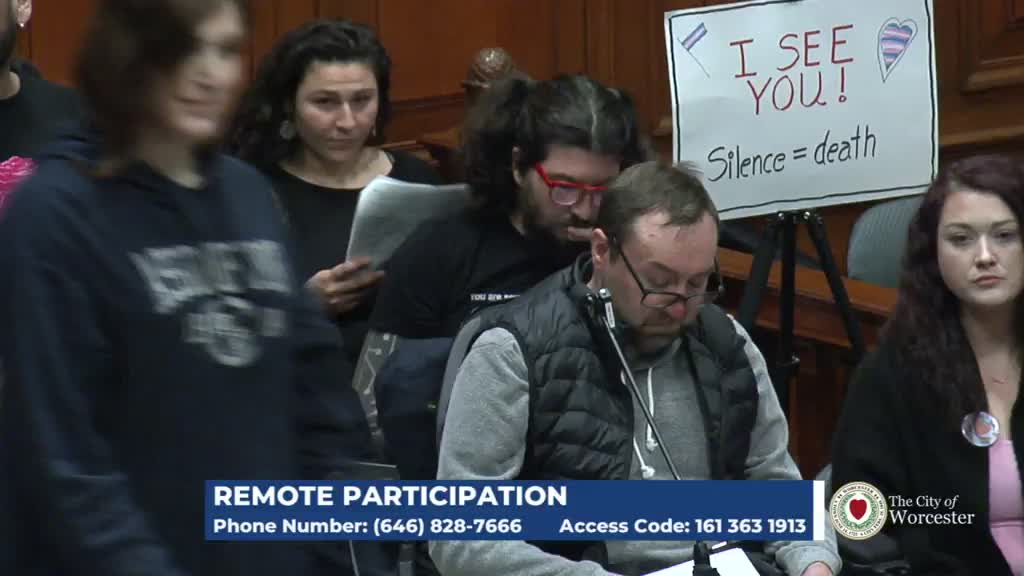
The approval came after repeated appeals from community members who urged the council to be explicit in defending gender‑affirming care and non‑discrimination protections. Joshua Croak, founder of the nonprofit Love Your Labels, told the council, "We will not cooperate with a federal government that seeks to erase and minimize and kill you," and called for local officials to use "every law and policy possible" to protect vulnerable people. Pastor Julie Payne Britton of Hadwin Park Congregational Church said, "The Jesus I know would be at this mic ... lining up to speak during this public comment, standing in solidarity with the brave people here." Mayor Joseph Petty said he apologized earlier in the controversy and announced he would vote for the resolution.
Why it matters: supporters said the resolution is a local affirmation of safety and belonging at a time when federal directives and executive actions have targeted transgender people. Opponents and some councilors warned that a symbolic resolution could trigger legal or funding risks, citing the uncertainty of how the current federal administration might respond to municipal declarations. City officials and the law department told the council that the legal landscape is unsettled and that risk cannot be precisely quantified.
What the council did: The roll call on adoption of 14 B recorded the following votes as announced on the floor: Councilor Haggai—yes; Councilor King—yes; Councilor Carlson—yes; Councilor Nguyen—yes; Councilor Ojeda—yes; Councilor Basil—yes; Councilor Toomey—yes; Mayor Petty—yes; Councilor Bergman—no; Councilor Calorio—no. The tally was announced as eight in favor and two opposed. A later motion for reconsideration failed on a roll call in which all members voted no, leaving the resolution in effect.
Investigation request left unresolved: Petition 10 B, which asked the council to hire a third‑party investigator with LGBTQIA+ and BIPOC expertise to examine allegations of transphobia and a toxic council culture raised by Councilor Nguyen and others, was discussed at length but did not result in a formal vote during this meeting. Several councilors urged a neutral, outside process; others suggested state bodies such as the Massachusetts Commission Against Discrimination might be an appropriate venue. The council solicitor advised that discussions about allegations can, in some circumstances, be held in executive session, but that the body may also vote in public to authorize an investigation.
Funding question and city response: Multiple speakers raised concern that the city could lose federal grant money if the city declared itself a sanctuary in the immigration sense. Attorneys and speakers countered that court precedent has often protected municipalities and that the anti‑commandeering doctrine limits the federal government's ability to force local enforcement. City Manager Edward Batista told the council he would prepare a report on the federal funds the city receives and continue discussions with community partners about budget options; he said details on specific dollar amounts would be provided to the council as a follow‑up.
Public pressure and context: Hundreds of residents testified over several weeks, including teachers, students, clergy, health‑care workers and nonprofit leaders. Many speakers linked the city vote to urgent concerns about the safety and mental health of transgender youth, as well as local providers' ability to continue offering gender‑affirming care if federal policy changes restrict or criminalize it.
What happens next: The resolution is a policy statement rather than an ordinance. City officials said they would report back with analyses requested by councilors, including the composition and amount of federal funds that could be affected and options for implementing the city manager's $500,000 queer and trans resiliency fund in the FY‑26 budget. Supporters said they will continue to press for a third‑party investigation and for implementation steps that go beyond the symbolic vote.
Ending note: The vote split the chamber but did not end public pressure; many community members left the meeting urging the council to follow the resolution with concrete actions, including the promised report and the conversation about how the city will protect services and providers in the face of federal changes.