Get Full Government Meeting Transcripts, Videos, & Alerts Forever!
Get email alerts on the Ceasefire Resolution topic
No spam. Unsubscribe anytime.
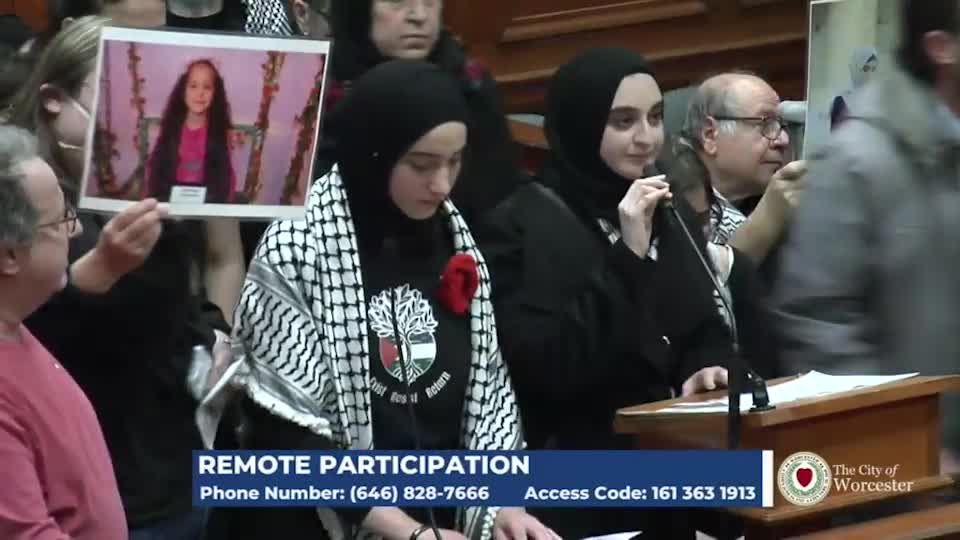
Worcester council votes to file petition calling for Gaza ceasefire after hours of public comment
Summary
After more than two hours of public testimony and competing appeals, the Worcester City Council voted 6-5 to file — effectively not advance — a citizen petition asking the city to call for a permanent ceasefire in Gaza and for restrictions on U.S. arms transfers to Israel.
The Worcester City Council voted 6-5 to file a citizen petition asking the city to call for a permanent ceasefire in Gaza and to urge enforcement of U.S. laws that could restrict weapons transfers. The vote came after more than three hours of public comment during which roughly 1,500 petition signers and dozens of residents urged conflicting outcomes.
Supporters said the measure — which asked the council to call for an immediate, permanent ceasefire, the release of hostages and detainees, the unhindered resumption of humanitarian aid to Gaza, and enforcement of U.S. laws such as the Leahy law and the Arms Export Control Act — would signal moral opposition to civilian deaths and press federal officials to act. Opponents argued the council lacked jurisdiction and warned the item would politicize a local legislative body.
The petition’s lead organizer, Patricia Kirkpatrick, told the council the City Hall display — eight dolls representing infants who recent commentators said froze to death — underscored the humanitarian stakes. "Silence during a US bankroll genocide is complicity," Kirkpatrick said during public comment, summarizing why petitioners pressed for a hearing and a council vote.
Many speakers framed their remarks around humanitarian and legal claims. Dr. Miretta Al Higrassy, who identified herself as a Worcester neurologist, cited international reports and said bodies including the International Court of Justice, the International Criminal Court and human-rights groups have described acts in Gaza as potentially amounting to genocide or crimes against humanity. Representatives of Doctors Without Borders and local clergy also urged a ceasefire so aid could reach civilians.
Other residents spoke in opposition. Councilor Morris Bergman and others said a petition that asks the city to call for federal action — including halting arms transfers — exceeded the council’s municipal role. "Once we get to that point, I believe we're going beyond the jurisdiction of this body," Bergman said during the council debate.
The vote to file was taken by roll call: Councilors Morris Bergman, Candice Calorio, Merrill Carlson, George Russell, Toomey, and Mayor Petty voted in favor of filing; Councilors G.I., King, Nguyen, Ojeda and Pacillo voted against. The clerk announced the result as 6 to 5 in favor of filing the petition.
Council discussion also touched on a prior procedural dispute: petitioners and several councilors said last year’s handling of a related item had denied residents the opportunity to speak; the American Civil Liberties Union of Massachusetts sent the city a letter asserting First Amendment concerns. City Solicitor Michael Trainor — whose retirement the council acknowledged at the start of the meeting — testified he had not instructed the clerk to withhold the petition previously and said rule 11’s application had been uneven over the years. Mayor Petty acknowledged an earlier error in placing an item on the agenda last year and said he did not intend to prevent public testimony, but reiterated his concern that national foreign-policy questions fall outside the council’s authority.
The proceeding included repeated references to local impacts and national law: speakers said Worcester taxpayer dollars had been tied to federal aid and weapons transfers, cited the Leahy law and Arms Export Control Act by name, and noted decisions by international bodies. Several speakers also urged councilors to consider the city’s role as a resettlement gateway for refugees and to weigh local public-safety and community cohesion impacts from the war and from contentious hearings.
After the vote, several councilors asked the law department and the city clerk for a written report clarifying the application of council Rule 11 and whether the city’s past handling of similar petitions had been consistent. Councilors who supported a report noted that courts have ruled against municipal bodies that apply rules unequally. The council scheduled no further action on the ceasefire petition at the meeting.
The council’s formal filing of the petition means the text will not move forward as a council-sponsored resolution; advocates who brought the petition said they would continue to press other municipalities and state officials and to pursue federal channels.
The public comment period and the council’s vote underscored a sharply divided local electorate and raised procedural questions about how the Worcester City Council handles citizen petitions on national issues that many residents see as having local consequences.