Get Full Government Meeting Transcripts, Videos, & Alerts Forever!
Get email alerts on the Sidewalks And Resurfacing topic
No spam. Unsubscribe anytime.
Public and councilors oppose moving sidewalk work from DTM to Public Works; manager to provide report
Summary
A proposal to move responsibility for sidewalk repair and street resurfacing from the Department of Transportation and Mobility to the Department of Public Works drew sustained public opposition and a request from the council for a written report from the city manager.
A proposal to move responsibility for sidewalk repair and street resurfacing from the Department of Transportation and Mobility to the Department of Public Works drew sustained public opposition and a request from the council for a written report from the city manager.
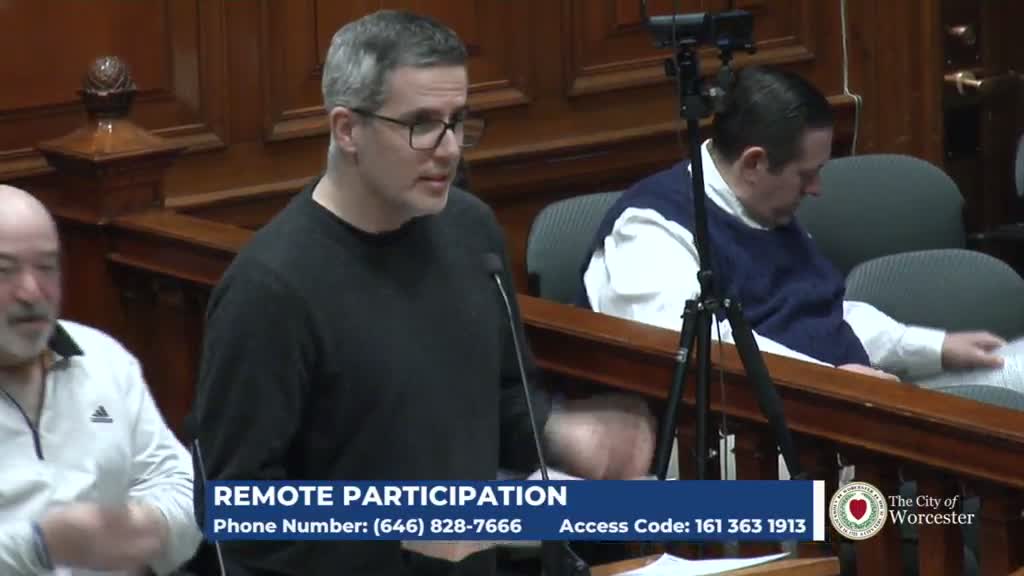
The debate centered on item 14C, described in council orders as a feasibility review of removing sidewalk and resurfacing duties from DTM and returning them to DPW. Residents and neighborhood groups told the City Council that separating those responsibilities would create bureaucratic “silos,” add delay, and undercut ADA and safety improvements done when streets are resurfaced.
"If there's an opportunity for DTM . . . to improve or redesign a street, it totally makes sense to do that during resurfacing as opposed to resurfacing and then ripping it up a month later," said Oliver Chadwick, a Worcester resident who spoke during public participation. "I strongly think it should remain with DTM."
Other callers and in-person speakers made similar points. Jacob Seidel, a Worcester resident, warned that splitting jurisdictions "is a huge stumbling block for bureaucratic systems," adding that DTM has the staff and expertise to make sidewalks and crossings ADA compliant during resurfacing projects. Priscilla Chung, also a resident, said moving those duties "does not make sense" and would be a step toward inefficiency.
Council discussion moved beyond the narrow jurisdiction question to a wider review of street selection, funding and pavement-management practices. Councilor Mary Carlson noted historical budget lines that district councilors use to select local resurfacing and sidewalk projects, saying, "for 45 years . . . there's $1,200,000 that gets allocated for street resurfacing. There is a $120,000 that gets allocated for . . . sidewalks." She and other councilors said the process for producing and sharing the lists of candidate streets had broken down in recent years and asked the manager to restore transparent lists and timelines.
City Manager Michael Mandra told the council that DTM took on resurfacing responsibilities roughly when the department was created and that a backlog and turnover in DPW had contributed to gaps in maintaining the lists. He said the administration will provide a report with a sidewalk list and timelines: "We will be bringing that forward back to the council with a report and the list of the sidewalks that need to be repaired. We're prepared to do that for the next meeting," he said.
Councilors also asked the administration to develop a pavement-management strategic plan and to provide an audit of recent construction progress and selections. After discussion, the council voted to file the 14C order, effectively dismissing the immediate proposal to transfer duties while directing the manager to report back with clarifying information and proposed next steps.
Why it matters: Sidewalk and resurfacing work affects everyday accessibility, pedestrian safety and the city’s ability to meet ADA requirements. Residents said doing safety upgrades at the time of resurfacing is more efficient and less costly than separate, sequential projects. The manager’s promised report and a pavement-management plan could affect budgets and project schedules ahead of the next construction season.
Votes at a glance: The council later took a motion to file the 14C order and to request the manager provide the detailed list and report referenced above; the motion was adopted by roll call (see provenance for where the council discussed and recorded these actions).
Ending: The manager told the council he would present a clarified list and timeline soon and that the administration is reviewing both department roles and funding levels ahead of the budget cycle. If delivered as promised, the report could resolve which department handles specific tasks and how district councilor selections will be restored.