Get Full Government Meeting Transcripts, Videos, & Alerts Forever!
Get email alerts on the Mbta Zoning topic
No spam. Unsubscribe anytime.
Framingham council closes MBTA hearing, refers plan to shrink Central Business District to planning panel
Summary
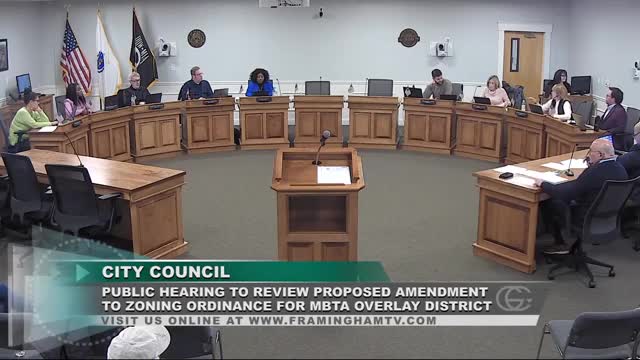
After extended debate and public comment, the Framingham City Council closed a lingering MBTA-zoning public hearing and voted to refer a separate effort to shrink the Central Business (CB) District to the Planning and Zoning subcommittee for study and amendment. The referral passed 9-1; the hearing was closed unanimously.
Framingham City Council on Feb. 4, 2025 closed a public hearing on a previous planning-board MBTA zoning submission and voted to send a separate proposal to shrink the city’s Central Business (CB) District to the Planning and Zoning subcommittee for further work and public review. The referral vote to begin an amendment process passed 9-1; a related vote to close the earlier public hearing passed unanimously.
The move matters because the MBTA Communities Act requires certain communities to adopt zoning that enables a prescribed amount of housing near transit. Councilors and residents disagreed about how much of that new housing should be concentrated downtown under the city’s CB District versus spread to other parcels. Councilor Christine Long, who led the planning-and-zoning discussion at the meeting, argued the city’s conditional compliance filing with state reviewers makes changing the CB map risky unless the council coordinates a separate, formal zoning amendment. “If we approve the compliance that the mayor sent in, then we cannot alter the map,” Long said during the debate.
Councilors pressed two paths: accept the mayor’s conditional-compliance submission so the city remains in compliance with state deadlines, or pursue a separate zoning amendment that would shrink the CB District and steer potential housing to other parts of Framingham. Councilor Adam Ward and others urged using the conditional-compliance window to study targeted changes rather than race to final submission; Councilor Malek cast the lone no vote on the referral motion.
Public commenters urged caution and asked the council to weigh impacts on schools, traffic and the city’s commercial tax base. Geoff Epstein, a District 6 resident, said the likely mix of new units (many one- and two-bedroom apartments) has different school impacts than three-bedroom units and asked the council to “consider the number of students it’s going to generate.” Several speakers asked the council to use “paper zoning” (crediting already-built units) and to target other parcels such as Shoppers World and the 990 Industrial site rather than compressing most growth downtown.
City staff and the mayor said the administration will complete the state-required economic feasibility report (the 180-day submission tied to conditional compliance) while the council and planning staff study possible CB reductions and alternative sites. The council’s referral sends the specific question of reducing the CB District’s boundaries and any related map changes to the Planning and Zoning subcommittee; that body will follow the usual notice, planning-board referral and public-hearing process before any final council vote.
Next steps: the Planning and Zoning subcommittee will draft precise map changes and a public process for review; the administration will continue work on the third‑party economic feasibility analysis that the state requires for full compliance. The council did not adopt any zoning change at the Feb. 4 meeting and took no final action on the mayor’s conditional-compliance submission.