Get Full Government Meeting Transcripts, Videos, & Alerts Forever!
Get email alerts on the Land Use Rezoning topic
No spam. Unsubscribe anytime.
Sarasota commissioners deny rezoning for Smith Farm next to Celery Fields after flood, wildlife and compatibility concerns
Summary
Sarasota County commissioners voted unanimously Feb. 12 to deny a petition (RZ‑23‑30 / Ordinance 2024‑076) to rezone 50.82 acres on Raymond Road to permit a 126‑lot single‑family subdivision adjacent to the Celery Fields.
Sarasota County commissioners voted unanimously Feb. 12 to deny a petition to rezone roughly 50.82 acres on Raymond Road from OUR (Open Use Rural) to RSF‑1/PUD to allow a 126‑lot single‑family subdivision. The vote followed a full public hearing during which county staff, the applicant and more than 60 speakers discussed stormwater, wildlife and neighborhood compatibility.
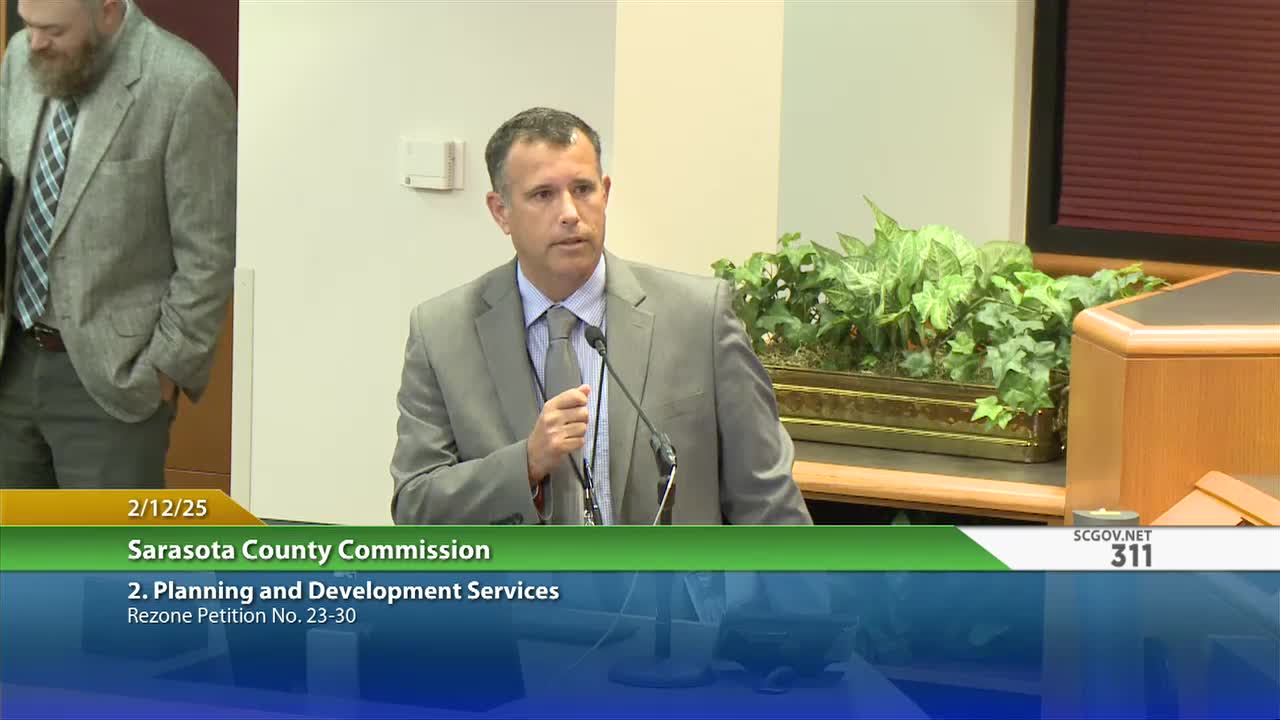
The petition—listed on the agenda as Ordinance 2024‑076 approving Rezone Petition RZ‑23‑30—was presented to the board by Matt Osterhaus, director of Sarasota County Planning and Development Services, and Everett Farrell, the county planner assigned to the case. The applicant team, led by attorney Charlie Bailey of Williams Parker and planner Kelly Klepper of Kimley‑Horn, told commissioners their revised plan reduced the proposal from 170 units to 126 and included strengthened buffers, limits on exterior lighting and a one‑story/20‑foot height limit along the roadway closest to the Celery Fields.
Why it mattered: The parcel directly borders the southernmost cell of the county‑owned Celery Fields regional stormwater and wildlife area, a site that county staff and numerous public speakers described as a nationally known birding destination and an important component of local flood mitigation. Residents and conservation groups warned that raising and paving the Smith property would displace stormwater storage, increase runoff into the Phillippi Creek watershed and reduce habitat for migratory and resident birds.
Staff and applicant presentations Matt Osterhaus read the public‑hearing notice and introduced Everett Farrell and the applicant team. Farrell summarized county staff findings and noted the property’s future‑land‑use designation of “moderate‑density residential,” the applicant’s request for RSF‑1 with a binding development concept plan, and staff’s analysis of compatibility and floodplain issues. Farrell told commissioners the site plan shows setbacks and buffers “with the greatest opacity facing the Celery Fields,” and that about 55% of the subject property lies in FEMA Zone AE.
Attorney Charlie Bailey and planner Kelly Klepper described changes made since the Planning Commission hearing: a drop from RSF‑2 to RSF‑1, a reduction from 170 to 126 lots (about 2.48 units per acre), expanded buffers along Raymond Road, a proposed wood fence with native planting to increase visual opacity, restrictions on streetlights and night‑sky‑sensitive lighting limits, and deed restrictions on roof colors for houses nearest the Celery Fields. The applicant also said it will provide a central wet detention pond and design the stormwater system to exceed the county’s 100‑year (10‑inch/24‑hour) benchmark—proffering design for 11.8 inches in 24 hours.
Public comment and community concerns More than 60 people spoke during the public comment portion. Speakers included longtime neighbors, Audubon volunteers and board members, scientists, youth birders and residents from multiple nearby subdivisions. Public testimony focused on three recurring themes:
- Flooding and stormwater: Residents from Shadow Oaks, Deerfield, Sylvan Lee and other nearby neighborhoods described roads and yards rendered impassable during recent storms (including Tropical Storm Debbie in 2024) and asked the commission not to remove existing flood storage. Several speakers showed photographs of flooded streets and backyards and said filling the Smith property would displace water into adjacent communities. As one local resident said of flood experience during the recent storms, “We had houses that were impacted during Debbie,” and speakers repeatedly described blocked roads and long recovery times for debris and damage.
- Wildlife, birds and ecotourism: Current and former Sarasota Audubon volunteers and biologists said Raymond Road and the Celery Fields support hundreds of bird species, including state‑listed or federally protected species, and attract national and international visitors. Fifteen‑year‑old volunteer Sofia Hackman told commissioners, “Celery Fields is a great place for beginners... Saying yes to this petition would stop kids just like me from finding that passion. Please vote no.” Audubon representatives said nearby development and construction noise, night lighting, lawns and domestic animals would reduce habitat quality and likely shift birds away from the boardwalks where visitors and school groups currently gather.
- Compatibility, safety and traffic: Multiple speakers and former planning commissioners argued the proposed density and access—two entrances with direct frontage on Raymond Road—were incompatible with the existing rural/suburban development pattern. They also flagged pedestrian safety at the Raymond boardwalk (school buses and people with heavy camera gear use the shoulder), and urged the commission to postpone a rezoning decision pending county‑wide stormwater policy updates discussed at a Jan. 21 stormwater workshop.
Applicant rebuttal and technical points In rebuttal Charlie Bailey reiterated the reductions in density and the added conditions. Project engineer Andrew Pluta of Kimley‑Horn said the team had designed the system to “exceed the minimum standard” and confirmed the applicant would accept a stipulation to design the stormwater system to accommodate 11.8 inches over 24 hours. He also said the applicant had discussed wastewater coordination with county utilities so the nearby Sylvan Lee package plant could be retired if requested and utility infrastructure upgraded.
Deliberation and vote During deliberations commissioners repeatedly cited compatibility and floodplain concerns. Commissioner Mast (District not specified in the transcript) said the parcel “does not fit” as the “last piece of the puzzle” given its adjacency to the Celery Fields. Commissioner Smith noted the site’s low elevations relative to the county’s base flood elevation and said filling the property would “disperse the water elsewhere.” After discussion Commissioner Mast moved to deny Rezone Petition RZ‑23‑30; Commissioner Knight seconded. The motion carried unanimously.
Formal action recorded The commission’s action was recorded as a motion to deny Rezone Petition RZ‑23‑30 (Ordinance 2024‑076 on the agenda). The vote was recorded as: Chair — yes; Commissioner Mast — yes; Commissioner Knight — yes; Commissioner Smith — yes; Commissioner Cuttsinger — yes. The motion passed unanimously.
Why the denial matters The vote preserves the property’s current OUR zoning and keeps the 50.82‑acre parcel from moving forward as a 126‑lot RSF‑1 PUD as proposed by the applicant. Commissioners and many public speakers framed the decision as one balancing private property questions against public safety, flood resilience and protection of a high‑value conservation and tourism asset. Several public speakers and Audubon representatives urged the county to pursue alternative conservation solutions for the property, including land‑trust acquisition or donation that would expand buffers around the Celery Fields.
What’s next County staff and the county attorney’s office will prepare the formal resolution of denial for the record. Speakers who advocated for conservation said they will continue working with nonprofits and potential funders to seek protections for the parcel; applicant representatives said they had proffered technical measures and remain available for further discussion. Commissioners also noted county‑level stormwater policy work is ongoing and that broader regulatory changes could follow the county’s January stormwater workshop.
The public hearing and vote on RZ‑23‑30 was the most substantive agenda item at the Feb. 12 meeting; commissioners recessed for other business following the vote.